How to Use a Walking Cane Properly
Hold the cane on the side opposite your weaker or painful leg. Set its handle near your wrist, then move the cane forward with that leg and step through with your stronger leg.
On this page (8 sections)
- Which hand should hold a walking cane?
- How should a walking cane fit?
- How do you walk with a cane?
- How do you sit down and stand up with a cane?
- How do you use a cane on a step or stairs?
- What should you check before using a cane?
- Where can you learn more about choosing a cane?
- How to use a walking cane properly: what should you remember?
To use a walking cane properly, hold it on the side opposite your weaker or painful leg. Set the handle near your wrist, move the cane forward with that leg, then step through with your stronger leg.
A cane can help with balance and support, but it needs to fit and move with your steps. If you have been given instructions after an injury or surgery, follow those directions first.
Which hand should hold a walking cane?
Hold the cane in the hand opposite the weaker or painful leg. This lets the cane move forward with that leg and gives you support as you step.
For example, if your right leg is weaker, hold the cane in your left hand. If you have pain or weakness in both legs, or you are unsure which side to use, ask a physical therapist or health care professional to guide you.
The right style depends on the support you need. Our guide to types of canes for elderly users explains common options, and the mobility aids for seniors guide covers other types of walking support.
How should a walking cane fit?
The handle should be near your wrist crease when you stand upright with your arms relaxed. With your hand on the handle, your elbow should bend slightly.
Adjust the cane according to its instructions, then check the fit while wearing the shoes you usually walk in. If you can't find a comfortable height, ask a physical therapist to check the cane and your posture.
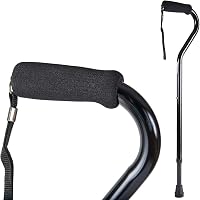
{{product B000CSWBWU}} This product's adjustable height, offset handle, and wrist strap may suit someone who wants a cane they can fit to their height.
The DMI Walking Cane and Walking Stick adjusts from 30 to 39 inches in 1-inch increments. Its soft offset handle and wrist strap give you a simple setup to consider if those features match your needs.
{{product B00E9ZFBII}} This product's adjustable 30.5–37.5-inch range may suit someone who wants a folding cane that can be stored between walks.
The HurryCane Freedom Edition Foldable Walking Cane adjusts from 30.5 to 37.5 inches and folds to 13.7 inches. Check that its height range and handle work for you before choosing it.
For more choices, see our guide to the best walking cane for seniors. If cost is part of your decision, compare the factors in our walking cane cost guide.
How do you walk with a cane?
Move the cane and your weaker leg forward together, then step past them with your stronger leg. Keep the cane close enough that you can place its tip firmly on the ground before leaning on it.
- Hold the cane in the hand opposite your weaker or painful leg.
- Move the cane and that leg forward about the same distance.
- Set the cane tip firmly on the ground before putting weight on it.
- Step through with your stronger leg.
- Repeat at a pace that lets you stay balanced.
Look ahead rather than down at your feet, and take shorter steps if you feel unsteady. Turn slowly by taking small steps instead of twisting your body over a planted cane.
{{product B0BG8DPFN1}} This product's adjustable height and foldable design may suit someone who wants a cane they can fit and carry between walks.
The REHAND Walking Cane has 8 height settings in 1-inch increments and folds for carrying. Its adjustable range is 2 ft 7 in to 3 ft 2 in, so check that it fits your height.
How do you sit down and stand up with a cane?
Use a stable chair with armrests when possible, and move slowly as you sit or stand. Keep the cane close enough to reach without leaning too far.
To sit, back up until you feel the chair behind your legs. Hold the cane in one hand, reach for an armrest with the other, and lower yourself carefully.
To stand, push up from the armrests rather than pulling on the cane. Once you're steady, take hold of the cane before walking.
How do you use a cane on a step or stairs?
Use a handrail if one is available, and take one step at a time. A common sequence is stronger leg first going up, and cane first going down.
For a single step going up, step up with your stronger leg. Bring the weaker leg and cane up to meet it.
Going down, place the cane on the lower level, then step down with your weaker leg and bring the stronger leg down.
On stairs, hold the handrail with one hand and the cane in the other, when possible. The common sequence is stronger leg, weaker leg, then cane going up; cane, weaker leg, then stronger leg going down.
Stairs can be unsafe if you can't hold the rail and manage the cane at the same time. Ask a physical therapist to show you the right method for your situation before attempting them alone.
What should you check before using a cane?
Check that the cane is set to the right height and the tip is in good condition. A worn or loose tip may not grip the floor as expected.
Look for cracks, loose parts, or an adjustment button that doesn't lock into place. If replacing the tip, check our cane tip size guide for fit.
Follow the cane's care and adjustment instructions, and don't use it if it appears damaged.
Start on a flat, uncluttered surface. Clear loose rugs and cords from your route, wear shoes that fit securely, and avoid rushing on wet or uneven ground.
If the cane feels too hard to control, you feel less steady with it, or your pain or weakness is significant, ask a health care professional whether another aid would suit you better. If you are considering a quad cane, see how to use a quad cane properly.
Where can you learn more about choosing a cane?
The right cane should fit your height, hand, and daily walking needs. Read our Rehand walking cane review if you're considering that folding model.
If a cane doesn't provide enough support for longer outings, you might compare a mobility scooter for mall walking or a mobility scooter for walking trails. Check the terrain and places you plan to visit before choosing.
For step-by-step guidance, MedlinePlus explains how to use a cane, including fit, walking, turns, and stairs. The NHS also provides an overview of walking aids and choosing a walking stick.
How to use a walking cane properly: what should you remember?
Hold the cane opposite your weaker leg, move it with that leg, and step through with your stronger leg. Check the fit and cane tip, and get help with stairs if you feel unsure.
Choose a cane that matches your height and the support you need. If you're still comparing styles, start with our guide to types of canes for elderly users.
Frequently asked questions
Which hand should you hold a walking cane in?
Hold a cane in the hand opposite the weaker or painful leg. Move that hand and the cane forward as you step with the affected leg, then step through with your stronger leg.
If you have symptoms on both sides or have been given different instructions, ask a physical therapist or health care professional to check your technique.
How high should a walking cane be?
Set the handle near the crease of your wrist when you stand upright with your arms relaxed. Your elbow should bend slightly when you hold the handle.
Ask a physical therapist or other health care professional to check the fit if you are unsure, and follow the cane's adjustment instructions.
Should you use a cane on stairs?
Use a handrail when one is available, and take one step at a time. A common sequence is stronger leg first going up, then the weaker leg and cane; going down, place the cane below first, then the weaker leg and stronger leg.
Get personalized instruction if stairs feel unsafe.
When should you ask for help using a cane?
Ask a physical therapist or health care professional if you have trouble balancing, significant pain or weakness, or can't use the cane steadily. A cane may not provide enough support for everyone.
Have someone check your technique and discuss whether a walker or another aid would better match your needs.