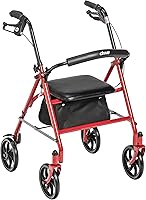
8 Best Folding Walkers for Seniors (November 2026)
The best folding walkers for seniors include the Drive Medical Two-Button Folding Walker with Wheels for daily home use, the Medline Two-Button Folding Walker for Seniors for higher capacity, and the Medline Lightweight Two Button Folding Walker for frequent lifting.
On this page (6 sections)
The Drive Medical Two-Button Folding Walker with Wheels is the best folding walker for seniors who want front wheels and rear glides for daily use. The Medline two-button model has the highest stated capacity in this group.
The Stander folds to a compact 5 x 7 inch footprint. A useful fit still depends on frame width, handle height, wheel arrangement and folding controls.
Those details decide whether a walker helps or hinders at doorways, in tight turns and during transfers. Think first about where it will be used most.
Home use places more weight on smooth movement over carpet and tile. Frequent car trips place more weight on folded size and lifting effort.
Consider who will fold and unfold it each day. The design should suit the hands and strength of the person who will actually manage the controls.
For a broader comparison of walker styles, start with the complete walker for seniors buying guide.
That guide can help you decide whether front wheels, rear glides, hand brakes or a fixed-foot frame best match the user. The right pick is the one the user can adjust, control, fold and store without strain.
Measure the user, the doorway and the storage space before you commit. A short check at home can prevent a suitable looking model from feeling awkward in daily life.
Our picks at a glance
-
1
 Best for daily home use
Drive Medical Two-Button Folding Walker with Wheels
9.7/10 our score
See it on Amazon -
2
 Best for higher capacity
Medline Two-Button Folding Walker for Seniors
9.4/10 our score
See it on Amazon -
3
 Best for frequent lifting
Medline Lightweight Two Button Folding Walker
8.8/10 our score
See it on Amazon
- 4
 Best for tight storageCheck it
- 5
 Check it
Drive Medical Trigger Release Folding Walker
Best for manual-grip folding - 6
 Check it
Loyoda Folding Walker with 2 Skis
Best for rear support options - 7
 Check it
Vive Mobility Lightweight Walker for Seniors
Best for narrow halls - 8
 Check it
DELOG Narrow Folding Walker for Seniors
Best for adjustable width
Which folding walker for seniors fits each need?
The Drive Medical Two-Button Folding Walker with Wheels is the strongest all-around match here; the other picks serve specific needs such as compact storage, a narrow frame or a different release style. We compared each walker’s fit, folding design, stated capacity and wheel arrangement for the situations senior buyers are likely to face.
Drive Medical Two-Button Folding Walker with Wheels: Best for daily home use
- 5-inch front wheels
- Rear glide caps
- Dual push-button releases
- Supports up to 350 lb
Front wheels and rear glide caps help the frame move across indoor floors, low-pile carpet and many outdoor surfaces. Dual push buttons fold it for storage.
Pros
- Front wheels and rear glides
- Dual push-button releases
- Height adjustable
Cons
- Only the front legs have wheels
- Check the adjusted height and fit before use
The Drive Medical Two-Button Folding Walker with Wheels has 5-inch front wheels and rear glide caps to help the frame roll or slide over carpet, tile and many outdoor surfaces. Its aluminum frame weighs 7.5 lb and supports up to 350 lb.
Dual push-button releases fold the frame using fingers, palms or the side of the hand. The height adjusts, and ergonomic hand grips are shaped for control and comfort.
Choose this model for everyday movement around the home when front wheels and a familiar two-button fold meet your needs. Skip it if you need wheels on all 4 legs or want the smallest folded shape in this group.
Before using it, set the handles for the person’s reach and check that the frame clears doorways and furniture. Choose it for front wheels and a straightforward fold.
For a walker with wheels at the rear as well, compare our best rolling walkers for seniors.
Medline Two-Button Folding Walker for Seniors: Best for higher capacity
- Supports up to 400 lb
- 5-inch wheels
- Folds for storage and transport
- Height adjusts from 32.5 to 39.5 in
A two-button fold and 5-inch wheels suit seniors who want a folding frame with rolling support. Its stated capacity is the highest among these picks.
Pros
- 400 lb capacity
- Tool-free assembly
- Height range from 32.5 to 39.5 in
Cons
- Height range may not fit every user
- Measure storage space before choosing
The Medline Two-Button Folding Walker for Seniors supports up to 400 lb, the highest stated capacity among these picks. Its 5-inch wheels support movement across everyday surfaces, and the handles adjust from 32.5 to 39.5 inches.
Medline gives a recommended user height range of 5 ft 5 in to 6 ft 6 in. It folds for storage, transport and narrow passages, and assembles without tools.
This is the clearest choice when the 400 lb capacity and listed height range fit the user. Skip it if the handles cannot be adjusted to a comfortable position or if its folded shape will not fit the storage space.
Measure the space in a closet or vehicle before choosing, including the opening the walker must pass through. Choose it for a higher stated capacity and tool-free assembly.
For lighter models, see our guide to the best lightweight walkers for seniors.
Medline Lightweight Two Button Folding Walker: Best for frequent lifting
- 6 lb stated weight
- 5-inch wheels
- Two-button folding mechanism
- Supports up to 300 lb
This aluminum walker combines a two-button fold with 5-inch wheels. Its stated 6 lb weight makes it the lightest option here.
Pros
- Lightest stated weight in this group
- Two-button folding
- Side sections fold independently
Cons
- 300 lb capacity
- Confirm height and fit before use
The Medline Lightweight Two Button Folding Walker weighs 6 lb and supports up to 300 lb. Its aluminum frame has 5-inch wheels and side cross braces.
Two buttons fold the frame for storage or transport, and each side folds independently. The height adjusts from 32 to 38 inches, with Medline giving a recommended user height range of 5 ft 5 in to 6 ft 4 in.
This model suits someone who needs to lift a walker into a vehicle or move it between rooms and whose capacity needs fall within its rating. Skip it if the user needs more than 300 lb capacity or the adjustment range does not fit their posture.
Try folding and opening it with the user’s hands before relying on the mechanism as part of a daily routine. Choose it when lower frame weight matters most.
If travel and packing are the main use, compare the best folding walkers for travel.
Stander Space Saver Walker: Best for tight storage
- Folds to a 5 x 7 in footprint
- 6-inch fixed front wheels
- Rear ski glides
- Supports up to 300 lb
Its EZ Fold-N-Go design folds to a compact footprint for closets or vehicle storage. Fixed front wheels and rear ski glides support forward movement.
Pros
- Compact folded footprint
- Arrives assembled
- Adjustable padded handles
Cons
- Front wheels are fixed
- Weighs 8 lb
The Stander Space Saver Walker folds to a 5 x 7 inch footprint, making it the most compact storage option in this group. It weighs 8 lb and supports up to 300 lb.
It has fixed 6-inch front wheels and rear ski glides. Its padded handles adjust from 32.5 to 39 inches, and it arrives assembled.
The compact fold suits a small closet, a tight hallway corner or a vehicle where a bulky frame would be hard to place. It may suit someone who stores the walker daily and needs a predictable place for it.
The fixed front wheels are a trade-off. They can support steady forward movement, but they do not swivel, so turning may need extra space and a wider arc than a walker with different wheel control.
Padded handles that adjust in height can help the user find a comfortable position. Set them so the arms stay relaxed and the hands rest on the grips without reaching forward or shrugging.
Choose it if closet or vehicle space is tight and the small folded footprint solves a real storage problem. Skip it if fixed front wheels make turning in your home difficult, or if you need a higher capacity.
Unfold it fully and check that the frame locks into its usable position before walking. Confirm that both sides are secure and that the walker stands level on the floor.
Practice folding it in the actual storage spot before you rely on it. A walker that folds small in principle still needs a clear path in and out of that space.
Drive Medical Trigger Release Folding Walker: Best for manual-grip folding
- Trigger release folding
- 5-inch wheels
- Rear glide caps
- Handle height adjusts from 32 to 39 in
The trigger release folds and opens without removing hands from the handles. Five-inch wheels and rear glide caps support movement over most indoor surfaces.
Pros
- Trigger release can be operated while holding the walker
- Height adjustable
- Ribbed contoured hand grips
Cons
- Inside hand grip width is 18 in
- Confirm the fit for your doorways
The Drive Medical Trigger Release Folding Walker has a trigger release mechanism that folds or opens without removing hands from the grips. Its aluminum frame weighs 6 lb and supports daily use over most indoor surfaces with 5-inch wheels and rear glide caps.
Handle height adjusts from 32 to 39 inches, with an inside hand grip width of 18 inches. Ribbed contoured hand grips add comfort and control during longer use.
This design may suit a user who finds paired push buttons awkward to press in sequence. Keeping hands at the grips can feel steadier when opening or closing the frame beside furniture.
Comfort still depends on reach and grip strength. The user should be able to squeeze the trigger without twisting the wrist, leaning the frame or losing balance while stationary.
Measure doorways and the route around furniture, since the 18 inch grip width may be too wide for a tight passage. Practice opening and closing the walker while stationary, away from stairs, before relying on it quickly.
Wipe the grips and keep them dry for a secure hold. Check the trigger and joints for wear, and stop using the walker if a control feels loose or damaged.
Loyoda Folding Walker with 2 Skis: Best for rear support options
- Two skis
- 5-inch wheels
- Round feet pre-installed
- 6.03 lb stated weight
This folding walker has two skis and pre-installed round feet. The round feet can be replaced with skis.
Pros
- Skis included
- 5-inch wheels
- Light stated weight
Cons
- Capacity and height range aren't specified
- Confirm setup details before use
The Loyoda Folding Walker with 2 Skis has 5-inch wheels, pre-installed round feet and 2 skis. The round feet can be replaced with skis, giving a choice of rear supports.
It weighs 6.03 lb. Its capacity and handle-height range are not specified, so confirm both with the seller and make sure the walker fits before relying on it for everyday support.
The choice of rear support can change how the walker moves at each step. Round feet and skis may suit different floors, so think about the surfaces the user crosses most often.
Because fit details are missing, this model needs more checking before purchase. Confirm the capacity, handle range and folded shape, and ask what is included in the package.
This is a possible fit if you want to choose between round feet and skis and can verify fit and capacity first. Skip it if you need confirmed capacity or height information and cannot obtain those details.
Follow the supplied setup instructions when changing rear supports, and check that both sides match before use. A mismatch can make movement uneven and harder to control.
Stand the walker on a level floor and check that it does not rock. Adjust the handles only after the frame is fully open and each side is secure.
Test the walker in the rooms where it will be used, including the narrowest doorway. If fit cannot be confirmed, a model with stated capacity and height details may be a safer choice.
Vive Mobility Lightweight Walker for Seniors: Best for narrow halls
- Narrow frame
- Hand brakes
- 6-inch wheels
- Supports up to 300 lb
A narrow frame, one-step fold and hand brakes suit buyers who want stopping control and a space-saving shape. It arrives fully assembled.
Pros
- Hand brakes
- Narrow frame
- Locking system keeps it folded
Cons
- Heavier than several picks here
- Check handle height and frame width
The Vive Mobility Lightweight Walker for Seniors has a narrow frame, hand brakes and a locking fold. Its 6-inch wheels are described for carpet, tile, pavement and uneven surfaces.
The handles adjust from 33 to 39 inches, and the frame supports up to 300 lb. The product features give a weight of 9.5 lb, while the product dimensions give 11.2 lb.
Confirm the lifting weight if that number will affect your choice. The narrow frame can help in small hallways where a wider walker may catch on furniture.
The open-frame design leaves a natural walking space without a rear bar in the way. Hand brakes add control for slowing or stopping.
They also add a task, since the user must reach and apply them reliably while moving. The one-step fold and locking system suit storage in a car or closet.
It arrives assembled, but the user still needs to unfold it fully and check that the lock holds. This model suits someone who needs a narrow shape and can use hand brakes.
Skip it if a 300 lb capacity is insufficient or lifting weight is a priority. Check brake reach and grip before walking, and confirm the frame clears tight turns.
Practice braking while stationary first, then at a slow pace in an open area. Confirm the true lifting weight before buying if the walker will be lifted often.
DELOG Narrow Folding Walker for Seniors: Best for adjustable width
- Width adjusts from 17 to 22 in
- Trigger release
- 5-inch wheels
- Supports up to 350 lb
The frame width adjusts from 17 to 22 inches, which can help when fitting through a narrow doorway. Its trigger release operates without taking hands off the grips.
Pros
- Adjustable width
- Trigger release
- Height adjusts from 30 to 37 in
Cons
- Confirm width settings and doorway clearance
- Check that handle height suits the user
The DELOG Narrow Folding Walker for Seniors has a width that adjusts from 17 to 22 inches. Its sides fold independently, and its trigger release operates without taking hands off the grips.
Height adjusts from 30 to 37 inches, and the walker weighs 6 lb. It supports up to 350 lb and has 5-inch wheels.
The adjustable width is the main reason to consider this model. It may help a user fit through a narrow doorway or hallway that a fixed-width frame would struggle to pass.
Width also affects comfort and turning space. A narrower setting may ease passage through a door, but the user still needs room to turn on the other side.
The trigger release can suit a user who prefers to keep hands on the grips. The sides fold independently, which may help when space is tight.
The user should still practice the motion while stationary. Choose this model if width adjustment can solve a measured doorway or hallway problem.
Skip it if the 30 to 37 inch handle range does not fit the user. A poor walking position will not be offset by the width advantage.
Measure the narrowest doorway, then allow space for turning on the other side. Recheck clearance after adjusting the width, since a walker that passes straight through may still be hard to turn.
Set the height with the user standing upright and arms relaxed. If the handles sit too low or too high, pause and adjust the fit before daily use.
What should you check before buying a folding walker?
Check the user’s fit, doorway clearance, release controls and wheel style before choosing a folding walker. If price is a priority, compare our affordable walkers for seniors.
A frame that folds for storage still needs to suit the person’s walking pattern and support needs.
How do you check walker height and doorway width?
Compare the handle adjustment range with the user’s height and standing posture, then measure the narrowest doorway and the space needed to turn. The DELOG width adjusts from 17 to 22 inches, while the Drive Medical Trigger Release model has an 18-inch inside grip width.
Don’t rely on a stated user-height range alone if the person has unusual posture, balance needs or hand limitations. A clinician or mobility specialist can help check the fit and initial setup.
Which folding control should you choose?
Choose a release the user can operate without twisting, straining or losing balance. Two-button models use paired release buttons, while trigger-release models fold and open without removing hands from the grips.
The Drive Medical Two-Button model’s releases can be operated with fingers, palms or the side of the hand. The Drive Medical Trigger Release and DELOG models use trigger mechanisms, so check that the user can reach and squeeze the controls comfortably.
Are front wheels or rear glides a better fit?
Front wheels help the frame move forward, while rear glides or skis slide along behind. The Stander has fixed front wheels that do not swivel, so the user may need more room to turn.
A walker without wheels may suit someone who needs to lift or reposition the frame with each step. Compare walkers without wheels for seniors if you prefer a fixed-foot design.
How do you know whether the folded size will work?
Measure the storage space and its opening, then compare those measurements with the folded walker. The Stander folds to a 5 x 7 inch footprint, while other models have different frame shapes and storage needs.
If you plan to keep the walker in a vehicle, check the space around seats and other items, not just the trunk opening. For a powered mobility option that folds for transport, compare best foldable mobility scooters and the best folding mobility scooter.
How should you set up and use a folding walker?
Set up a folding walker on a level surface, confirm that the frame is fully open, and adjust the handles before the user relies on it. Follow the instructions for that model, especially when changing wheels or rear supports.
Stand upright with arms relaxed and hands on the grips to check the handle position. If the user must hunch, reach upward or lean heavily, pause and get help adjusting the walker or choosing a better fit.
On a wheeled walker, move at a controlled pace and keep the frame close enough to use for support. Don’t push it too far ahead or use it to pull yourself up from a chair; use the chair arms or another stable surface to stand, then take hold of the walker.
For a two-button or trigger mechanism, practice folding and unfolding while stationary. Keep fingers clear of moving joints, and confirm the frame is fully open before stepping.
What care and use habits help a folding walker last?
Keep the frame clean and dry, and check the wheels, glides, grips and folding joints regularly. If a component is loose, cracked or worn, stop using the walker until it is repaired or replaced.
Remove dust and debris from wheels and rear glides so they can move as intended. Hair, grit and dried spills can make a wheel drag or a glide catch on carpet and tile.
Check that screws and adjustment buttons are secure, and keep the grips dry. A damp or worn grip can reduce control, especially when the user is tired.
Wipe the frame with a damp cloth and dry it after use in wet weather. Avoid soaking the joints or controls, since trapped moisture can harm parts that need to move freely.
Check the folding mechanism regularly for stiffness, looseness or uneven movement. If one side folds more easily than the other, have it checked before use in a tight space.
Inspect wheels for flat spots, cracks or debris caught in the axle. Turn each wheel by hand and listen for grinding, since a rough sound can signal wear.
Check rear glides, skis and caps for thinning or damage. A worn glide can scrape the floor or make the walker harder to push.
Store the folded walker upright or flat in a dry place where it will not be hit by a door. Repeated knocks can bend a frame or loosen a joint.
Avoid carrying heavy bags on the frame unless the walker instructions allow it. Extra weight can affect balance during turns or when crossing a threshold.
Re-read the model instructions when strength, balance or home layout changes. A walker that suited a short hallway may need a different setup once furniture moves.
What common folding walker mistakes should you avoid?
The most common mistake is buying by folded size or weight alone. A convenient frame still needs a suitable height, width, capacity and wheel arrangement.
Another common mistake is assuming a walker that folds small will be easy to use in a small home. Storage size and walking space are different problems, and both need measuring.
Do not assume that every walker with wheels turns the same way. Fixed wheels, front wheels with rear glides, and hand brakes each change control.
Do not guess about capacity or handle range when those details are missing. The Loyoda model has unspecified capacity and height range, so get those answers first.
Do not fold or adjust the walker while leaning on it. Stand safely, follow the instructions and make sure the frame is secure before walking again.
Do not set the handles by eye alone. Ask the user to stand upright with relaxed arms and check for hunching, reaching or leaning.
Do not ignore the controls. A release that looks simple may be hard for stiff or sore hands, so test it while stationary.
Do not use the walker to pull up from a chair or to carry shopping. Use chair arms or another stable surface to stand first.
The safest choice comes from measuring the person, the route and the storage space. A little checking can save the user from a walker that folds well but fits poorly.
Which folding walker should you choose?
Choose the Drive Medical Two-Button Folding Walker with Wheels for a practical mix of front wheels, rear glides and two-button folding. Pick the Medline two-button model if its 400 lb capacity and height range suit the user, or the Stander Space Saver if the 5 x 7 inch folded footprint solves a storage problem.
For a lighter frame, choose the Medline Lightweight model if its 300 lb capacity and height range fit. Choose the Drive Medical Trigger Release or DELOG when trigger controls are easier to manage, and consider Vive for a narrow frame with brakes.
The best folding walker for seniors is the one the user can fit, control and store safely. Measure first, practice the folding controls while stationary, and use a clinician or mobility specialist to check the setup if balance or strength is a concern.
Our top 3 picks at a glance
-
1
Best for daily home use
Drive Medical Two-Button Folding Walker with Wheels
9.7/10 our score
See it on Amazon -
2
Best for higher capacity
Medline Two-Button Folding Walker for Seniors
9.4/10 our score
See it on Amazon -
3
Best for frequent lifting
Medline Lightweight Two Button Folding Walker
8.8/10 our score
See it on Amazon
Frequently asked questions
Are folding walkers stable enough for everyday use?
A folding frame can provide everyday support when it fits the user and is used as directed. Folding describes how the frame stores, not how stable it will feel for a particular person.
Ask a clinician or mobility specialist to help choose and adjust a walker if balance or strength is a concern.
Should I choose a walker with wheels or without wheels?
Choose based on how you need to move the walker and the support you want at each step. Front wheels and rear glides roll or slide forward, while a walker without wheels needs to be lifted or repositioned.
Compare walkers without wheels for seniors if you want a fixed-foot design.
How do I choose the right walker height?
Compare the user's height and standing posture with the walker's adjustment range. Set the handles at a comfortable level, and check that the frame allows a natural stance.
Ask a clinician or mobility specialist to check the fit if you're unsure.
Can a folding walker fit in a car?
Many folding walkers are designed for storage or transport, but folded sizes differ. Measure the car's available space and compare it with the walker's folded shape before buying.
The Stander Space Saver folds to a 5 x 7 inch footprint, while other models may need more room.