8 Best Cheap Walkers for Seniors (November 2026)
The best affordable walkers for seniors include the Drive Medical Two-Button Folding Walker with Wheels for indoor routines, the VOCIC Z21 Rollator Walker for Seniors for uneven paths, and the Drive Medical Rollator Walker with Seat for seated errands.
On this page (8 sections)
- Which cheap walkers for seniors offer the best value?
- How should you choose a cheap walker for seniors?
- What should you measure before buying?
- How do you set up and check a walker?
- How can you use and care for a budget walker?
- What common walker-buying mistakes should you avoid?
- Is a three-wheel walker a good low-cost choice?
- Which cheap walker should you choose?
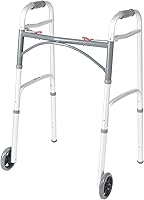
The best cheap walker for seniors who want basic support is the Drive Medical Two-Button Folding Walker with Wheels. It has an aluminum frame, front wheels and rear glide caps; choose a rollator if a seat for rests matters more.
A low-cost walker still needs to fit your height, doorway width, walking pattern and weight needs. We compared frame types, wheels, folding, seating and stated capacity so you can match the features to your routine.
Our picks at a glance
-
1
 Best for indoor routines
Drive Medical Two-Button Folding Walker with Wheels
9.7/10 our score
See it on Amazon -
2

-
3

- 4
 Check it
Medline Steel Rollator Walker with Seat
Best for car lifting - 5
 Check it
HOMLAND Foldable Rollator Walker for Seniors
Best for wider seating - 6
 Check it
Medline Lightweight Two Button Folding Walker
Best for compact storage - 7
 Check it
Loyoda Folding Walker with 2 Skis
Best for glide adjustments - 8
 Check it
VOCIC Z11 Standard Rollator Walker for Seniors
Best for higher capacity
Which cheap walkers for seniors offer the best value?
The best value depends on whether you need a simple frame or a rollator with a seat and brakes. The right budget walker fits your daily route and movement needs before extra features enter the decision.
Drive Medical Two-Button Folding Walker with Wheels: Best for indoor routines
- 5 in front wheels
- Rear glide caps
- Height adjustable
- Aluminum frame
- Supports up to 350 lb
Front wheels and rear glide caps help the frame move across carpet, tile and outdoor surfaces. Two push-button releases fold it for storage.
Pros
- 350 lb weight capacity
- Push-button folding
- Glides across several surfaces
Cons
- No seat for resting
- Only the front legs have wheels
The Drive Medical Two-Button Folding Walker with Wheels is the strongest match here for basic daily support. Its aluminum frame adjusts in height, and the two push-button releases let you fold it using fingers, palms or the side of a hand.
The 5 in front wheels help it move forward, while rear glide caps help it slide across carpet, tile and some outdoor surfaces. That arrangement suits someone who wants help moving through rooms without rollator hand brakes.
The stated capacity is 350 lb. Check the walker height against the user's fit and the frame width against the narrowest doorway or furniture gap on the usual route.
Choose it for a folding frame with front wheels and glide caps. Skip it if you need to sit during walks or want a storage pouch attached to the walker.
VOCIC Z21 Rollator Walker for Seniors: Best for uneven paths
- 8 in wheels
- Seat and backrest
- Three brake modes
- Supports up to 350 lb
- Folds for storage
This rollator combines a seat and backrest with 8 in wheels. Its handle and seat heights adjust to fit a range of users.
Pros
- Seat and backrest
- 8 in wheels
- Three brake modes
Cons
- About 22 lb
- Requires checking the brakes and frame before each use
The VOCIC Z21 suits buyers who want larger wheels and a seat in one frame. Its 8 in puncture-proof tires, seat, backrest and three brake modes give it more features for outdoor routes and planned rest stops.
The handle height adjusts across five settings from 31.5 to 36.6 in, while the seat adjusts from 20 to 22 in. It weighs about 22 lb and has a stated capacity of 350 lb, so consider who will lift it into a vehicle.
Before each use, make sure the frame is fully unfolded and locked, fasteners are secure, wheels turn freely and brakes work. For setup steps on a knee walker, see knee walker assembly instructions.
Don't use it if anything appears faulty or loose.
Choose it for uneven paths or outings where a seat is useful. Skip it if a heavier frame would be difficult to lift or if your main need is a simple indoor walker without a seat.
Drive Medical Rollator Walker with Seat: Best for seated errands
- 7.5 in wheels
- Padded seat
- Locking hand brakes
- Under-seat pouch
- Steel frame
A padded seat and under-seat pouch suit outings where you may want a place to rest and carry small essentials. The frame folds for storage.
Pros
- Padded seat
- Locking hand brakes
- Under-seat pouch
Cons
- Heavier than the folding walkers
- Wider frame needs doorway checks
The Drive Medical Rollator Walker with Seat suits errands and indoor use when a resting place and storage pouch matter. Its 7.5 in wheels, padded seat and under-seat pouch provide a place to rest and carry small essentials.
The height adjustment lever lets you set the handles, and the hand brakes lock the wheels for stationary seating. The steel frame folds for storage.
Before sitting, stop on level ground and engage the brakes. Check that the seat and backrest are secure, then follow the instructions for standing and moving again.
Choose it for a padded seat and pouch for everyday errands. Skip it if you need a frame that's easy to lift often or have narrow doorways that the wider frame won't clear.
Medline Steel Rollator Walker with Seat: Best for car lifting
- 6 in wheels
- Padded seat and backrest
- Supports up to 350 lb
- Folds for storage
- 16.5 lb
This steel rollator pairs a padded seat and backrest with a 16.5 lb frame. Adjustable handles and an under-seat bag cover common daily needs.
Pros
- Padded seat and backrest
- Folds for transport
- 350 lb weight capacity
Cons
- 6 in wheels
- Seat measures 12 x 12 in
The Medline Steel Rollator Walker with Seat is a lighter rollator option at 16.5 lb. It has 6 in wheels, adjustable handles from 31 to 35 in, a 12 x 12 in padded seat and a backrest.
Its steel frame folds for storage and supports up to 350 lb. The under-seat bag holds small items, while push-down brake handles lock the wheels when the rollator is stationary.
Measure tight doorways and storage spaces before choosing it. Compare the seat dimensions with your preferred sitting position, especially if a compact seat may feel restrictive.
Choose it for a seat and backrest in a comparatively light rollator frame. Skip it if you need larger wheels for rougher routes or a wider seat.
HOMLAND Foldable Rollator Walker for Seniors: Best for wider seating
- 16 x 12 in seat
- 8 in wheels
- Three brake modes
- 20.4 lb
- Adjustable seat and handles
Its 16 x 12 in seat is wider than the 12 x 12 in Medline seat in this guide. The seat and handle heights adjust independently.
Pros
- Wider seat
- 8 in puncture-proof wheels
- Pinch-proof folding design
Cons
- 20.4 lb frame
- Confirm the 20 to 23 in seat height fits your needs
The HOMLAND Foldable Rollator Walker for Seniors stands out for its 16 x 12 in seat, wider than the Medline seat in this group. It also has 8 in puncture-proof wheels, a breathable backrest and an under-seat storage bag.
The seat height adjusts from 20 to 23 in, and the handles adjust from 33 to 40 in. The frame weighs 20.4 lb and folds to 39 x 25 x 11.5 in, so measure your car trunk or storage area first.
Its three brake modes offer free, deceleration and stop settings. HOMLAND describes the folding design as pinch-proof; follow the setup instructions and check that the frame locks before walking.
Choose it if seat width is a key comfort factor. Skip it if the frame's weight or folded size makes storage and transport impractical for you.
Medline Lightweight Two Button Folding Walker: Best for compact storage
- Aluminum frame
- Two-button folding
- 5 in wheels
- Supports up to 300 lb
- Height adjustable
A two-button fold and 5 in wheels make this a straightforward option for indoor use and storage. Check its 300 lb capacity and stated height range against your needs.
Pros
- Two-button fold
- Aluminum frame
- 5 in wheels
Cons
- 300 lb weight capacity
- No seat for resting
The Medline Lightweight Two Button Folding Walker suits a buyer who wants a straightforward folding walker with 5 in wheels. Its aluminum frame has side cross braces and folds through a two-button mechanism.
The stated capacity is 300 lb. The handle height adjusts from 32 to 38 in, and the product weighs 6 lb, so compare that range with the user's height and grip comfort.
Unlike the rollators, this walker has no seat or hand brakes. Its wheels help it move forward, but you'll still need to lift or reposition the frame as you walk.
Choose it for a basic folding design with front wheels. Skip it if you need a seat, rollator-style brakes or a capacity above 300 lb.
Loyoda Folding Walker with 2 Skis: Best for glide adjustments
- Folding frame
- Two skis
- 5 in wheels
The walker comes with round feet and replaceable skis for gliding.
Pros
- Two glide options
- 5 in wheels
- Lightweight frame
Cons
- Few other features are specified
- No seat for resting
The Loyoda Folding Walker with 2 Skis offers two glide options: it comes with round feet, and the skis can replace them.
The product information gives few other feature details, so confirm that the exact model's height range and capacity suit the user before buying. Check that the selected feet or skis are attached correctly and slide as expected on the floor at home.
Choose it if you want to compare skis with standard round feet. Skip it if you need a seat, brakes or a clearly stated capacity as part of your decision.
VOCIC Z11 Standard Rollator Walker for Seniors: Best for higher capacity
- Supports up to 380 lb
- Adjustable handles
- Dual brakes
- Storage bag
- Steel frame
Its stated 380 lb capacity is the highest among these picks, and five handle-height settings suit users from 4 ft 11 in to 6 ft 3 in.
Pros
- 380 lb stated capacity
- Five handle-height settings
- Large storage bag
Cons
- No wheel size specified
- Check fit and brake operation before use
The VOCIC Z11 is the option to compare when stated weight capacity is a priority. It supports up to 380 lb and has five handle settings from 30.7 to 38.2 in, a dual-brake system and an 11 lb capacity storage bag.
Its frame uses a carbon steel structure, and the handle range is given for users from 4 ft 11 in to 6 ft 3 in. The wheel size and seat dimensions aren't specified, so confirm those details if they affect your route or fit.
Choose it if its stated capacity and handle range suit you. Skip it if you need known wheel dimensions or a particular seat size before you can decide.
How should you choose a cheap walker for seniors?
Start with the user's walking pattern, home layout and ability to manage the frame. A low price saves little if the walker is too tall, too wide, too heavy to lift or difficult to control.
A standard folding walker can fit someone who wants a frame for short indoor trips and can lift or reposition it as they step. Two front wheels and rear glide caps make forward movement easier than a frame with four fixed feet, while a two-button fold can simplify storage.
A rollator is designed to roll on four wheels, with hand brakes that control or stop movement. Choose one when the user can operate those brakes reliably and wants a seat or storage for outings; skip it if they need to lift the walker with each step or can't manage the brake levers.
Consider the route before choosing wheel size. Smaller wheels can suit smooth indoor floors, while larger wheels can make it easier to pass over some bumps and thresholds, but they do not make every surface safe or comfortable.
If the walker will go in a car, compare its weight and folded dimensions with the person who will load it and the available trunk space. A lighter walker isn't automatically a better fit if its handle range, capacity or support style doesn't suit the user.
For a home with rugs or carpet, start by checking the routes the user walks most often. Our guide to walkers for seniors on carpet compares options for carpeted rooms, and the walkers and rollators buying guide explains common frame styles and fit.
What should you measure before buying?
Measure the user and the route, then compare those measurements with the specific walker's adjustment range and frame dimensions. A fit check is more useful than choosing by age or by the words "senior walker."
With the user standing upright in their usual shoes, check that the chosen handle range allows a relaxed grip and a slight bend at the elbows. If the user can't stand comfortably or isn't sure how to set the height, ask a physical therapist or clinician to help with fit.
Measure the narrowest doorway, hall or gap the walker must pass through. Also check turns and the space beside the bed or chair, since a frame may fit through a doorway but still be awkward to turn in a small room.
For rollators, check the seat height against the user's ability to sit down and stand up comfortably. Seat width and depth matter too, and the frame needs enough room to open fully where rests will happen.
Compare the walker's stated weight capacity with the user's weight and any items carried in its bag or basket. Don't assume frames with similar shapes share the same capacity; the picks here range from 300 to 380 lb.
If recovery needs or a specific condition are part of your decision, ask the care team what support style is appropriate. Our guide to the best walkers for knee replacement covers that use case, and best upright walkers for Parkinson's covers another distinct style and situation.
How do you set up and check a walker?
A walker is ready to use only when its frame, wheels or feet, and any brakes or seat parts are fitted and working as intended. Follow the instructions for the exact model, since folding mechanisms and adjustments differ.
Open a folding frame fully and make sure its locks engage before walking. Set the handles evenly at the chosen height, then check that hand grips are firmly attached and that wheels, glide caps or skis are seated correctly.
For a rollator, unfold and lock the frame, secure the seat and backrest, and check the brake cables and wheels. Test the brakes while standing still: the handles should slow or stop the rollator as intended, and the parking brakes should hold the frame in place.
Take a few careful steps in a clear area before using the walker on a regular route. Check that the frame moves straight, doesn't catch on the floor and can turn through the spaces where it will be used.
Don't use a frame with a loose fastener, damaged grip, slipping brake, bent part or wheel that doesn't turn properly. Stop and resolve the problem using the manufacturer's instructions or qualified support.
How can you use and care for a budget walker?
Use the walker as a support frame, not as a substitute for a chair, grab bar or stair rail. Keep the route clear, move at a controlled pace and use a rollator seat only when the frame is stationary with the brakes engaged.
With a standard walker, follow the clinician's instructions for stepping and moving the frame. Avoid reaching far forward or leaning heavily on the walker, and don't hang heavy bags from the handles because they can affect balance and control.
Before sitting on a rollator, stop on level ground and engage both parking brakes. Sit centered on the seat, keep the frame still, and check the instructions for how to stand again; never sit on a standard folding walker unless it was designed for seating.
Wipe the frame and grips with a suitable cleaner and dry them before use. Keep wheels and glide parts free of hair, lint and grit, and check for worn caps, skis, loose hardware or damage as part of routine care.
Store the walker folded only if it stays secure and protected from damage. Don't leave it where someone might trip over it, and avoid carrying more in a storage bag than its stated capacity.
What common walker-buying mistakes should you avoid?
The most common mistake is choosing by price or one attractive feature without checking fit and control. A cheap walker can still be the wrong tool for a user's strength, balance, home or daily route.
- Choosing a rollator without checking brake use: the user needs to grip and operate the brakes reliably, including the parking lock before sitting.
- Assuming a seat means a safe place to sit anywhere: stop on level ground, lock the brakes and follow the model's instructions.
- Skipping doorway measurements: check the narrowest opening and turning space, not just the width of the room.
- Treating wheel size as a promise for every surface: larger wheels may help over some bumps, but check the actual route and how the walker behaves there.
- Ignoring height and capacity: compare the user's fit and weight with the model's ranges and stated limit.
- Overloading handles or bags: extra weight can change how a walker moves and may make it harder to control.
- Using it with loose or worn parts: check the frame, wheels, grips and brakes before each walk, and stop if anything is damaged or unstable.
If balance, strength or recovery needs make the right style unclear, discuss the options with a clinician before buying. The safest walker for seniors guide offers more questions to consider.
Is a three-wheel walker a good low-cost choice?
A three-wheel walker may suit someone who values a compact shape and tighter turns, but none of the products in this roundup is identified as a three-wheel rollator. Check the exact wheel layout, brake design, weight capacity and fit before considering a different model.
A low price doesn't show whether a walker suits your balance or route. If you meant a powered mobility scooter rather than a walking aid, compare our best cheap mobility scooters guide or see best 3-wheel mobility scooters.
A walker provides support while you walk, while a powered scooter is for seated travel. Those devices serve different needs, so choose based on the type of movement the user can do safely and comfortably.
Which cheap walker should you choose?
Choose the Drive Medical folding walker for basic indoor support, the Medline rollator for a lighter frame with a seat, or the HOMLAND if a wider seat matters most. For the best cheap walker for seniors, make fit, capacity and safe brake use the deciding checks before buying.
If you need a seat and larger wheels, compare the VOCIC Z21; if stated capacity is the priority, consider the VOCIC Z11 after confirming its seat and wheel details. Match the walker to the user's routine, then ask a clinician for help if fit or safe use is uncertain.
Our top 3 picks at a glance
-
1
Best for indoor routines
Drive Medical Two-Button Folding Walker with Wheels
9.7/10 our score
See it on Amazon -
2
-
3
Frequently asked questions
What is the cheapest type of walker for seniors?
A basic folding walker is often the simplest low-cost style to compare. It usually has fewer features than a rollator, so decide whether you need front wheels, a seat, brakes or a storage bag before choosing.
Compare fit and setup needs as well as the frame style.
Is a 3 wheel walker a good budget choice?
A 3 wheel walker can suit someone who wants a more compact turning shape and a storage pouch, but this roundup's options are standard walkers and four-wheel rollators. Check that the exact model has the support features you need and can be controlled safely.
Ask a physical therapist or clinician if you're unsure which style fits your mobility.
How do I choose the right walker height?
Adjust the handles so you can stand upright with a relaxed grip and a slight bend at the elbows. Follow the model's height range and ask a clinician to help with fit if you have trouble standing comfortably.
A walker that is too high or too low can make control harder.
Are rollators safe to sit on?
A rollator seat is for resting only when the frame is fully open and locked and the brakes are engaged. Check the user instructions and weight capacity, and never sit on a standard folding walker unless its maker specifically designed it for seating.
Ask for help if the brake controls are hard to use.
What should I check before using a walker?
Check that the frame is fully open and secure, the hand grips are firm, and any wheels, glide caps or skis are fitted correctly. On a rollator, test the brakes and make sure the seat and backrest are attached.
Don't use it if anything feels loose or damaged.