9 Best Tub Transfer Benches for Seniors (November 2026)
The best tub transfer benches for seniors include the Drive Medical Tub Transfer Bench for Bathtub for precise seat fit, the Platinum Health Carousel Sliding Shower Chair Tub Transfer for padded swivel transfers, and the DMI Tub Transfer Bench and Shower Chair for personal care access.
On this page (5 sections)
The best tub transfer bench for elderly users who cannot step over a tub wall is the Drive Medical Tub Transfer Bench for Bathtub. Its adjustable legs move in half-inch increments, and the backrest, drainage openings and suction cup feet suit a basic sit-and-slide transfer.
Choose the DMI if a removable cutout supports personal care, or the Platinum Health Carousel if a padded swivel seat and pivoting armrests suit the user. The Medline Transfer Bench is a strong choice when you need a reversible backrest and a 400 lb capacity.
A transfer bench has to fit the person and bathroom together. Measure the tub and surrounding floor area, then compare seat height, transfer style and weight capacity before buying.
Our picks at a glance
-
1
 Best for precise seat fit
Drive Medical Tub Transfer Bench for Bathtub
9.7/10 our score
See it on Amazon -
2
 Best for padded swivel transfers
Platinum Health Carousel Sliding Shower Chair Tub Transfer
9.6/10 our score
See it on Amazon -
3
 Best for personal care access
DMI Tub Transfer Bench and Shower Chair
9.5/10 our score
See it on Amazon
- 4
 Check it
Medline Transfer Bench for Bathtubs and Showers
Best for changing tub layouts - 5
 Check it
Medline Padded Transfer Bench for Bathtub
Best for longer seated baths - 6
 Check it
HOMLAND Tub Transfer Bench with Backrest
Best for adjustable 400 lb support - 7
 Check it
Moen DN7105 Home Care Premium Tub Transfer
Best for a roomy seat - 8
 Check it
Eagle Health Supplies Toilet-to-Tub Transfer Bench
Best for toilet-to-tub access - 9
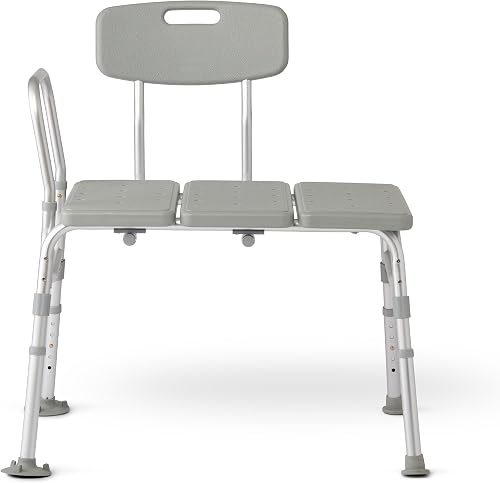 Best for simple assemblyCheck it
Which tub transfer benches suit seniors best?
The best tub transfer bench for elderly users depends on transfer ability, bathroom space and the support features they can use. These nine choices cover standard sit-and-slide benches, a swivel seat, padding, a cutout and a toilet-to-tub design.
Drive Medical Tub Transfer Bench for Bathtub: Best for precise seat fit
- Adjusts in half-inch steps
- Reversible design
- Backrest
- Suction cup feet
- 350 lb capacity
Half-inch leg adjustments help fine-tune seat height for the user and tub. A backrest, drainage openings and suction cup feet add practical support features.
Pros
- Half-inch height increments
- Reversible design
- Drainage openings and suction cup feet
Cons
- 350 lb capacity is lower than several other picks
- Confirm the bench dimensions against your bathroom
The Drive Medical bench is the top choice when fine seat-height adjustment matters. Its aluminum frame has dual-column leg extensions, with height changes in half-inch increments to help set the seat for the user and tub.
A backrest supports the user while seated, and drainage openings let water pass through the seat. Suction cup feet are included, and the reversible design can adapt to different bathroom layouts.
The stated capacity is 350 lb. Confirm that limit, the dimensions and the adjustment range for the specific user and tub before choosing it.
This is a practical starting point for someone who can sit and move across the tub edge with suitable support. The complete guide to bathroom safety for seniors covers other ways to assess the bathing area.
Platinum Health Carousel Sliding Shower Chair Tub Transfer: Best for padded swivel transfers
- Swivel sliding seat
- Padded seat, back and arms
- Reversible for either side
The swivel seat and padded contact points distinguish this bench from basic fixed-seat designs. Check the dimensions and weight capacity before choosing it.
Pros
- Swivel seat
- Padding on seat, back and armrests
- Can be used from either side
Cons
The Platinum Health Carousel suits shoppers who want padding at every main contact point and a swivel seat. The seat pivots, and the design can be used from either side of the tub.
Its seat, back and armrests have closed-cell polyurethane padding described as water-resistant and easy to clean.
Check the user's weight, seat width and bathroom clearance before choosing it.
If a sliding movement is the priority, compare other sliding tub transfer benches.
DMI Tub Transfer Bench and Shower Chair: Best for personal care access
- Removable cutout
- Safety belt
- Adjustable seat height
- 400 lb capacity
A removable cutout gives access for personal care, and the bench includes a safety belt and adjustable seat height. Its 39 in width makes measuring the bathroom especially important.
Pros
- Removable cutout
- Safety belt and strap locks
- 400 lb capacity
Cons
- 39 in overall width needs space
- Contains latex
The DMI is the pick for personal care access through a removable cutout. It also has a safety belt, strap locks, a handle and suction cup feet, with adjustable seat height from 19 to 23.5 in.
At 39 in wide, it needs a clear transfer path and enough space beside the tub. Its stated capacity is 400 lb, and it can be configured for right- or left-side installation.
Choose this model when the cutout is useful and the footprint fits. Our cutout transfer bench guide explains what to consider with that seat style.
Medline Transfer Bench for Bathtubs and Showers: Best for changing tub layouts
- Reversible backrest
- Stationary armrest
- Adjustable height
- 400 lb capacity
The backrest switches sides to fit different tub layouts, and the bench includes an armrest and slip-resistant feet. Its stated overall width is narrower than several other picks here.
Pros
- Backrest switches sides
- Stationary armrest
- Tool-free assembly
Cons
- Armrest stays on one side
- Check seat and tub measurements together
The Medline Transfer Bench suits bathrooms where a backrest that changes sides is useful. The armrest stays on one side, so check that it will be on the user's preferred side after assembly.
The seat height adjusts from 17.5 to 22.5 in, and the capacity is 400 lb. Wide suction cup feet go inside the tub, while rubber feet sit on the bathroom floor.
Its 28.7 in overall width is narrower than several benches in this roundup. Compare that measurement with your tub and floor space, and check that the armrest position works for the transfer.
Medline Padded Transfer Bench for Bathtub: Best for longer seated baths
- Padded seat and backrest
- Side arm
- Reversible backrest
- 400 lb capacity
This Medline bench adds padding to the seat and backrest while keeping adjustable legs, a side arm and a reversible backrest. Compare its stated 32 in overall width with available floor space.
Pros
- Padded seat and backrest
- Reversible backrest
- Tool-free assembly
Cons
- Padded seat may not suit every cleaning preference
- Confirm the full footprint before buying
The Medline Padded Transfer Bench adds a padded seat and backrest to an adjustable design. It also includes a side arm and reversible backrest.
The seat adjusts from 18 to 22 in, and the capacity is 400 lb. The seat measures 16 x 24 in, so compare that surface with the user's needs and check the bench's full footprint in the bathroom.
Choose it when padding is a priority and the dimensions suit your space. Our guide to the best padded tub transfer bench covers that style in more detail.
HOMLAND Tub Transfer Bench with Backrest: Best for adjustable 400 lb support
- Adjusts from 17.5 to 22.5 in
- Reversible backrest
- Aluminum frame
- 400 lb capacity
The push-button height adjustment and reversible backrest help it fit different users and tub layouts. Check its minimum footprint and leg placement against the bathroom.
Pros
- 400 lb capacity
- Reversible backrest
- Drainage holes in the seat
Cons
- Minimum overall depth is 22.4 in
- Confirm bathroom fit before buying
The HOMLAND bench is a standard sit-and-slide choice with a reversible backrest and 400 lb capacity. Its height adjusts from 17.5 to 22.5 in with a push-button system.
The seat has drainage holes, and the frame is aluminum. Its minimum overall dimensions are 32.3 in wide and 22.4 in deep, so check that the legs and seat leave enough room around the tub.
Choose it for an adjustable, conventional bench when those dimensions fit. Compare bariatric tub transfer bench options if a higher capacity is essential.
Moen DN7105 Home Care Premium Tub Transfer: Best for a roomy seat
- Seat measures about 29.25 x 18.125 in
- Adjusts from 16.5 to 21 in
- Arm supports
- 400 lb capacity
The broad seating surface and integrated arm supports may suit people who want more room to sit. Its overall width and depth need careful comparison with the tub and surrounding floor.
Pros
- Broad seat
- Integrated arm supports
- Adjustable height
Cons
- Broad dimensions may limit placement
The Moen DN7105 suits people who want a broad seat with integrated arm supports. The seat measures about 29.25 x 18.125 in, and its height adjusts from 16.5 to 21 in.
The bench has a seat back and non-slip feet, with a stated capacity of 400 lb. Its overall width is about 32.75 in, so allow room for the bench and the user's approach.
Measure the transfer area as well as the tub before buying. For a different tub shape, our guide to a transfer bench for clawfoot and garden tubs covers fit questions specific to those designs.
Eagle Health Supplies Toilet-to-Tub Transfer Bench: Best for toilet-to-tub access
- Toilet-to-tub transfer design
- Cutout seat
- Reversible installation
- 350 lb capacity
Its extended design is made for transfers between a toilet and tub, with a cutout seat and reversible installation. The 55.5 in width calls for careful room and tub measurement.
Pros
- Designed for toilet-to-tub transfers
- Cutout seat
- Tool-free assembly
Cons
- Very wide footprint
- 350 lb capacity
The Eagle Health Supplies bench is built for a transfer between toilet and tub. Its extended frame combines a sliding shower transfer bench with a cutout seat and reversible installation.
It measures 55.5 x 22.5 x 37.75 in, with a seat height range of 20.25 to 24.25 in. Its stated capacity is 350 lb, and the sliding distance is 29.5 in.
The wide footprint makes measurement essential. Choose it only if the layout supports its extended frame and the user can manage this transfer arrangement safely.
Dr. Dunley Tub Transfer Bench: Best for simple assembly
- Tool-free click-together assembly
- Suction feet
- Lightweight frame
- 400 lb capacity
The tool-free assembly and suction feet are useful features for a straightforward bench setup. Confirm seat height, overall dimensions and tub fit before choosing it.
Pros
- Tool-free assembly
- Suction feet
- 400 lb capacity
Cons
- Dimensions are not specified here
- Confirm adjustment range before buying
The Dr. Dunley is worth considering if tool-free assembly is a priority.
It has a lightweight frame, supportive backrest and suction feet. Its stated capacity is 400 lb.
Its overall dimensions and seat-height range aren't specified here, so it is difficult to confirm fit from those details alone. Get the exact measurements before choosing it for a particular tub.
How should you compare the best tub transfer bench for elderly users?
Choose by transfer method, seat support, height adjustment, capacity and fit. Those details matter more than a long feature list if a bench will not fit the tub or the user cannot use its transfer style.
| Product | Best for | Frame | Height adjustment | Weight capacity | Our score |
|---|---|---|---|---|---|
| Drive Medical Tub Transfer Bench for Bathtub | precise seat fit | Aluminum | Half-inch increments | 350 lb | 9.7 |
| Platinum Health Carousel Sliding Shower Chair Tub Transfer | padded swivel transfers | 9.6 | |||
| DMI Tub Transfer Bench and Shower Chair | personal care access | 400 lb | 9.5 | ||
| Medline Transfer Bench for Bathtubs and Showers | changing tub layouts | 400 lb | 9.5 | ||
| Medline Padded Transfer Bench for Bathtub | longer seated baths | 400 lb | 9.4 | ||
| HOMLAND Tub Transfer Bench with Backrest | adjustable 400 lb support | 9.3 | |||
| Moen DN7105 Home Care Premium Tub Transfer | a roomy seat | 400 lb | 8.7 | ||
| Eagle Health Supplies Toilet-to-Tub Transfer Bench | toilet-to-tub access | 8.5 | |||
| Dr. Dunley Tub Transfer Bench | simple assembly | 400 lb | 8.2 |
A transfer bench bridges the tub wall so the user can sit down before moving across the edge. For a separate handhold at the tub edge, see clamp-on tub rails.
A fixed seat supports a seated transfer, while a sliding or swivel design changes how the seat moves.
Check space outside the tub as well as the area inside it. The legs need a stable place to stand on both sides, and the user needs room to approach, sit and move across the bench.
What should you check before buying a tub transfer bench?
Measure the tub and surrounding floor area before selecting a bench, then compare seat height and capacity with the user's needs. A backrest, arm support, padding or cutout can help narrow the choice once the basic fit works.
Which tub transfer bench dimensions should you measure?
Measure the tub's height and width, the floor space beside it, and the path the seat must span. Compare those measurements with the bench's full width and depth, leg placement and adjustment range.
The DMI is 39 in wide, while the Eagle Health Supplies design is 55.5 in wide. For a tighter layout, check the fit advice in our best tub transfer benches for small bathrooms guide.
How do seat height and weight capacity affect fit?
The seat needs to be at a height that lets the user sit and move across the tub edge with support. Compare its adjustment range with the person's seated position and tub rim, then follow the bench instructions when setting the legs.
Capacity varies across the picks. Confirm the selected bench's stated limit rather than assuming similar frames carry the same load.
When is a cutout or padded seat useful?
A cutout can make personal care easier, while padding may feel more comfortable for someone who sits longer during bathing. Neither feature replaces checking seat size, cleaning needs, transfer method and bathroom fit.
The DMI has a removable cutout, and the Medline padded and Platinum Health models add padding. Pick the style that suits the user's routine and ability to transfer safely.
Should you choose a sliding or swivel transfer bench?
A sliding or swivel design can help when moving across the tub edge is difficult, provided the user can sit securely while the seat moves. These designs still need enough floor space and a clear transfer path.
The Platinum Health Carousel has a swivel seat, while other benches use a sliding seat. Read how to use a tub transfer bench for a step-by-step look at the seated transfer.
How do you set up and care for a tub transfer bench?
Follow the bench's instructions, lock each leg and check stability before use. A caregiver may need to help when the user cannot move across the bench without assistance.
What should you check during setup?
Assemble the frame as instructed and set every leg to the height needed for the tub and user. Confirm that the bench spans the tub wall as intended, the legs sit firmly on the floor, and the feet inside the tub make the contact specified for that model.
Keep the route clear so the user can approach without stepping over clutter. Before each bath, check that locking buttons are engaged and the seat and backrest are firmly attached.
Read how to set up a tub transfer bench and how to measure for a tub transfer bench before assembly. Those guides help you plan the placement and check the fit before someone uses the seat.
How can you make the transfer easier to manage?
Place bathing items within reach before the user sits down, so they do not need to twist or stretch from the bench. Keep the bathroom floor and the user's route free of loose towels, cords and products.
Use the transfer method recommended for the specific bench and the user's abilities. Don't pull on the backrest or use a feature as a handhold unless its instructions identify it for that purpose.
How should you clean and maintain the bench?
Rinse away soap and residue after use, then let the seat and frame dry according to the care instructions. Check the feet, frame connections, adjustment buttons and straps regularly for wear, looseness or damage.
Padded seats need care that suits their material. The Platinum Health model uses closed-cell polyurethane padding described as easy to clean and disinfect, but follow its care instructions rather than applying unapproved cleaners.
What common mistakes should you avoid?
Buying before measuring is a common mistake, especially with wide models or bathrooms where the toilet, door or vanity limits the transfer path. Check the full footprint, not just the seat width or the space inside the tub.
A second mistake is treating a weight limit as a fit guide. Confirm capacity separately, set the seat height correctly, and don't use a bench that shifts, has loose parts or does not sit securely.
A bench also does not make every transfer safe or independent. Ask a health professional or occupational therapist for guidance if the user cannot sit steadily, follow transfer steps or move across the seat without help.
Which tub transfer bench should you choose?
Choose the Drive Medical bench for half-inch height adjustments and a straightforward sit-and-slide design. Pick the DMI when a removable cutout is needed, or the Platinum Health Carousel when its padded swivel seat suits the user and space.
The Medline Transfer Bench is a good match when its reversible backrest and narrower stated width address your layout. Choose the Eagle Health Supplies model only when you need a toilet-to-tub transfer and have room for its 55.5 in frame.
Before buying, compare the full footprint, seat height range, transfer style and capacity with the person and bathroom. Our guide to tub transfer bench cost can help with the next buying question.
For the best tub transfer bench for elderly users, prioritize a fit the person can use safely and support features that match their transfer. If bathing is part of a broader mobility plan, see our guides to mobility scooters for men over 70 and mobility scooters for women over 70.
Our top 3 picks at a glance
-
1
Best for precise seat fit
Drive Medical Tub Transfer Bench for Bathtub
9.7/10 our score
See it on Amazon -
2
Best for padded swivel transfers
Platinum Health Carousel Sliding Shower Chair Tub Transfer
9.6/10 our score
See it on Amazon -
3
Best for personal care access
DMI Tub Transfer Bench and Shower Chair
9.5/10 our score
See it on Amazon
Frequently asked questions
How does a tub transfer bench help seniors?
A tub transfer bench lets you sit outside the tub, then move across the tub wall while seated. This can avoid stepping over a high edge, but the bench must fit the tub and be set up securely.
Ask a health professional or caregiver for help if you need guidance with transfers.
How do I choose a tub transfer bench for an older adult?
Start with the person's transfer needs, then check the tub's width, height and surrounding floor space against the bench dimensions. Confirm seat height and capacity, and consider whether a backrest, arm support, padding or cutout would help.
A bench does not replace assistance when a person cannot transfer safely alone.
Can a tub transfer bench work in a small bathroom?
It can if the legs, seat and transfer path fit without blocking the bathroom door or needed access. Measure the space outside the tub as well as the tub opening, then compare both with the bench's full dimensions.
See our small-bathroom transfer bench guide for fit considerations.
When should I choose a padded transfer bench?
A padded bench may feel more comfortable than a hard seat for someone who spends longer sitting while bathing. Check how the padding is attached and whether the seat dimensions suit the user.
Compare options in our padded tub transfer bench guide.
How do I set up a tub transfer bench?
Follow the instructions for the exact bench and make sure its legs are level, locked and stable before use. Position the feet as directed, check the seat height, and confirm that the bench does not shift during a careful stability check.
See our guide on how to set up a tub transfer bench.


