9 Best Wheelchair Armrest and Side Bags (November 2026)
The best wheelchair armrest and side bags include the ZHCHG 2 Pack Wheelchair Side Bag for two armrest pouches, the FINPAC Wheelchair Side Bag with Cup Holder for visible evening rides, and the Vive Wheelchair Carry Bag for bulky daily items.
On this page (7 sections)
- Best wheelchair side bags for different routines
- How should you choose a wheelchair side bag?
- How do you set up a wheelchair armrest pouch?
- What mistakes should you avoid with a wheelchair side bag?
- How do you care for a wheelchair bag?
- Are wheelchair side bags better than trays?
- Which wheelchair side bag should you choose?
The ZHCHG 2 Pack Wheelchair Side Bag is a strong fit for keeping small essentials within reach. Its five front pockets sort everyday items, and an elastic pocket holds a drink.
That mix suits a phone, wallet, glasses, pen or medication, with each item in a predictable front pocket. You can reach them without turning to a back bag.
FINPAC offers more pocket types and reflective details for pens and rear items. Vive suits a larger central compartment when one main space matters more than many small slots.
Samdew and the second ZHCHG option hang behind the chair for clothing, blankets or other larger items. A side bag is not a tray, and a back bag is harder to reach while seated.
Measure the armrest or rear of the chair before ordering. Check straps, controls and transfer space so the bag helps rather than gets in the way.
For daily essentials only, start with an armrest pouch. If bulk is the problem, use a back bag and keep quick use items close at hand.
Our picks at a glance
-
1

-
2
 Best for visible evening rides
FINPAC Wheelchair Side Bag with Cup Holder
9.3/10 our score
See it on Amazon -
3

- 4
 Check it
samdew Large Wheelchair Bag to Hang
Best for rear chair storage - 5
 Check it
supregear Wheelchair Carry Bag
Best for mixed-size essentials - 6
 Check it
JanSport Central Adaptive Accessory Bag for Wheelchairs
Best for crossbody carry - 7
 Check it
ZHCHG Wheelchair Bags to Hang on Back
Best for rear drink pockets - 8
 Check it
P&F HIGH QUALITY PRODUCTS pf Wheelchair Side Pouch
Best for full-length arms - 9
 Check it
Cejiuga Wheelchair Side Bag with Cup Holder
Best for divided pocket access
Best wheelchair side bags for different routines
The best wheelchair side bag depends on what you carry, how you reach it and where the chair can safely hold a pouch. This roundup includes armrest organizers and larger back bags, so compare each pick by its intended job.
ZHCHG 2 Pack Wheelchair Side Bag: Best for two armrest pouches
- Five front pockets
- Elastic drink pocket
- 14.2 x 7.5 in
Five front pockets offer space to sort small daily items. An elastic pocket holds a drink within reach.
Pros
- Five front pockets
- Elastic drink pocket
- Adjustable straps
Cons
- Measure the armrest area before attaching
- No rear mesh pockets
The ZHCHG two-pack gives separate places for a phone, wallet, pen, snacks or medication. Each bag has five front pockets, and the elastic band pocket gives a drink its own place.
That layout helps when items are grabbed many times a day. A pen or glasses case stays in a known pocket instead of moving in one shared space.
ZHCHG describes heavy-duty nylon with double-stitched seams and reinforced stress points. Those details matter where straps and pocket corners take repeated pulling.
Adjustable straps allow quick attachment and removal, and the nylon can be wiped with a damp cloth. Quick removal helps with cleaning, folding or moving a pouch between chairs.
Two pouches can divide personal belongings and care supplies. Check that straps fit your armrest and do not cover a control or reduce transfer space.
Choose this set if you want two matching armrest organizers and a drink pocket. Skip it if you need a single deep compartment for clothing or a blanket.
FINPAC Wheelchair Side Bag with Cup Holder: Best for visible evening rides
- Eight pockets
- Cup holder for 16–26 oz bottles
- Reflective stripes
- 14 x 7.5 in
Four front pockets, pen slots and two rear mesh pockets separate small items. Reflective stripes add visibility in dim conditions.
Pros
- Eight pockets including pen slots
- Elastic cup holder
- Reflective stripes
Cons
- Check the straps against the chair arm
- Bottle size is limited to the stated range
FINPAC is a strong match for users who sort small essentials into dedicated spaces. It has four front pockets, two pen slots and two rear mesh pockets, so keys, glasses, pens and medication can stay separated.
Rear mesh pockets are useful for items that are visible at a glance. They also keep lighter items from pressing against a phone or wallet in the front pockets.
The elastic cup holder is designed for 16-26 oz bottles. That stated range is helpful because a bottle that is too wide or too short may not stay upright in motion.
Reflective stripes are sewn into the bag, and the adjustable hook-and-loop straps are 13.2 in long. The strap length gives room to wrap around different arm shapes, but it still needs a fit check on your chair.
Its dimensions are 14 x 7.5 in. FINPAC describes it as fitting standard wheelchairs, walkers, mobility scooters, office chairs, baby carts and transport chairs, but check your chair's arm shape and controls before attaching it.
The 8-pocket count is a plus only if each pocket matches something you carry. For a simple phone and wallet routine, a plainer pouch may be easier to keep tidy.
Pick FINPAC for pocket variety and reflective stripes. Skip it if your bottle falls outside the stated size range or if a simpler pouch would be easier to manage.
Vive Wheelchair Carry Bag: Best for bulky daily items
- Large interior compartment
- Two exterior pockets
- Zippered pouch
- 11.8 x 8.6 in
A large interior compartment holds larger daily items, while exterior pockets and a zippered pouch separate smaller belongings.
Pros
- Large main compartment
- Four attachment points
- Water-resistant polyester
Cons
- Fewer named small pockets than some options
- Measure the available armrest space
The Vive Wheelchair Carry Bag suits belongings that are awkward to divide among small pockets. Its large interior compartment provides the main storage space, with two exterior pockets and a zippered pouch for smaller items.
That structure works well for a jacket, book, snack container or other items that need one open space. Exterior pockets can hold things you need quickly without opening the main compartment.
The bag measures 11.8 x 8.6 in and attaches with adjustable fastener straps at four points, including a bottom strap. Four points can help the bag stay steadier than a design held by two straps alone.
Vive describes its polyester material as water-resistant, and the bag is made for wheelchairs, scooters and rollators. Water-resistant fabric helps with light splashes, but it does not make the contents fully protected in heavy rain.
Large O-ring zipper pulls offer a broad grip point. That can help if small zipper tabs are hard to hold, especially when wearing gloves or when hand strength is limited.
The layout favors a few larger storage zones over many individually named pockets. It works best when you want one main place for daily belongings and a separate zipped spot for valuables.
Choose Vive when you want a roomy main compartment with a few separate pockets. Skip it if you need a specific bottle holder or many small compartments.
samdew Large Wheelchair Bag to Hang: Best for rear chair storage
- 14 x 6 x 16 in
- Four inner-wall pockets
- Two padded laptop layers
- Detachable shoulder strap
This larger bag hangs behind the chair and can be carried with its detachable shoulder strap. Its insulated front pocket is designed for medicine storage.
Pros
- Room for clothing and larger items
- Insulated front pocket
- Bright lining and reflective strip
Cons
- Not an armrest pouch
- Check handle and chair clearance
The samdew bag hangs behind the chair for clothing, a blanket, a transfer sling or larger supplies. Its main compartment has four inner-wall pockets, and two padded layers fit laptops up to 15.6 in.
The padded layers suit carrying a computer to appointments or work. Inner-wall pockets keep smaller items from sliding into the main space.
A front pocket uses thermal insulation material for medicine storage. That suits medication kept apart from general belongings.
Two side mesh pockets, a back pocket for medical records, reflective trim and bright orange lining add storage and visibility. Bright lining makes dark items easier to spot in a deep compartment.
It measures 14 x 6 x 16 in and includes a detachable padded shoulder strap. That lets you carry the bag away from the chair when you transfer out for part of a day.
Two side webbing straps hang from the handle grips, while back webbing allows hand carry. Check clearance around wheels and brakes.
Choose samdew for larger rear storage and a detachable carry strap. Skip it if you need items within arm's reach or have little space behind the chair.
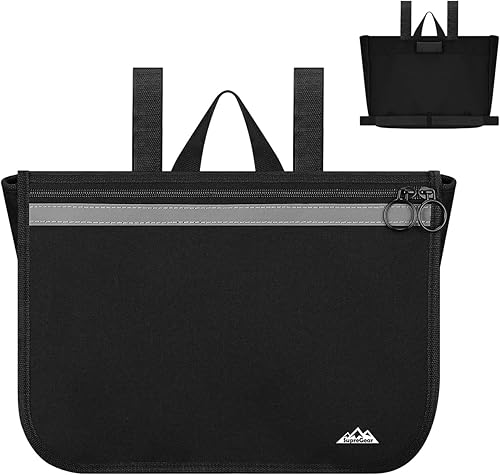
supregear Wheelchair Carry Bag: Best for mixed-size essentials
- Two mesh pockets
- Two exterior pockets
- Zippered pouch
- 12.4 x 9.5 x 2.4 in
The combination of mesh, exterior and zippered pockets helps divide glasses, snacks, drinks and medication. Adjustable straps attach the bag to several types of mobility aids.
Pros
- Several pocket types
- Waterproof polyester fabric
- Fits multiple mobility aids
Cons
- Measure the chair arm before ordering
- No stated bottle-size range
The supregear carry bag balances a main compartment with several pocket types. It has two mesh pockets, two exterior pockets, a zippered pouch and a spacious main compartment.
That mix can suit a routine where some items need quick access and others should stay closed. Mesh pockets show what is inside, while the zippered pouch keeps smaller items contained.
The bag measures 12.6 x 9.5 x 2.4 in. The shallow depth means it should sit flatter against an armrest than a deep bag, but it may not hold thick items as easily.
Adjustable fastener straps attach it to wheelchairs, walkers, rollators, mobility scooters and knee scooters. That range is useful if the same bag may move between aids, though each aid still needs its own fit check.
Supregear describes the polyester fabric as waterproof and lightweight. Lightweight fabric reduces added weight on the chair, and waterproof material helps with light wet weather.
The mixed layout suits someone who wants visible pockets for quick-grab items and a zipped spot for belongings that should stay contained. It is less suited to someone who needs every item labeled by a specific pocket.
Pick supregear for mixed-size items and a multi-pocket layout. Skip it if you need a defined drink size, since no bottle range is specified.
JanSport Central Adaptive Accessory Bag for Wheelchairs: Best for crossbody carry
- 6 L capacity
- Adjustable removable shoulder strap
- Attachment loops and buckles
- Sanitizer pocket
Adjustable loops and buckles attach this compact bag to a wheelchair, power chair or walker. A removable shoulder strap lets you carry it crossbody when off the chair.
Pros
- Switches between chair and crossbody carry
- Main compartment organizer panel
- Dedicated sanitizer pocket
Cons
- Smaller capacity than back bags
- Check strap reach and chair attachment points
JanSport's Central Adaptive Accessory Bag works on the chair and off it. Adjustable loops and quick-release buckles attach it to a wheelchair, power chair or walker, while the removable shoulder strap converts it to crossbody carry.
You can leave it on the chair for daily use, then wear it crossbody when away from the chair. That flexibility is the main idea here.
The bag holds 6 L and measures 9 x 10 x 3 in. Its main compartment includes an organizer panel, with a front zip pocket, side daisy chains and a dedicated sanitizer pocket.
The sanitizer pocket keeps hand sanitizer separate from papers or electronics. It is easier to find without opening the main compartment.
Easy-grab zipper pulls make zippers easier to locate and hold. The compact size favors daily essentials over bulkier belongings.
Daisy chains can hold extra gear, depending on the clips or straps you add. Keep added items light so the bag does not swing or pull at attachment points.
Choose JanSport for a compact bag with chair and crossbody carry modes. Skip it if your routine needs space for clothing or a blanket.
ZHCHG Wheelchair Bags to Hang on Back: Best for rear drink pockets
- 15 x 1.7 x 13 in
- Two side mesh cup holders
- Adjustable attachment straps
- Reflective strips
A large interior compartment holds items such as a book, blanket or medical supplies. Two side mesh pockets provide places for drinks.
Pros
- Roomy interior
- Two side cup holders
- Reflective strips
Cons
- Hangs behind the chair, not on the armrest
- Check dimensions against chair clearance
The ZHCHG back bag offers a roomy interior for a book, blanket, laptop or medical supplies. Two elastic mesh cup holders sit at the sides, and adjustable straps attach it to most manual and electric wheelchairs.
Two side drink pockets can suit a routine where a companion or assistant needs access to drinks. They are less useful if you need to reach a bottle yourself while seated.
It measures 15 x 1.7 x 13 in. A two-way zipper opens the main compartment, while reflective strips add visibility in dim conditions.
The two-way zipper can make loading easier because the opening can be widened from both ends. That helps with books, blankets or other items that do not fold well.
ZHCHG describes the bag as nylon with sponge lining and says it is waterproof, wear-resistant and tear-resistant. Sponge lining can add some padding, but it does not turn the bag into a padded case for fragile items.
Check the chair's rear clearance, including space around wheels and other equipment, before choosing a back-mounted design. A bag that hangs behind the chair can also change how the chair folds or fits through a doorway.
Choose this bag for rear storage with two side drink pockets. Skip it if you need direct access to items while seated without assistance.
P&F HIGH QUALITY PRODUCTS pf Wheelchair Side Pouch: Best for full-length arms
- Double-sided pouch
- Cup and phone holder
- Five card holders
- For full-length armrests
This double-sided pouch is designed for full-length armrests and includes a cup holder, phone holder and card slots. Confirm your armrest length before choosing it.
Pros
- Designed around full-length armrests
- Includes a cup and phone holder
- Has a medical-alert-symbol pocket
Cons
- Not for short armrests
- Measure the chair carefully
The P&F side pouch is designed for full-length armrests only. Its double-sided layout includes a cup holder, phone holder, five card holders and a pocket marked with a medical alert symbol.
Double-sided storage can keep items on both faces of the armrest. That may suit a chair where one side is blocked or where a phone needs a separate place from cards.
It measures 16.5 x 12.5 x 0.5 in and has clips at both ends. A top handle lets you carry the pouch and its contents away from the chair.
The handle is useful if you move the pouch between a chair and a bed or car seat. It also means the pouch can be carried without relying on the clips while it is off the chair.
The armrest restriction is decisive: a short armrest won't suit this design. Measure your armrest and compare the layout with your controls and transfer space before choosing it.
Five card holders may suit someone who carries cards often, but they also add a fixed purpose to the pouch. If you rarely use cards, those slots may not justify the specialized design.
Choose P&F only if your wheelchair has full-length armrests and its dimensions work for your chair. Skip it if you use short armrests or want a standard strap-on pouch.
Cejiuga Wheelchair Side Bag with Cup Holder: Best for divided pocket access
- Five front pockets
- Zippered compartment
- Two rear mesh pockets
- 14 x 7.7 in
Front pockets, a zippered compartment and rear mesh pockets divide small items. An elastic drink pocket and pen slots add dedicated places for common essentials.
Pros
- Eight storage areas
- Elastic drink pocket
- Adjustable straps
Cons
- Check whether the pocket layout suits your reach
- Measure the armrest before attaching
Cejiuga combines a cup holder with several places to sort small items. It has five front pockets, one zippered compartment and two rear mesh pockets, along with pen slots.
Front pockets can hold items you use while seated, while rear mesh pockets can hold lighter items you set aside. The zippered compartment gives small valuables a closed place.
The bag measures 14 x 7.7 in and uses adjustable straps to attach to many wheelchairs, walkers, rollators and mobility scooters. Check the shape of your bottle before relying on the elastic drink pocket, since a bottle-size range isn't specified.
An elastic pocket is flexible, but flexibility does not guarantee a fit. A tall, wide or tapered bottle may sit differently from a standard bottle on a walk or ride.
Cejiuga describes the material as polyester, while its product bullets describe nylon with double-stitched seams. That difference is worth noting because material can affect cleaning and how the fabric feels in daily use.
A loop on the zipper pull gives you a larger point to grip when opening the compartment. That can help if a standard zipper tab is hard to manage with gloves or reduced grip.
Choose Cejiuga for front and rear pocket access plus a zipped space. Skip it if you need a confirmed bottle fit or have trouble reaching pockets on both sides of the armrest.
How should you choose a wheelchair side bag?
Choose a wheelchair side bag by matching attachment, storage shape and access to your chair and routine. A high pocket count matters only if pockets sit where you can reach them without blocking controls or transfers.
Start with the chair. Measure armrest length and width, locate the joystick or brake, and check space needed for transfers.
Compare the usable area with bag dimensions, then consider where straps or loops will sit.
Next, list what you carry on a typical outing. Phones, glasses, keys and medication suit an armrest pouch.
A blanket, extra clothes or a transfer sling usually calls for a back bag.
Test access while seated. Open and close zippers, buckles or hook-and-loop straps from your usual position.
A bag that is easy to attach but hard to open will not simplify daily trips.
Check whether a drink pocket matches your bottle and chair movement. Only FINPAC specifies 16–26 oz bottles here.
Other cup holders need a fit check with your own bottle.
For broader choices, see the wheelchairs and power chairs buying guide and best wheelchair accessories for seniors. For scooters, compare mobility scooters with armrests and mobility scooter armrest pads.
How do you set up a wheelchair armrest pouch?
Set up a wheelchair armrest pouch so it stays stable, leaves chair controls clear and keeps frequently used items within comfortable reach. Start with an empty bag and test the fit before loading it.
Attach the straps to the armrest according to the bag's design, then check whether the pouch shifts when you move the chair or reach into it. Reposition it if it slides, hangs too low or presses against a control.
Load the bag in stages. Put light, frequently used items in easy-to-reach pockets, and keep smaller valuables in a zippered compartment where available.
Place a drink only in a holder that fits its shape and size.
Then sit in your usual position and confirm that you can reach the items without leaning or twisting sharply. Check transfers, doorways and any chair controls again after the bag is loaded, since the added weight can change how it hangs.
What mistakes should you avoid with a wheelchair side bag?
The most common mistake is choosing by pocket count alone. A bag with many pockets can still be a poor fit if you can't reach them, the straps don't suit the armrest or the pouch blocks a control.
Avoid overloading a side pouch with heavy or bulky items. Extra weight can make a bag hang lower or shift, while bulky contents may crowd the armrest and make transfers harder.
Don't assume every drink holder fits every cup. Check the stated size range when available, and otherwise test your bottle in the holder before relying on it during an outing.
Don't put every essential in a back bag if you need to reach those items independently. Back storage is useful for volume, but it can be difficult to access from a seated position.
Also avoid covering brakes, joysticks or other controls with straps or fabric. A small adjustment before use can prevent an organizer from becoming an obstacle.
How do you care for a wheelchair bag?
Care for a wheelchair bag by removing loose debris, wiping fabric as appropriate and checking straps and seams regularly. Follow supplied care directions before using water or cleaning products.
Shake out crumbs and check pocket corners for loose threads. A simple routine can prevent small problems from becoming repairs.
ZHCHG describes its nylon side bags as wipe-clean with a damp cloth, and Vive describes its polyester as water-resistant. Water-resistant fabric does not mean zippers or seams can be submerged, so wipe rather than soak unless directions say otherwise.
Wiping is usually enough for dust, light spills and everyday marks. Harsh cleaners can damage coatings or weaken fabric.
Empty crumbs and small items before cleaning. Debris can scratch a phone screen, stain fabric or make a zipper harder to close.
Let the bag dry fully before loading medication, electronics or papers. Check attachment straps for wear before each trip, since damp fabric left closed can hold moisture and smell stale.
Clean lint and hair from hook-and-loop straps, as buildup reduces grip. Inspect stitching at strap points and pocket corners, where repeated pulling stresses seams.
Store a spare bag dry and away from direct heat. Fold it loosely rather than forcing it into a tight space with sharp items.
Keep a simple list of medication or medical supplies inside the bag. Clean drink pockets after spills, even water, as residue can stiffen elastic and mesh.
Do not overload a pouch to test straps or seams. Heavy contents can make it sag or shift.
For a back bag, check webbing and buckles move freely before a trip. Dirt can make a buckle stick and a strap harder to adjust.
Are wheelchair side bags better than trays?
Side bags carry belongings, while trays provide a flat surface for a meal, book or activity. Pick the format that matches the task you need from the chair.
A pouch suits a phone, wallet, glasses or small medication items to carry between places. Those items need storage and quick access more than a work surface.
A tray offers a broader surface but takes up more space across the chair. It can help with reading, eating or crafts, yet may be harder in narrow spaces.
Some people need both. A tray may suit meals at home, while a side bag travels better to appointments or errands.
A tray keeps items in front of you instead of reaching to the side. That reach matters if leaning causes pain or controls sit where a pouch would hang.
A side bag keeps the front clear for transfers, controls or a lap blanket. Neither format is better in general, as they solve different problems.
For a flat surface, compare a wheelchair lap tray or an activity tray for a wheelchair. Those focus on surface area rather than pocket storage.
A back-mounted bag may suit storage volume better. It can hold bulky items that would not fit in a pouch or on a tray.
Consider cleaning and setup too. A tray may need wiping after meals, while a bag needs emptying of crumbs and small items.
Start with the task you repeat most. Add the other format only if it solves a separate need.
Which wheelchair side bag should you choose?
Choose the ZHCHG two-pack if you want separate armrest pouches with front pockets and an elastic drink pocket. Pick FINPAC if you value pocket variety and reflective stripes, or Vive if one roomy interior compartment matters more than many small pockets.
For larger belongings, choose samdew if you want an insulated front pocket and a detachable shoulder strap, or the ZHCHG back bag if side mesh drink pockets are useful. JanSport is the compact choice when you want to switch between chair attachment and crossbody carry.
Choose P&F only for a wheelchair with full-length armrests. Before ordering any bag, measure the chair, check strap placement and confirm that you can reach what you plan to carry.
For more volume behind the chair, see our guide to wheelchair backpacks and back bags.
Our top 3 picks at a glance
-
1
-
2
Best for visible evening rides
FINPAC Wheelchair Side Bag with Cup Holder
9.3/10 our score
See it on Amazon -
3
Frequently asked questions
What should you keep in a wheelchair armrest bag?
Keep items you reach for often, such as a phone, wallet, glasses, keys or medication, in an armrest bag. Use a secure zippered pocket for small valuables and keep drinks upright in a holder made for your bottle size.
Avoid filling the pouch so heavily that it gets in the way of transfers or chair controls.
How do you choose a wheelchair side bag that fits?
Measure the armrest length and width, then compare those measurements with the bag and its straps. Check where the straps attach and whether the pouch could cover a control, brake or transfer space.
The P&F pouch is for full-length armrests only, so it needs a closer fit check.
Is an armrest bag or a wheelchair back bag better?
An armrest bag keeps small items close at hand, while a back bag offers room for bulkier belongings such as clothing or a blanket. Choose based on what you carry and what you can reach comfortably.
For more back-mounted options, see our guide to the best bag for back of wheelchair.
Can wheelchair side bags hold a drink?
Some wheelchair side bags have an elastic or mesh drink pocket. FINPAC specifies a holder for 16–26 oz bottles, while other options describe a cup holder without a bottle-size range.
Measure your bottle and check that the holder position works with your chair and movement.
What if I need a flat surface instead of a pouch?
A side pouch is for carrying small items. A tray gives you a broader surface for reading, meals or activities, so compare a best wheelchair lap tray or a best activity tray for wheelchair if that is your main need.