7 Best Wheelchair Trays (November 2026)
The best activity trays for wheelchairs include the The Aftermarket Group for right-arm support, the GBH-MED Wheelchair Tray Table for meals and notes, and the Jeelathy Wheelchair Tray Table with Cup Holder for wider chair compatibility.
On this page (10 sections)
- How we chose these wheelchair activity trays
- The best wheelchair trays for different needs
- How do you choose the right activity tray for a wheelchair?
- What should you measure before buying a wheelchair tray?
- Which wheelchair tray works best for meals, reading or hobbies?
- Are full trays and wheelchair arm trays interchangeable?
- How should you set up a wheelchair activity tray?
- What mistakes make a wheelchair tray harder to use?
- How do you clean and care for a wheelchair tray?
- Which wheelchair tray should you choose?
The best activity tray for wheelchair use depends on the chair and what you'll do at it. The Aftermarket Group is a right-side padded half tray, while GBH-MED and Jeelathy offer full surfaces with features for meals and small items.
A full wheelchair activity tray can make a meal, book or hobby materials easier to keep within reach. A half tray or armrest tray serves a different purpose: supporting one arm while leaving more of the chair open.
If you're still choosing a chair, start with our wheelchair for seniors guide. For more add-ons, see our best wheelchair accessories for seniors.
Our picks at a glance
-
1

-
2

-
3
 Best for wider chair compatibility
Jeelathy Wheelchair Tray Table with Cup Holder
9.2/10 our score
See it on Amazon
- 4
 Check it
AlveyTech Wheelchair Tray Table with Cup Holder
Best for quick removal - 5
 Check it
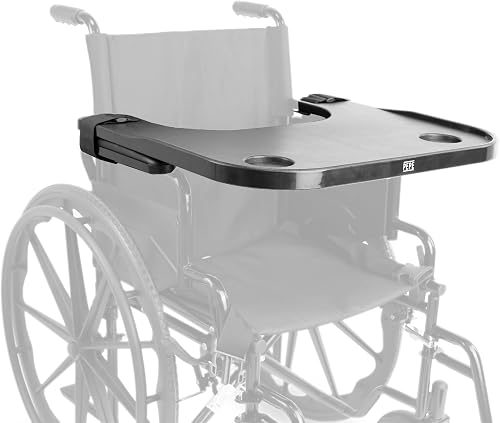
PEPE Mobility Wheelchair Tray Table for Adults
Best for facility routines - 6
 Check it
Rehabilitation Advantage Speckled Wheelchair Armrest Tray
Best for narrow arm supports - 7
 Check it
POWYS Wheelchair Lap Tray Cushion Wheelchair Lap
Best for padded resting
How we chose these wheelchair activity trays
These wheelchair activity trays were compared by shape, attachment, fit information and features suited to meals, reading and hobbies. The focus was on what a tray does in daily use, not just whether it looks broad enough on a shelf.
A cup holder or pencil well can be useful, but a tray still needs to fit the chair and the person using it. That means checking armrest spacing, the side the user needs, and whether straps or a slide-on base will sit securely.
Small details were weighed against the task at hand. A padded surface suits resting an arm, while a firm full tray suits food, books and writing materials.
Depth of surface and ease of removal also matter for routine use. A removable tray can be taken off for transfers, while an armrest support may stay out of the way more easily.
| Product | Best for | Type | Surface | Attachment | Our score |
|---|---|---|---|---|---|
| The Aftermarket Group | right-arm support | Right-side half tray | Black padded vinyl | Slides onto a standard padded arm pad | 9.7 |
| GBH-MED Wheelchair Tray Table | meals and notes | Hook-and-loop straps | 9.4 | ||
| Jeelathy Wheelchair Tray Table with Cup Holder | wider chair compatibility | Hook-and-loop straps; two extra straps included | 9.2 | ||
| AlveyTech Wheelchair Tray Table with Cup Holder | quick removal | Hook-and-loop straps; no tools required | 9.1 | ||
| PEPE Mobility Wheelchair Tray Table for Adults | facility routines | Adjustable Velcro straps | 8.9 | ||
| Rehabilitation Advantage Speckled Wheelchair Armrest Tray | narrow arm supports | Slides onto an armrest | 8.7 | ||
| POWYS Wheelchair Lap Tray Cushion Wheelchair Lap | padded resting | 8.6 |
The best wheelchair trays for different needs
The right tray shape depends on whether you need a broad work surface, a place to set a drink, or support for one arm. The picks below cover full removable tables, armrest supports and a padded lap cushion.
The Aftermarket Group: Best for right-arm support
- Padded vinyl half tray
- Right side
- Slides onto a standard padded arm pad
- Flip-up hardware
A padded half tray for a wheelchair user who needs a place to rest one arm. Check the chair's arm pad and the right-side orientation before choosing it.
Pros
- Padded vinyl surface
- Half-tray format leaves the other side open
- Flip-up hardware
Cons
- Right-side model
- Made to slide onto a standard padded arm pad
The Aftermarket Group is a right-side padded half tray that slides onto a standard padded arm pad. Its shape is suited to resting one arm, rather than covering the lap with a broad work or dining surface.
The black padded vinyl top gives a softer place for the forearm than a hard plastic panel. That padding may suit someone who will sit with the arm resting for longer periods, such as during reading or conversation.
The flip-up hardware may matter when the tray needs to move out of the way. Since this version is for the right side, confirm which side the seated user needs before ordering.
This style differs from full removable trays that span both armrests. If you want a broad surface for a meal or book, compare your needs with a best wheelchair lap tray.
Choose it for one-arm support when the chair has a compatible padded arm pad and the right-side orientation is correct. Skip it if you need a large surface for meals, books or crafts.
GBH-MED Wheelchair Tray Table: Best for meals and notes
- Fits standard arms 18–20 in
- Two cup indents
- Pencil well
- Hook-and-loop straps
The two cup indents and pencil well give small items set places on the tray. Measure the chair's arms because this model is sized for 18–20 in spacing.
Pros
- Two cup indents
- Pencil well helps keep a pen from rolling
- Strap attachment
Cons
- Fit range is 18–20 in
- Arm spacing needs to be measured
GBH-MED's tray suits meals and small items, with two cup indents and a pencil well. Hook-and-loop straps secure it between the armrests, and it fits standard wheelchair arms 18–20 in apart.
Measure the arm spacing instead of assuming a standard chair will fit. This range is narrower than Jeelathy's stated 16–20 in armrest range.
The cup indents and pencil well give drinks and pens their own places. That layout can help keep a cup from sliding toward a plate and keep a pen from rolling off during writing.
For daily care, a plastic tray like this is usually wiped clean after use. Removing it between meals can make cleaning easier and keep food residue away from the straps.
Choose it when the chair measures 18–20 in and you want small-item features for meals or writing. Skip it if the chair falls outside that range or you need a half tray for one arm.
Jeelathy Wheelchair Tray Table with Cup Holder: Best for wider chair compatibility
- Fits armrests 16–20 in
- Cup holder
- Two extra straps included
- No tools required
Its stated 16–20 in armrest range covers a broader span than several full trays here. Measure the chair before buying and confirm the straps can secure it as intended.
Pros
- Stated fit range starts at 16 in
- Cup holder
- Two extra straps included
Cons
- Still requires an armrest measurement
- Full tray may not suit a one-arm support need
Jeelathy has a stated armrest width range of 16–20 in. It attaches with hook-and-loop straps, needs no tools and includes two extra straps.
The full surface is intended for items such as papers, cups, phones and pens. That wider span may suit a chair at the narrower end of the range, but only if the tray still leaves room for the user to sit comfortably.
The cup holder's exact dimensions aren't specified, so compare your usual drink container with the holder before relying on it. A small cup and a large mug may behave very differently in the same holder.
Jeelathy says the ABS plastic surface is easy to wipe clean. Check that the tray sits level on your chair and that the straps can be secured around its armrests.
Choose this tray when your armrests measure within the stated 16–20 in range and the extra straps suit your setup. Skip it if your main need is a one-arm support surface rather than a full lap desk.
AlveyTech Wheelchair Tray Table with Cup Holder: Best for quick removal
- Fits many standard wheelchairs 18–20 in wide
- Cup holder
- Removable
- Hook-and-loop straps
A removable tray for eating, writing or crafts, with a cup holder and strap attachment. Check the chair width and armrest layout before choosing it.
Pros
- Removable design
- Cup holder
- No-tool strap attachment
Cons
- Fit is described for standard chairs 18–20 in wide
- No specific cup-holder dimensions
AlveyTech's removable tray is designed for many standard wheelchairs 18–20 in wide. It has a cup holder and attaches to the armrests with hook-and-loop straps, with no tools required.
That combination suits someone who wants to take the tray off between meals or activities. Its described uses include eating, writing notes and crafts, so think about how much surface area those tasks need.
The tray is made from ABS plastic. That material is light enough for regular removal, but check how it feels when loaded with a plate and a drink.
Match the chair's dimensions and armrest layout to the fit description before deciding it will work. A strap can only hold firmly if it can wrap and tighten around the armrest as intended.
Choose AlveyTech for a removable desk with a cup holder. Skip it if your chair is outside the stated fit range or needs a different attachment style.
PEPE Mobility Wheelchair Tray Table for Adults: Best for facility routines
- Integrated cup holder
- Adjustable Velcro straps
- ABS plastic
- 22.8 x 20.7 x 1.4 in
Its removable, strapped design is described for use at home, in hospitals and outdoors. Compare the dimensions with the seated user's space and the chair's armrests.
Pros
- Integrated cup holder
- Adjustable straps
- ABS plastic
Cons
- Measure the chair and available seated space
- No armrest fit range is specified
PEPE Mobility gives you a full tray measuring 22.8 x 20.7 x 1.4 in, with an integrated cup holder and adjustable Velcro straps. Compare its dimensions with the user's lap space and chair.
The tray is designed for eating, reading and other activities at home, in hospitals or outdoors. It is made from ABS plastic and can be removed when not needed.
No specific armrest width range is given, so check compatibility with your wheelchair before choosing it. A tray that is too wide or deep may make it harder to reach controls or move the chair.
For set-up, the straps should be adjusted so the tray rests level without pressing into the user. The user should be able to reach the near edge without leaning forward.
Choose PEPE Mobility if you want a removable full tray with a cup holder and its dimensions suit the chair. Skip it if you need a stated fit range before you can decide whether it will attach.
Rehabilitation Advantage Speckled Wheelchair Armrest Tray: Best for narrow arm supports
- 21.5 x 5.5 in
- Slides onto a wheelchair armrest
- Sold individually
- Right or left orientation
This narrow plastic tray supports one arm along an armrest rather than creating a full lap desk. Choose the side from the seated user's perspective.
Pros
- Narrow armrest-tray shape
- No hardware needed
- Available for either side
Cons
- Sold individually
- Not a broad surface for meals or reading materials
Rehabilitation Advantage's 21.5 x 5.5 in armrest tray is a narrow surface for one arm. It slides on and off the wheelchair armrest without hardware, so it serves a different role from a broad lap desk.
The tray is sold individually in either a right or left version. The side is determined from the seated user's perspective, so confirm the orientation before buying.
Its plastic construction is easy to clean. Wiping it down should be straightforward, and sliding it off can help with cleaning around the armrest.
The narrow width makes it a poor match for a full meal or reading setup. It may suit someone who mainly wants a place to rest an arm while keeping the lap open.
For head and neck comfort, see our guide to the best wheelchair neck support.
Choose it when arm support is the main need and a slide-on attachment fits the chair. Skip it if you need space for a meal, book or several activity supplies.
POWYS Wheelchair Lap Tray Cushion Wheelchair Lap: Best for padded resting
- 14.4 x 17 in pillow
- Foam and leather fabric
- Anti-slip points
- Armrest straps
A cushioned lap support for resting the forearms while reading or sitting. Tighten its straps as directed and check that its shape suits the user's position and needs.
Pros
- Cushioned surface
- Anti-slip points
- Armrest straps
Cons
- Soft support, not a rigid meal desk
- The brand advises allowing 48 hours after unboxing for a firmer feel
POWYS is a cushioned lap support with a 14.4 x 17 in pillow, foam fill and leather fabric. Its anti-slip points and armrest straps are intended to help keep it in place.
This is not a rigid desk surface for a plate or a stack of books. POWYS describes it as a support cushion for resting the forearms while reading or sitting, and recommends tightening the straps.
Its surface may suit someone who wants a padded place to rest their arms. The foam shape follows the lap area, so check that it does not push the user forward or raise the arms too high.
The leather fabric is described as easy to wipe clean. That can help with everyday spills, but the cushion still needs regular checks to make sure the straps remain tight.
Choose it for cushioned arm support, not as a substitute for a full meal tray. Skip it if you need a firm tabletop for dining or writing.
How do you choose the right activity tray for a wheelchair?
Start with the task, then check fit and attachment. A person who needs a work surface for meals or crafts has different needs from someone who wants a place to rest one arm.
For meals, reading and writing, look at full trays that span the chair. Decide whether you want a cup holder, cup indents or a pencil well, then consider whether those details match what the user carries.
A tray with a large surface can still be inconvenient if the chair's arms are too far apart or the user cannot comfortably reach its far edge.
For arm support, a half tray or narrow armrest tray can leave more of the lap open. Check whether the design is for the right or left side and whether it slides onto an arm pad or rests along the armrest.
For soft resting support, a cushion is a different category from a desk. It can be a better fit when padding matters most, but it won't replace a level surface for dishes, papers or hobby supplies.
What should you measure before buying a wheelchair tray?
Measure the chair's armrest spacing or width using the same points the tray's fit instructions describe. The full trays here include stated ranges of 16–20 in and 18–20 in, while other options give overall tray dimensions or describe a slide-on fit instead.
Also check the available lap space and how the seated user reaches the tray. A full surface may interfere with access to controls or caregiver assistance if it sits too far forward, too high, or too close to the user's body.
For a slide-on armrest tray, measure or inspect the arm pad where the base will sit. For a strap-on tray, check whether the straps can wrap around the armrests and tighten without covering a control or getting in the way.
A measurement is only useful if it matches the product's stated fit method. Don't compare the chair's outside width with an armrest spacing range unless those are the same measurement.
Which wheelchair tray works best for meals, reading or hobbies?
A full removable tray is usually the most useful shape for meals, books and hobby materials. A narrow armrest tray is better for resting one arm, while a cushioned lap support offers padding rather than a hard tabletop.
For meals, look for a full surface and decide whether a cup holder or indents help keep drinks in place. Keep food and drink within comfortable reach, and avoid loading the tray with more than the user can manage safely.
For reading, leave room for the book or device without blocking the user's view or access to the chair. A pencil well may help with writing or note-taking, while an open surface can suit papers and crafts.
For hobbies, think through the actual supplies used in one session. Small tools, yarn or art materials can roll, slide or crowd a tray, so choose enough working room and keep the setup uncluttered.
Are full trays and wheelchair arm trays interchangeable?
No. A full tray spans the lap area and supports several items, while a wheelchair arm tray usually attaches along one armrest and supports one arm or a smaller item.
The Aftermarket Group and Rehabilitation Advantage options are half or armrest styles. GBH-MED, Jeelathy, AlveyTech and PEPE Mobility are full tray tables, while POWYS is a cushioned lap support.
Choose based on the surface you need and how the user sits. A full tray may provide more room, but a smaller armrest attachment may be easier to move out of the way or keep clear of the lap.
The difference also affects set-up and care. A full tray needs both armrests and careful strap tension, while an armrest tray needs the correct side and a base that slides on properly.
A cushioned support sits apart from both types. It offers padding for resting forearms, but it cannot hold a plate, book or craft supplies level.
Matching the type to the task prevents disappointment. Meals and writing need a firm surface, while resting an arm needs support that does not block the lap.
How should you set up a wheelchair activity tray?
Set the chair on a stable surface and keep the user seated in their usual position. Before adding food, books or supplies, attach the tray according to its design and check that it sits level and does not shift with light pressure.
For a strap-on tray, place it between the armrests and fasten each strap firmly. If the tray includes extra straps, use them only as intended and check that they don't obstruct controls, wheels or the user's hands.
For a slide-on armrest tray, match the side and armrest before sliding it into place. Don't force a base that feels too tight or unstable; the attachment should fit the chair it is meant for.
Check the user's reach from the seated position. Place frequently used items toward the near edge, and leave controls, transfer paths and caregiver access unobstructed.
What mistakes make a wheelchair tray harder to use?
The most common mistake is buying before measuring. A tray may have useful cup holders or a broad surface, but those features won't compensate for armrests outside its fit range.
Another mistake is choosing by shape alone. A cushioned lap support, a narrow armrest tray and a full meal desk serve different purposes; choosing one in place of another can leave the user's main task unsupported.
Don't assume a tray fits every standard wheelchair. Armrest shape and spacing vary, and some models rely on straps while others slide onto a padded arm pad.
Compare the attachment to the actual chair.
Avoid placing heavy or frequently shifting items near the tray's edge. Keep drinks upright, avoid blocking the user's view, and remove the tray before transfers if it obstructs the movement or assistance needed.
Finally, don't use an activity tray as a restraint or assume it prevents a user from leaving the chair. The tray should support an activity or arm position, and the user's seating needs should guide the setup.
How do you clean and care for a wheelchair tray?
Follow the care directions for the specific material and wipe spills promptly. Jeelathy describes its ABS plastic tray as easy to wipe clean, and Rehabilitation Advantage describes its plastic armrest tray as easy to clean.
For a removable tray, take it off before cleaning if that makes the surface easier to reach. Keep straps dry and free of food residue, and check that hook-and-loop areas still hold securely before putting the tray back in use.
A padded vinyl or cushioned surface needs a different approach from a rigid plastic tabletop. Use a cloth and a cleaner suitable for the material, and avoid soaking foam or attachment areas unless its care directions allow it.
Before each use, look for loose straps, a shifted base or a cracked surface. Stop using the tray if its attachment no longer holds it in place.
Which wheelchair tray should you choose?
Choose The Aftermarket Group for right-side padded arm support, GBH-MED for a full tray with cup indents and a pencil well, and Jeelathy for a full tray with a stated 16–20 in armrest range. Pick AlveyTech for a removable desk with a cup holder, or PEPE Mobility if its full-tray dimensions suit your chair.
Choose Rehabilitation Advantage for a narrow slide-on armrest surface, and POWYS when padded forearm support matters more than a firm desk. Before buying, measure the chair, confirm the tray's side and attachment, and compare its size with the user's seated space.
For more lap-tray options, browse wheelchair lap trays. If you need to carry personal items beside the seat, a wheelchair armrest or side bag may suit that task better.
For mobility equipment questions, see mobility scooters for seniors with weak arms and mobility scooter cup holder attachments.
Our top 3 picks at a glance
-
1
-
2
-
3
Best for wider chair compatibility
Jeelathy Wheelchair Tray Table with Cup Holder
9.2/10 our score
See it on Amazon
Frequently asked questions
How do I choose an activity tray for a wheelchair?
Choose by task, chair fit and attachment. A full lap tray gives you a surface for meals, reading or hobbies, while a half tray or armrest tray supports one arm.
Measure the arm spacing and compare it with the tray's stated fit.
Then consider the user's seated space, reach and ability to manage the tray.
How do I measure a wheelchair for a tray?
Measure the distance or width the tray's fit instructions specify, then compare it with the chair. Some full trays here are designed for 18–20 in arms, while another is designed for 16–20 in.
Also check the arm shape and available lap space, and make sure straps or a slide-on base can attach securely.
Can a wheelchair tray be used for meals and reading?
Many full wheelchair trays provide a surface for meals, reading and writing. Some include a cup holder or indents for drinks, while a padded lap cushion is better suited to resting the arms than holding a meal.
Keep items within comfortable reach and secure the tray before placing anything on it.
Are wheelchair trays universal?
No single fit works for every chair. Some trays specify an armrest width range, and others slide onto a standard padded arm pad or attach with straps.
Measure your wheelchair and compare its arms with the stated fit before buying.
If the chair has unusual armrests, check compatibility before relying on a tray.


