9 Best Wheelchair Ramps for Home (November 2026)
The best wheelchair ramps for home entry include the FACHNUO 2FT Portable Wheelchair Ramp for Home for short home steps, the VEVOR 3" Rise Rubber Threshold Ramp for 3 in doorways, and the VEVOR 4" Rise Rubber Threshold Ramp for assisted entry.
On this page (9 sections)
- How we chose wheelchair ramps for home entry
- Compare the best wheelchair ramps for home
- Which wheelchair ramp is best for each home entry?
- What should you measure before choosing a home ramp?
- How do you choose ramp length and slope?
- Which ramp style fits your home entry?
- How should you set up and care for a home ramp?
- What mistakes should you avoid when buying a wheelchair ramp?
- Which wheelchair ramp should you choose for home?
The best wheelchair ramp for home depends on the rise and the room available for a safe approach. FACHNUO suits short steps, and Nuvium suits low sills.
A longer or handrail ramp may suit a raised entry. These wheelchair ramps for home should be matched to both the doorway and the chair.
Measure the rise, clear width, approach length, landing and chair wheelbase before comparing materials or extra features. Those checks quickly rule out ramps that are too short, too narrow or incompatible with the door.
Our picks at a glance
-
1
 Best for short home steps
FACHNUO 2FT Portable Wheelchair Ramp for Home
9.6/10 our score
See it on Amazon -
2

-
3

- 4
 Check it
Nuvium 1" Rise Rubber Threshold Ramp
Best for low door sills - 5
 Check it
KOLOTOOL 7FT Telescoping Aluminum Portable Wheelchair Ramp
Best for manual wheelchairs - 6
 Check it
RDCMKL Wheelchair Ramp with Handrails
Best for handrail support - 7
 Check it
WECARLLE Curb Ramps for Wheelchairs 3.9
Best for curb-like ledges - 8
 Check it
Sturdon Aluminum Threshold Ramp for Doorways
Best for wide entries - 9
 Check it
HOMCOM Wheelchair Ramp 10FT Aluminum Threshold Ramp
Best for long approaches
How we chose wheelchair ramps for home entry
The best choices match a specific entry height and give you enough width and approach space for the chair. We compared dimensions, materials, carrying or setup details, and each ramp's stated cautions.
A high capacity alone does not make a ramp suitable. Rise, slope, clear width, stability and the user's ability to control the chair all matter.
Compare the best wheelchair ramps for home
Use the table to narrow the choices by rise, size and intended use. Confirm the entry and chair measurements before selecting a ramp.
| Product | Best for | Length | Rise | Capacity | Our score |
|---|---|---|---|---|---|
| FACHNUO 2FT Portable Wheelchair Ramp for Home | short home steps | 24 in unfolded | 2–6 in; wheelchair step height recommended up to 4 in | 800 lb | 9.6 |
| VEVOR 3" Rise Rubber Threshold Ramp | 3 in doorways | 35.5 in | 3 in | 2,200 lb | 9.5 |
| VEVOR 4" Rise Rubber Threshold Ramp | assisted entry | 41.8 in | 4 in | 2,200 lb | 9.4 |
| Nuvium 1" Rise Rubber Threshold Ramp | low door sills | 1 in | 2,000 lb | 9.4 | |
| KOLOTOOL 7FT Telescoping Aluminum Portable Wheelchair Ramp | manual wheelchairs | 48–84 in | 600 lb | 9.3 | |
| RDCMKL Wheelchair Ramp with Handrails | handrail support | 3–10 in | 770 lb | 9.2 | |
| WECARLLE Curb Ramps for Wheelchairs 3.9 | curb-like ledges | 3.9 in | 7,000 lb | 8.8 | |
| Sturdon Aluminum Threshold Ramp for Doorways | wide entries | 3.3–9.2 in | 1,000 lb | 8.4 | |
| HOMCOM Wheelchair Ramp 10FT Aluminum Threshold Ramp | long approaches | 120 in | 594 lb | 8.2 |
Which wheelchair ramp is best for each home entry?
The right ramp is the one that matches the measured rise and can be positioned securely with enough room at both ends. The picks below are ordered by score, but the best fit depends on whether the user rolls independently or needs assistance.
Best wheelchair ramp for home steps: FACHNUO
FACHNUO 2FT Portable Wheelchair Ramp for Home: Best for short home steps
- 24 in unfolded length
- 2–6 in height adjustment range
- 800 lb capacity
- Folding aluminum design with handle
A folding aluminum ramp for short home steps and doorways. Its maker recommends a step height of no more than 4 in for wheelchair access.
Pros
- Folds with a built-in carrying handle
- Textured non-slip surface
- Extended guide rails at both ends
Cons
- Wheelbase must not exceed 27 in
- Short run limits it to modest rises
FACHNUO is the top pick for a short home step when a folding ramp is useful. Its aluminum surface is textured, and a built-in handle makes it easier to carry between locations.
It unfolds to 24 in and is intended for height adjustments from 2 to 6 in. For wheelchair access, the brand recommends keeping the step to 4 in or less.
Extended guide rails sit at both ends. Before each use, position the front extension plate fully flush with the ground.
Measure the wheelchair wheelbase first. It must not exceed 27 in, and the vertical side walls may affect door opening or interfere with a sliding door track.
Choose this for a modest rise and occasional repositioning. Skip it for a taller porch or when the short approach would make the slope difficult to control.
Best wheelchair ramp for a 3 in doorway: VEVOR
VEVOR 3" Rise Rubber Threshold Ramp: Best for 3 in doorways
- 35.5 in long
- 3 in rise
- 17.7 in wide
- Grooved rubber surface
This one-piece rubber ramp has beveled edges and a grooved tread for a 3 in threshold. It is 17.7 in wide.
Pros
- Beveled edges on all sides
- No-tool setup
- Works indoors or outdoors
Cons
- A fixed 3 in rise may not match other thresholds
VEVOR's 3 in rubber threshold ramp suits a doorway or ledge with a matching rise. For the junction between a ramp and the floor, compare wheelchair ramp transition plates.
Beveled edges allow an approach from different sides, and the grooved tread gives the surface texture.
The one-piece design needs no tools to set in place or remove.
Check the opening width carefully. This ramp is 17.7 in wide and is intended for wheelchairs up to 26.8 in wide.
Choose it when the rise is 3 in and the available approach is suitable. Skip it for a 1 in sill or a taller step because its fixed height won't match those transitions.
Best wheelchair ramp for assisted entry: VEVOR 4 in
VEVOR 4" Rise Rubber Threshold Ramp: Best for assisted entry
- 41.8 in long
- 4 in rise
- 24 in wide
- Three cable channels
A heavy rubber ramp for a 4 in rise, with a grooved surface and three channels for cables. Its roughly 14-degree slope calls for assisted wheelchair use.
Pros
- Three channels for cables or hoses
- One-piece, no-tool setup
- Raised button surface
Cons
- Weighs 65 lb
- Steep slope calls for assistance with wheelchair use
The VEVOR 4 in ramp fits a 4 in doorway or curb rise and has three channels for wires, cables or hoses. Its raised button surface adds texture, while the channels keep lines out of the main wheel path.
This one-piece ramp weighs 65 lb. Its weight makes moving it a planned task, even though no tools are needed for assembly or removal.
The slope is about 14 degrees, so wheelchair use requires another person's assistance. A high load capacity does not make a steep incline suitable for independent travel.
Choose it when the rise matches, an attendant can help, and the cable channels are useful. Skip it if the wheelchair user needs an independent, gentler route.
Best wheelchair ramp for low door sills: Nuvium
Nuvium 1" Rise Rubber Threshold Ramp: Best for low door sills
- 1 in rise
- 35.5 in wide
- Grooved rubber surface
- Can be trimmed or placed side by side
A low rubber transition ramp for raised door sills. It can be trimmed for a narrower opening or placed beside another ramp for more width.
Pros
- Grooves add traction
- Adhesive strips help reduce shifting on clean, smooth surfaces
- Can be cut to fit
Cons
- Only handles a 1 in rise
- Rubber may arrive curved or with a mild odor
Nuvium is designed for a 1 in sill, with a grooved rubber surface and a 35.5 in width. It can be trimmed to fit a narrower opening or placed beside another ramp to cover more width.
Adhesive strips help reduce shifting on clean, dry, smooth surfaces. Check the floor material before using them, since some surfaces may absorb color.
The rubber may arrive slightly curved or with a mild odor. Let it sit flat in a ventilated area if needed, and confirm that the threshold is about 1 in high.
Choose it when a small lip catches wheels but a taller ramp would create an unnecessary rise. Skip it for steps that need a longer, sloped path.
Best wheelchair ramp for manual wheelchairs: KOLOTOOL
KOLOTOOL 7FT Telescoping Aluminum Portable Wheelchair Ramp: Best for manual wheelchairs
- Extends from 48 to 84 in
- 600 lb capacity
- Two ramp sections
- Storage bag included
The telescoping pair extends to 84 in for a longer approach than a short threshold ramp. It is designed for manual wheelchairs, not power wheelchairs or scooters.
Pros
- Adjustable length
- No-tool extension
- Storage bag included
Cons
- Not compatible with power wheelchairs or scooters
- Two narrow ramp tracks require wheel alignment
KOLOTOOL's telescoping pair extends from 48 to 84 in, providing a longer path for a manual wheelchair over steps or into a vehicle. It extends without tools and comes with a storage bag.
The pair is rated for 600 lb. It is not compatible with power wheelchairs or scooters, so confirm the chair type before considering it for home access.
These are two tracks rather than a full-width platform. Measure the chair's wheel spacing and align each wheel with its track before use.
Choose it when the user has a manual wheelchair and needs portable length. Skip it for powered mobility devices or if keeping both wheels aligned would be difficult.
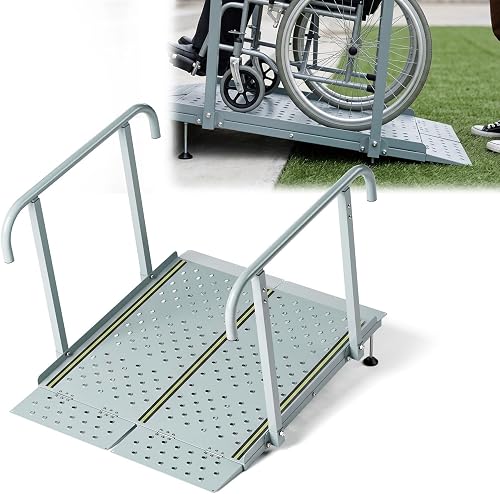
Best wheelchair ramp with handrail support: RDCMKL
RDCMKL Wheelchair Ramp with Handrails: Best for handrail support
- Designed for 3–10 in rises
- Dual handrails
- 770 lb capacity
- Carbon steel frame
A ramp with dual handrails for home steps and porches, with a stated rise range of 3–10 in. Measure the entry and plan for assembly and anchoring.
Pros
- Integrated dual handrails
- High-traction surface
- Folds for storage or transport
Cons
- Assembly and anchoring are needed
- The selected size needs to match a rise from 3 to 10 in
RDCMKL is designed for a raised entry where dual handrails are useful. The carbon steel frame accommodates rises from 3 to 10 in, and its high-traction surface is intended for home steps, porches and garages.
The ramp folds and can be disassembled, but assembly and anchoring are part of setup. It has pre-drilled holes and security bolts for anchoring.
Measure the step, landing and available pathway before choosing a size. The selected ramp must match a rise from 3 to 10 in.
Choose this when rails offer a useful grip point and the ramp can be anchored. For more options, see our guide to the best wheelchair ramps with handrails.
Best wheelchair ramp for curb-like ledges: WECARLLE
WECARLLE Curb Ramps for Wheelchairs 3.9: Best for curb-like ledges
- 3.9 in rise
- Two-piece set
- Textured surface
- Pre-drilled mounting holes
A pair of compact rubber curb ramps for a 3.9 in ledge. The pre-drilled holes allow mounting, though bolts are not included.
Pros
- Textured surface
- Two ramps in the set
- Mounting holes are pre-drilled
Cons
- Short 17.3 in length
- Mounting bolts must be sourced separately
WECARLLE's pair of compact curb ramps is made for a 3.9 in ledge. Each ramp has a textured surface, an underside cable channel and two pre-drilled mounting holes.
At 17.3 in long, each ramp has a short approach. Check the rise and slope carefully before choosing it for regular wheelchair access.
Bolts are not included. If you plan permanent mounting, make sure you have suitable hardware and a mounting surface.
Choose it for a curb-like obstacle where the short ramp fits the approach. Skip it when the user needs a longer incline or a wide, continuous path.
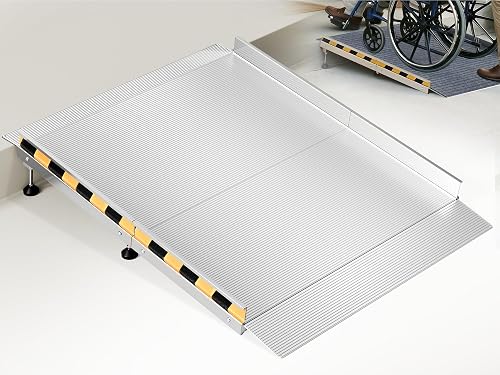
Best wheelchair ramp for wide entries: Sturdon
Sturdon Aluminum Threshold Ramp for Doorways: Best for wide entries
- 48 in long by 36 in wide
- Adjustable for 3.3–9.2 in rises
- 1,000 lb capacity
- Folds for storage
A wide aluminum ramp with adjustable feet for a single step or doorway. It needs more than 36 in of passage width and more than 48 in of approach space.
Pros
- Wide 36 in path
- Adjustable leveling feet
- Side curbs and reflective markers
Cons
- Weighs 33.4 lb
- Higher rises create a steeper approach
Sturdon provides a 48 x 36 in aluminum path for a single-step entry. Adjustable feet are designed for rises from 3.3 to 9.2 in, while side curbs and reflective markers define the edges.
The ramp needs more than 36 in of clear passage width and more than 48 in of approach space. It weighs 33.4 lb, and two adults are suggested for positioning and installation.
A 48 in run gives a 1:12 slope for rises up to 4 in, according to the brand. Higher rises produce a steeper approach, where assistance may be needed.
Choose it when the wide path suits the entry and the rise is within range. For a detailed comparison of access options, read the ramps, lifts and stairlifts buying guide.
Best wheelchair ramp for long approaches: HOMCOM
HOMCOM Wheelchair Ramp 10FT Aluminum Threshold Ramp: Best for long approaches
- 120 in long
- Aluminum construction
- Folds for storage
- Skidproof surface and side walls
A long folding aluminum ramp with a skidproof surface and raised side walls. Its 120 in length may suit a taller entry when the home has room for the approach.
Pros
- Long 120 in ramp
- Folds for storage
- Side walls help guide wheels
Cons
- Two people are suggested for moving it
HOMCOM offers a folding aluminum ramp with a 120 in length, skidproof surface and raised side walls. Its length may create a gentler approach for a given rise, provided the home has enough clear space.
Folding helps with storage, but this is not a lightweight ramp to carry frequently.
Measure the doorway and check that the raised sides won't interfere with the threshold or door. The ramp is 28.25 in wide, so compare that with the chair and entry clearance.
Choose it for a long approach where storage and handling are manageable. For a ramp system that can follow a home's layout, compare the best modular ramp for wheelchair access.
What should you measure before choosing a home ramp?
Measure the vertical rise from the lower surface to the top landing, then measure the clear path width and flat approach length. These figures help rule out ramps that are too short, too narrow or too tall for the entry.
Also measure the wheelchair's overall width and wheelbase. Check the door swing, threshold shape, landing space, screen door and any sliding door track that could meet the ramp.
A short rise can suit a threshold ramp. A porch or several steps may need a longer system or a landing platform; our guide to wheelchair ramps with platforms explains when a landing can help with layout.
How do you choose ramp length and slope?
A longer ramp usually creates a gentler path for the same rise, but it needs more clear ground space. Don't choose a short ramp solely because it fits the doorway if the resulting incline is hard for the user to control.
For example, FACHNUO's short ramp is intended for modest rises, and wheelchair access is recommended only for steps no higher than 4 in. The VEVOR 4 in ramp has a roughly 14-degree slope and requires assistance for wheelchair use.
For a regular entry, consider whether a fixed or modular system will be more practical than setting up a portable ramp each time. If the space cannot accommodate a usable ramp, compare ramps, lifts and stairlifts as different access options.
Which ramp style fits your home entry?
Rubber threshold ramps suit small, fixed height changes such as door sills. Folding aluminum ramps are useful when portability matters, while telescoping tracks extend for different tasks but require careful wheel alignment.
A wider adjustable ramp can provide a broader path across a single step, but it needs space on both sides of the transition. A handrail ramp may suit someone who benefits from a grip point, while a long folding ramp needs enough room to open and store.
For a mobility scooter, check ramp width, capacity and surface against the scooter's dimensions. Our best mobility scooter ramp guide focuses on that device type, and mobility scooters for small homes can help if indoor turning space is also a concern.
How should you set up and care for a home ramp?
Set the ramp on a stable, clear surface and follow its setup and anchoring instructions. Check that both ends meet their surfaces cleanly, the ramp sits flat, and no door, track or cable blocks the path.
For FACHNUO, the front extension plate should be fully flush with the ground. For Nuvium, use the adhesive strips only on a clean, dry, smooth surface and check whether the flooring may absorb color.
Before use, inspect the ramp for shifting, damage, loose fasteners or a wet surface that could affect traction. Keep grit and debris off the ramp, and follow the care instructions for its material.
What mistakes should you avoid when buying a wheelchair ramp?
The most common mistake is matching a ramp to the step height but ignoring its run, width or slope. A ramp that reaches the landing can still be too steep or too narrow for the wheelchair and user.
Don't assume a high capacity means a ramp works with every mobility device. KOLOTOOL is intended for manual wheelchairs, while FACHNUO has a wheelbase limit of 27 in.
Don't overlook weight and handling. Rubber ramps can be heavy, and a folding design may still require two people to move it.
Check door swings, sliding tracks, landing clearance and mounting needs before ordering.
Which wheelchair ramp should you choose for home?
Choose FACHNUO for a modest step and a portable folding design, or Nuvium for a low sill. Pick a fixed rubber ramp only when its stated rise matches the doorway, and consider a longer or handrail ramp for a raised entry.
Measure first, then compare the slope and space with the wheelchair user's ability and the help available. The best wheelchair ramp for home is the one that fits the entry and gives that person a manageable path.
Our top 3 picks at a glance
-
1
Best for short home steps
FACHNUO 2FT Portable Wheelchair Ramp for Home
9.6/10 our score
See it on Amazon -
2
-
3
Frequently asked questions
How do I choose the right wheelchair ramp for home?
Measure the vertical rise, clear doorway width and flat space available for the ramp. Match the ramp's rated rise to the step, then consider the slope the wheelchair user can manage and whether assistance is needed.
Also check the chair's wheelbase and width against the ramp.
How long should a wheelchair ramp be for a home step?
The needed run depends on the rise and the user's ability to manage an incline. A longer ramp generally gives a gentler approach for the same step, while short ramps suit small thresholds.
Measure the space before choosing, and ask an accessibility professional to assess a permanent entry.
Can I use a rubber threshold ramp at my front door?
Yes, if the ramp's rise and width fit the threshold and the surface underneath is suitable. These rubber threshold ramps range from a 1 in rise to a 4 in rise.
Check the door swing, landing space and any cables or track that could interfere.
Do wheelchair ramps need handrails?
Handrails can provide a grip point on a ramp, and some ramp designs include them. Whether they are needed depends on the user's mobility, the ramp height and the entry layout.
For a raised porch, compare a handrail ramp and a ramp with a landing platform before deciding.
Can a portable ramp stay outside?
Some ramps are designed for indoor and outdoor use, but placement and weather exposure still matter. Check how the ramp sits on the surface, whether it can shift, and whether the door or path remains clear.
Follow the maker's setup instructions and inspect the ramp before use.


