Mobility Scooter Dimensions: Typical Size and Weight
Mobility scooter dimensions depend on the model and setup: compare length, width, height, folded size and the weight of each piece with your route, storage space and vehicle before choosing.
On this page (9 sections)
- What mobility scooter dimensions should you compare?
- How do you measure a scooter route at home?
- How much room does a scooter need to turn?
- What do these scooter examples show about size and weight?
- How do you choose a scooter size for your home?
- Will a mobility scooter fit in a car trunk?
- How should you set up and store a scooter?
- What mistakes lead to a poor size choice?
- Which mobility scooter dimensions should decide your choice?
Mobility scooter dimensions vary by model, and the right size is the one that fits your route, storage and transport plan. Compare length, width and height for riding, then check folded size and lifting weight if the scooter will travel in a car.
A compact label does not guarantee a fit. Measure the places the scooter must pass through and park, and compare those measurements with the exact model configuration.
What mobility scooter dimensions should you compare?
Compare ready-to-ride length, width and height first, then check folded size and weight for storage and transport. Each measurement answers a different fit question.
| Measurement | What it tells you | Where to check |
|---|---|---|
| Length | Front-to-back space while ready to ride | Parking spot, vehicle interior and turning space |
| Width | Side-to-side space at the widest point | Doorways, hallways, lifts and vehicle openings |
| Height | Height in the riding setup | Low storage spaces and vehicle openings |
| Folded size | Space needed after folding | Trunk, closet or storage area |
| Total weight | Weight in the stated configuration | Moving and loading plans |
| Heaviest piece | Weight of the largest part after disassembly | Whether you or a helper can lift it |
Dimensions can describe different setups. Check whether the width includes parts that extend beyond the main body, and whether the stated weight includes a removable battery.
For transport, find out the weight of each piece you would need to lift. A scooter that folds quickly can still be too heavy to load without help.
How do you measure a scooter route at home?
Measure every narrow opening and tight turn from storage to the place you plan to ride. A scooter may pass through a door but lack room to turn immediately beyond it.
Measure the clear opening between the door frame, not just the door itself. Include handles, trim or other obstacles that reduce the usable space.
Then measure the hallway and the floor area at corners. Check the entrance to the bathroom, bedroom or lift if those are part of the regular route.
Leave enough room to line up with a doorway and correct your approach without bumping into walls or furniture.
Make a simple route list before comparing models:
- Narrowest doorway and hallway
- Tightest turn and the open floor space around it
- Lift opening and interior, if applicable
- Storage area, including height under shelves
- Charging location and the path between it and the riding area
For a taller rider, the seat and tiller fit matter alongside overall size. Compare those adjustments with the advice in our guide to mobility scooters for tall people and mobility scooters for tall adults.
Shorter riders can also check our guides to mobility scooters for short adults and scooters for short people.
How much room does a scooter need to turn?
Allow room to turn as well as enough width to pass through a doorway. Overall length and width don't show how much floor space a scooter needs to reverse or make a tight turn.
Look for a turning radius or turning-circle measurement for the exact model. Compare it with the tightest corner in your home and the space around furniture, counters or parked vehicles.
Three-wheel and four-wheel designs can turn differently, but the wheel count alone doesn't confirm a fit. If you are comparing these styles, our electric mobility scooter guide and mobility scooter comparisons can help narrow the choices.
What do these scooter examples show about size and weight?
These examples show why model-specific measurements matter: folded size, total weight and seat dimensions can change the fit decision. They are not averages for all scooters, and the BlessReach is a knee scooter rather than a powered mobility scooter.
| Product | Ready-to-ride or package dimensions | Folded dimensions | Weight |
|---|---|---|---|
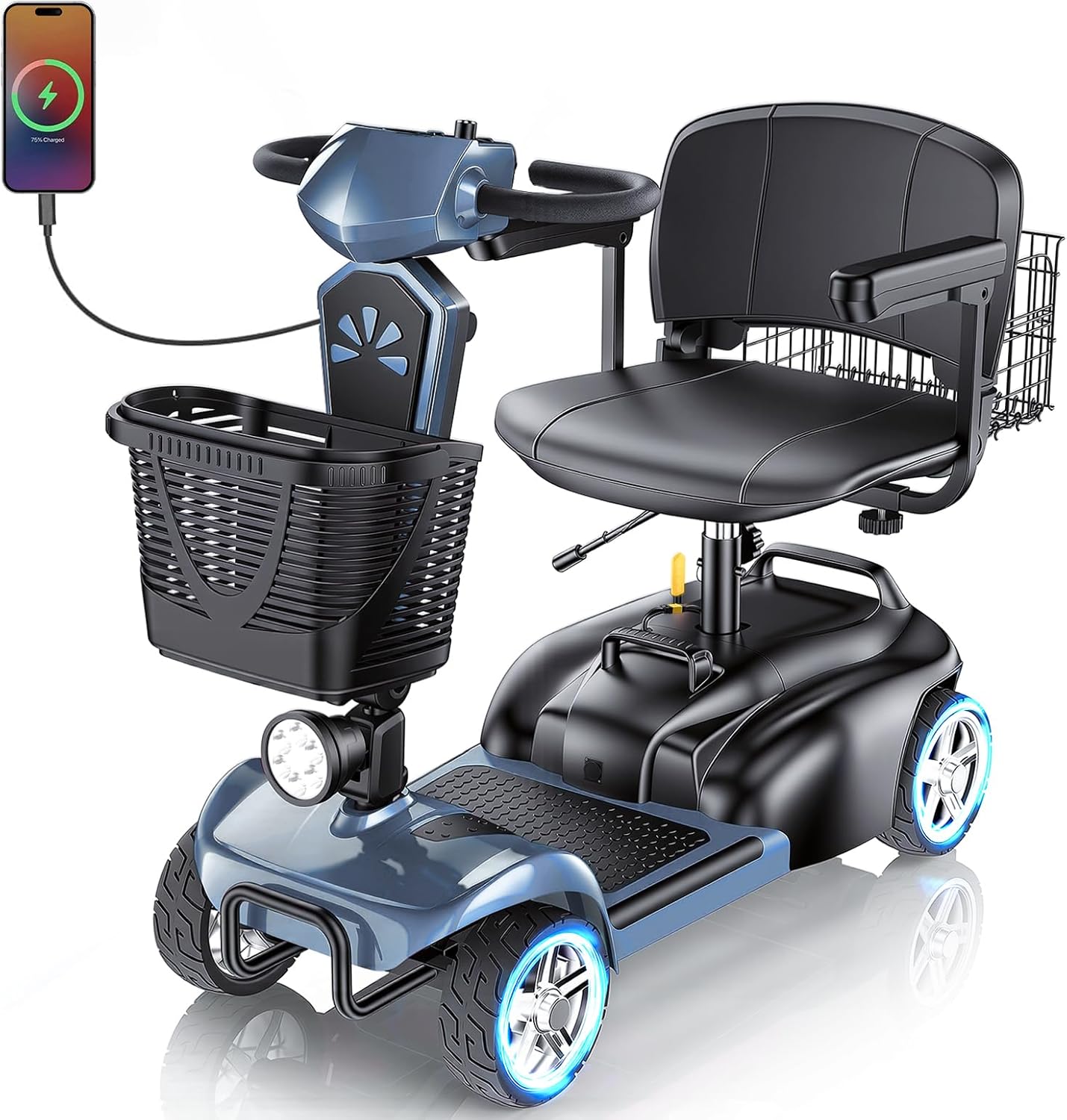
| WAYCARE Mobility Scooter for Adults & Seniors | 39.4 x 19.6 x 33.4 in | Not stated | 80.3 lb in feature details; 83 lb in dimensions |
| ONLYWIND Lightweight Mobility Scooter | 43.3 x 19.5 x 36.2 in | 38 x 20 x 13.5 in | 37.5 lb net, excluding battery; 48 lb in dimensions |
The WAYCARE is a four-wheel scooter with a 19.6 in width and a 19.6 x 18 x 16 in seat. Its listed total weight differs between 80.3 lb and 83 lb, so confirm which configuration applies before planning a lift.
This model suits someone who wants an adjustable seat and controls, a 330 lb capacity, and a scooter that folds and disassembles. Skip it if you need a verified folded measurement before deciding whether it fits your trunk; the folded size is not stated here.
{{product B0DY7F5VJV}} The 39.4 x 19.6 x 33.4 in dimensions give you a concrete reference for checking doorways and storage.
The ONLYWIND suits someone prioritizing a light frame, a stated folded size and a removable battery. Its net weight excludes the 4 lb battery, while the dimensions give a 48 lb weight, so plan for the full load rather than assuming the lighter figure is the lift weight.
Its folded measurements are useful for comparing with a trunk, but they do not guarantee a fit. Measure both the trunk opening and the inside space, and check whether you can lift the scooter into place.
{{product B0H891ZJZ8}} This product's 38 x 20 x 13.5 in folded size helps you compare the scooter with a trunk or storage area.
The BlessReach is a knee scooter for people recovering from foot, ankle, calf or knee injuries, including after some surgeries or amputation. Its adjustable knee pad and handlebar settings suit users from 5 ft 6 in to 6 ft 6 in, and it supports up to 300 lb.
Skip it if you need an electric mobility scooter for seated travel. The 19.5 x 15.2 x 11.5 in measurement is the package size, not the assembled footprint, so it cannot confirm a doorway or storage fit.
How do you choose a scooter size for your home?
Choose a scooter that clears your narrowest route and has enough room to turn at the tightest point. Start with the measurements that could rule out a model, then compare comfort and features.
If a doorway is the limit, compare the scooter's full width with the clear opening and keep some steering room. If a tight corner is the limit, use the model's turning measurement and the space available at that point.
For rider fit, check seat width, height and adjustability. A compact outside footprint does not guarantee a comfortable riding position.
The WAYCARE seat measures 19.6 x 18 x 16 in, while the ONLYWIND model has a wide padded seat and flip-up armrests.
Choose a different size or style if the scooter would only fit by removing a door, moving furniture each time or making an unsafe turn. A mobility scooter should work on the route you use every day.
Will a mobility scooter fit in a car trunk?
Compare folded dimensions with both the trunk opening and the usable space inside. A scooter's ready-to-ride length and width do not confirm that it will fit once folded.
Measure the opening at its narrowest point, including the height and any lip at the edge. Then measure the interior floor and height with the trunk closed.
Make sure there is room to lift the scooter in and out without twisting around obstacles.
The ONLYWIND folds to 38 x 20 x 13.5 in, which gives you dimensions to check against your car. WAYCARE folds and disassembles, but its folded size is not stated, so get that measurement before relying on it for trunk transport.
Also consider lifting. The ONLYWIND's 37.5 lb net figure excludes its battery, while the scooter is given as 48 lb in its dimensions.
The WAYCARE has two stated weights, 80.3 lb and 83 lb. Confirm the weight you will handle and ask about the heaviest removable piece.
How should you set up and store a scooter?
Set up the scooter in an open area, follow its assembly instructions and check clearances before riding through tight spaces. A short practice route helps reveal problems with doorway alignment, turning or parking.
If the scooter folds or comes apart, learn the folding or disassembly steps at home before planning a car trip. Keep the manual available and note which parts need to be removed, how they connect and where the battery goes.
Pick a storage spot that leaves room to park and access the scooter without blocking a walkway or exit. If the scooter is kept near a wall or under a shelf, include the handlebar and seat in your height check.
Store it where it can be kept dry and charged according to its instructions.
Keep the route clear of loose rugs, cords and small objects. Check the wheels, brakes and controls before a ride, and don't carry bags in a way that blocks the controls or your view.
What mistakes lead to a poor size choice?
The most common mistake is measuring only one doorway or relying on a model label instead of checking the full route. Small errors add up when the scooter must turn, park and travel in a vehicle.
Avoid these shortcuts:
- Using the door slab width: measure the clear opening inside the frame.
- Checking width but not turning space: a scooter can pass a doorway and still fail at the corner beyond it.
- Using ready-to-ride size for trunk fit: folded size and trunk opening matter for loading.
- Assuming folding means lightweight: check the total weight and the heaviest piece you must lift.
- Comparing inconsistent weights: confirm whether each figure includes the battery and other removable parts.
- Treating package dimensions as scooter dimensions: package size does not show the assembled footprint.
- Ignoring rider fit: seat and tiller position can matter as much as the scooter's outside width.
Measure again if you change the route, add a basket or accessory, or move the scooter to a different storage area. An attachment can extend beyond the original footprint.
Which mobility scooter dimensions should decide your choice?
Let your tightest doorway, smallest turning area and hardest transport step decide the size. Then choose among the models that fit those limits.
Choose the WAYCARE if its width and riding dimensions suit your home, you want an adjustable seat and controls, and you can confirm a safe plan for its transport weight. Choose the ONLYWIND if you need a stated folded size and removable battery, and its full weight works for your loading plan.
Choose the BlessReach only if you need a knee scooter for an injury or recovery, not powered seated mobility. Its package size cannot stand in for assembled dimensions.
Before buying, write down the narrowest opening, tightest turn, storage space, trunk opening and maximum weight you can manage. Compare those numbers with the exact model and setup.
For other mobility needs, see our electric mobility scooter guide.
Frequently asked questions
What are typical mobility scooter dimensions?
Compact mobility scooters can be around 38–44 in long and 19–21 in wide, but these are only rough examples. Full-size and heavy-duty models may need more room, and dimensions vary by model and setup.
Compare the exact ready-to-ride size with your route.
Use folded dimensions for storage and transport.
How wide is a mobility scooter?
Some compact models are about 19–21 in wide, but a model's total width can include parts that extend beyond its main body. Check the stated width and measure your narrowest doorway, hallway and lift opening.
Leave room to steer as you pass through, especially at a doorway with a turn close by.
How much does a mobility scooter weigh?
Weight depends on the frame, battery and configuration. Check whether the stated weight includes the battery, and look for the weight of each removable piece if you need to load the scooter into a vehicle.
Plan around the heaviest part you must lift, not only the assembled total.
What is the difference between folded and assembled dimensions?
Assembled dimensions describe the scooter ready to ride. Folded dimensions describe its size after folding, while a disassembled scooter may have separate dimensions and weights for each piece.
Use ready-to-ride measurements for doors and driving space.
Use folded or piece-by-piece measurements for storage and transport.
Will a mobility scooter fit through a standard doorway?
It may, but the model's width alone can't confirm a fit. Measure the narrowest clear opening, including the door frame and any parts that extend beyond the body.
Check the space on both sides of the doorway too.
The scooter needs room to line up and turn without scraping.