What Is a Quad Cane and Who Needs One?
A quad walking cane is a cane with a four-point base that rests on the floor, giving it a wider footprint than a single-point cane. It may suit someone who needs walking support and wants a base that can stand on its own.
On this page (7 sections)
A quad walking cane has 4 points at its base instead of one, creating a wider footprint that can stand on its own. It may suit someone who needs walking support and wants a cane that stays upright when set down.
The four feet change how the cane rests on the floor, but they don't make it a walker or guarantee better balance. Your mobility, grip, walking space, and ability to lift and place the cane all matter.
What is a quad cane and how does it work?
A quad cane has a handle, a shaft, and a base with 4 floor-contact points. The feet spread around the bottom of the cane, and the base stays attached as you lift and place it while walking.
The larger base can stand without leaning against a wall or chair. That may make it easier to reach for the cane when seated, though the base may take up more space than a single tip.
“Quad cane” describes the base, not one exact design. Bases vary in footprint and shape, and the way a cane is built can affect how it fits into your routine.
Who may benefit from a quad walking cane?
A quad walking cane may suit someone who needs one-handed support while walking and wants a base that can stand upright between steps. It could be worth considering if a single-point cane feels too narrow for the support you need.
A cane isn't right for every balance or mobility concern. If you have trouble standing, need help on both sides, or can't safely lift and position a cane, ask a health professional whether a walker or another aid fits better.
Compare canes, walkers, and other mobility aids for seniors if you're still deciding what type of support to explore. If you use a mobility scooter and are considering how one hand affects its controls, read Can You Use a Mobility Scooter with One Hand?.
Is a quad cane easier to keep upright?
A quad cane's four-point base can stand on its own when placed on a suitable surface. That may be useful when you want to sit without propping the cane against something.
Standing upright doesn't mean the cane can't tip or slip. Place it carefully and follow its instructions for surfaces and use.
What types of quad canes are there?
Quad canes vary in base size, handle design, height adjustment, and whether the cane folds. Those details affect where it fits and how easy it is to carry or position.
A larger footprint may appeal if you want a broader base, but it can be awkward in narrow halls or crowded spaces. A compact base may take less room while still giving you four contact points.
Some canes have an offset handle, which sits over the shaft rather than directly above it. Others fold for storage or travel.
See our Vive folding cane review for one example.
Check that the cane's design and adjustment range suit your height and routine.
The NOVA Offset Quad Cane for Seniors has a foam handle, wrist strap, anti-rattle lock, and a base designed to stand on its own. Its height adjusts from 28 to 39 in, and it has a stated capacity of 300 lb.
How does a quad cane compare with other walking aids?
A quad cane has four floor-contact points in one base, while other aids use different base shapes or give your hands more contact points. The right comparison depends on how much support you need and how much room you have to move the aid.
A tripod cane has three points at its base. See quad cane vs tripod cane for a closer look at that difference.
A single-point cane has one tip and a narrower footprint. For another cane option, read the Honey Bull walking cane review.
If you're comparing those styles, read quad cane vs single-point cane.
A walker has a wider frame that you hold with both hands. Compare quad cane vs walker for balance if you're weighing a one-handed cane against a two-handed aid.
A hemi walker is another option to discuss when you need a support aid used on one side. Our quad cane vs hemi walker comparison explains how their shapes differ.
How is a quad cane different from a Hurrycane?
“Quad cane” refers to a cane with a four-point base, while HurryCane is a brand name associated with a folding cane. The HurryCane Freedom Edition Foldable Walking Cane has a three-point contact base, so it isn't the same base design as a four-point quad cane.
It adjusts from 30.5 to 37.5 in and folds to 13.7 in. For a fuller comparison of the styles, see quad cane vs Hurrycane.
What should you consider before choosing a quad cane?
Check height fit, grip comfort, base footprint, and whether you can place it steadily. The cane should suit both your body and the spaces where you walk.
A quad base may feel cumbersome on stairs or in tight spaces. Think about doorways, bathroom layouts, and how you carry or store the cane before choosing one.
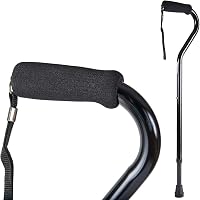
The DMI Walking Cane and Walking Stick is an adjustable single-point cane rather than a quad cane. It adjusts from 30 to 39 in and includes an ergonomic soft offset handle and wrist strap.
It may be useful if you're comparing a simpler base style.
For any cane, make sure you can grip the handle and lift the base comfortably. Ask a clinician or mobility specialist to help with fit if you have pain, weakness, or a recent change in balance.
How do you use a quad cane safely?
Use a quad cane only after confirming that its height and technique suit you. A clinician can show you which hand to use and how to place the base for your walking pattern.
Keep all four feet on the floor when placing the cane, and avoid rushing the step. Get guidance on stairs, uneven ground, and other situations where the base may not sit flat.
For more detail, follow our guide on how to use a quad cane properly. If the cane slips, feels unstable, or is difficult to move, stop and ask for help with fit or device choice.
What is a quad cane best used for?
A quad cane may suit someone who needs one-handed walking support and wants a wider, self-standing base. Its four points distinguish it from a single-point cane, but the wider footprint may be less convenient in tight spaces.
Compare the quad base with a tripod cane if you want fewer contact points, or a walker if you need a device held with both hands. Choose a cane only if you can position it safely, and ask a clinician for guidance when your support needs are uncertain.
Frequently asked questions
What is a quad cane?
A quad cane is a walking cane with 4 contact points at its base instead of 1. Its wider base can stand on its own and has a different footprint from a straight cane, but the user still needs to lift and place it with each step.
Who should use a quad cane?
A quad cane may suit someone who needs walking support and wants a wider base that can stand independently. The right aid depends on walking ability, hand strength, balance needs, and where it will be used, so ask a clinician if you're unsure.
Is a quad cane better than a regular cane?
A quad cane has a wider, self-standing base, while a regular single-point cane is narrower and may be easier to move through tight spaces. Neither is best for everyone.
Consider how much support you need and whether you can place the base steadily with each step.
Can a quad cane replace a walker?
A quad cane doesn't provide the same two-hand support as a walker. It may suit someone who needs one-handed walking support, while a walker may fit someone who needs both hands on an aid.
A clinician can help match the device to your needs.