9 Best Upright Walkers for Short People (November 2026)
The best upright walkers for short people include the ELENKER Upright Walker for multi-point fit, the Helavo Upright Walker with Seat for padded arm support, and the Vive Mobility Upright Walker with Seat for users over 5 ft.
On this page (8 sections)
- Which upright walkers fit short people best?
- Best upright walkers for short people
- How do you choose an upright walker for a short person?
- How can you check an upright walker’s fit at home?
- What should short seniors compare before choosing?
- What setup and care habits help an upright walker?
- What mistakes should you avoid when buying an upright walker?
- Which upright walker should a short person choose?
The best upright walker for short people is HOMLAND if you need a published fit range below 5 ft. Its user-height range begins at 4 ft 9 in, and it gives separate adjustment ranges for arm support and seat height.
Shorter stature alone does not determine the right fit. Your forearms need to rest comfortably on the supports, your hands need to reach the controls without hunching, and your feet should reach the floor when you sit.
For a broader look at frame styles, walking space and seats, read our walker for seniors buying guide. For more upright models, see the best upright walkers for seniors guide.
Our picks at a glance
-
1

-
2

-
3
- 4
 Check it
Agrish Narrow Walker Folding Upright Walker
Best for narrow doorways - 5
 Check it
ELENKER Upright Rollator Walker
Best for five-foot users - 6
 Check it
HOMLAND Upright Walker with Seat for Seniors
Best for under five feet - 7
 Check it
BlessReach Heavy Duty Upright Rollator Walker
Best for 300-pound users - 8
 Check it
VOCIC Z22 Upright Walkers for Seniors
Best for measured seat fit - 9
 Check it
LifeWalker UPWalker EZ Lite Upright Walker
Best for lighter lifting
Which upright walkers fit short people best?
HOMLAND has the lowest stated user-height minimum in this group, while the ELENKER and Vive models also publish user-height ranges. Other picks offer adjustable parts, but their stated measurements do not guarantee a minimum user height.
The most helpful comparison starts with your body measurements and daily routine. Decide whether you need a seat, whether the walker must fit through a narrow doorway, and how often someone will lift it into a vehicle.
The scores reflect how clearly each option’s stated features address a shorter buyer’s needs, including fit information, adjustment points, seating and practical handling. A listed frame adjustment is not a promise that every user will fit, so check arm position and seat height too.
| Product | Best for | Adjustment | Seat | Weight | Our score |
|---|---|---|---|---|---|
| ELENKER Upright Walker | multi-point fit | Forearm tube, handle bar and leg tube adjust | Padded, height adjustable, with backrest | 27 lb | 9.7 |
| Helavo Upright Walker with Seat | padded arm support | Height-adjustable handles; seat height up to 22 in | 18.9 in wide, 9.1 in deep | 22.7 lb | 9.7 |
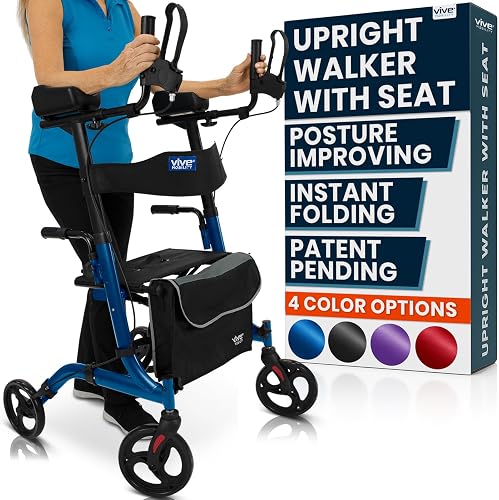
| Vive Mobility Upright Walker with Seat | users over 5 ft | Handles adjust from 45–52 in | 17.5 in wide | 20 lb | 9.5 |
| Agrish Narrow Walker Folding Upright Walker | narrow doorways | Height adjusts from 42–51 in | 11 lb | 9.4 | |
| ELENKER Upright Rollator Walker | five-foot users | Handlebar and seat heights adjust | 26 lb | 8.8 | |
| HOMLAND Upright Walker with Seat for Seniors | under five feet | Arm support adjusts from 37–47 in | Height adjusts from 20–23 in | 8.5 | |
| BlessReach Heavy Duty Upright Rollator Walker | 300-pound users | Handles have 6 adjustment levels | 27.2 lb | 8.3 | |
| VOCIC Z22 Upright Walkers for Seniors | measured seat fit | Handles 44–50 in; seat 20–22 in | 22.4 lb | 8.1 | |
| LifeWalker UPWalker EZ Lite Upright Walker | lighter lifting | Padded armrests adjust | 16.1 lb | 7.9 |
Best upright walkers for short people
The right choice depends on your height, arm position, need for a seat and available walking space. Use the fit details below to decide which models deserve an in-person check.
HOMLAND: best fit information for users under 5 ft
HOMLAND Upright Walker with Seat for Seniors: Best for under five feet
- Intended for users 4 ft 9 in–6 ft 4 in
- Arm support adjusts from 37–47 in
- Seat adjusts from 20–23 in
- 8 in puncture-proof wheels
HOMLAND has the lowest stated minimum user height in this group, with separate arm support and seat adjustments. It is the clearest starting point for a very short adult.
Pros
- Lowest stated minimum user height here
- Separate arm and seat adjustments
- Folds for transport and storage
Cons
- Steel frame
- No total folded dimensions are stated
HOMLAND is the clearest starting point for adults shorter than 5 ft because its intended user range begins at 4 ft 9 in. Arm support adjusts from 37–47 in, and seat height adjusts from 20–23 in.
The wide breathable backrest and memory foam seat provide a place to pause, while the storage bag carries personal items. The 8 in puncture-proof wheels swivel, and the frame folds for transport and storage.
Choose HOMLAND if you want the most specific low-height guidance in this group and need an integrated seat. Its steel frame weighs 24.5 lb, so it is not the best match if you must lift the walker frequently without help.
Skip it if you need exact folded dimensions before checking whether it fits in your car. Those dimensions are not stated, and the intended height range still needs an individual fit check.
ELENKER: best for several adjustable sections
ELENKER Upright Walker: Best for multi-point fit
- Adjustable forearm tube, handle bar and leg tube
- Adjustable padded seat with backrest
- 8 in solid PVC wheels
- Folds flat with one hand
Three adjustable frame sections give you several points to compare when one handle-height change is not enough. The padded seat and backrest add a place to rest.
Pros
- Three frame sections adjust
- Padded adjustable seat and backrest
- One-hand folding
Cons
- No user-height range is stated
- Heaviest stated weight among these picks
This ELENKER model adjusts at the forearm tube, handle bar and leg tube. That gives you more fit points to assess than a walker that only changes handle height.
It has a padded, height-adjustable seat and a backrest. An under-seat pouch, cane or umbrella holder, and one-hand folding design help with daily outings and storage.
Choose this model if you want multiple adjustable sections and a padded seat. It may suit someone whose arm position does not line up with a single handle adjustment.
Skip it if you need a published minimum user height or want the lightest walker to lift. The user-height range is not stated, and the frame weighs 27 lb.
Ask a mobility supplier to compare its settings with your standing and seated posture before committing.
Helavo: best for padded armrests and outdoor trips
Helavo Upright Walker with Seat: Best for padded arm support
- Height-adjustable ergonomic handles
- Padded armrests
- Seat height up to 22 in
- 10 in rubber front wheels
Adjustable handles and padded armrests give you two useful fit points. Check whether the seat's maximum height works with your leg length.
Pros
- Adjustable handles
- Soft padded armrests
- Parking brake
Cons
- No minimum user height is stated
- Seat height is given as a maximum
Helavo combines height-adjustable ergonomic handles with soft padded armrests, so you can compare hand and forearm fit. The seat is 18.9 in wide and 9.1 in deep, with a maximum height of 22 in.
Its 10 in rubber front wheels are described as cushioned and puncture-proof. A parking brake, cane holder and cup holder add practical features for trips outside.
Choose Helavo if padded armrests and a resting seat are priorities, and a supplier confirms the fit. It weighs 22.7 lb and supports users up to 300 lb.
Skip it if you need a stated minimum user height or a full seat adjustment range to compare before buying. Helavo gives a maximum seat height but no minimum user height.
The upright walkers with seats guide compares more options with seating.
Vive: best for users within its stated range
Vive Mobility Upright Walker with Seat: Best for users over 5 ft
- Intended for users 5 ft 2 in–6 ft 4 in
- Handle height adjusts from 45–52 in
- Adjustable forearm pads
- 17.5 in seat
Vive gives a specific user-height range and adjustable forearm pads. Its stated lower end is 5 ft 2 in, so compare that with your height and arm position.
Pros
- Published user-height range
- Forearm pads adjust forward and back
- Folds for transport
Cons
- Stated range starts at 5 ft 2 in
- No seat height range is stated
Vive gives an intended user-height range of 5 ft 2 in to 6 ft 4 in, with handle height adjusting from 45–52 in. Its forearm pads move forward and back, which is useful when arm length also affects where you rest your weight.
The seat is 17.5 in wide. The walker weighs 20 lb, folds for transport, and has flat-free wheels, loop brakes and a detachable shoulder bag.
Choose Vive if you are within its stated height range and want a walker with a clear user-height reference. It is easier to screen for fit than options with no user-height range.
Skip it if you are below 5 ft 2 in unless a fit check confirms it works for you. That is the stated lower limit, and no seat-height range is given.
Agrish: best for narrow doorways and low carry weight
Agrish Narrow Walker Folding Upright Walker: Best for narrow doorways
- Height adjusts in 10 positions from 42–51 in
- Width adjusts from 18–22 in
- Four-length adjustable armrests
- 11 lb
Agrish combines a defined frame-height range with adjustable width down to 18 in. The frame range is not a user-height range, so get help checking the fit.
Pros
- 10 height positions
- Adjustable width
- Removable armrests
Cons
- No seat
- Frame height does not confirm user-height fit
Agrish offers a frame-height range of 42–51 in across 10 settings, a width adjustment from 18–22 in, and four armrest length settings. At 11 lb, it is the lightest model in this roundup.
The narrowest 18 in setting can help where a wider walker would not pass through a doorway. The armrests can also be removed.
Choose Agrish if a narrow frame and lighter lifting matter more than an integrated seat. It is the only pick here with a stated adjustable width range.
Skip it if you need a seat or assume frame height proves user-height fit. The dimensions describe the walker, not a matching user-height range.
Ask a mobility supplier to help compare the settings with your arms and posture.
ELENKER Upright Rollator: best for users from 5 ft
ELENKER Upright Rollator Walker: Best for five-foot users
- Adaptable for users from 5–6 ft
- Adjustable handlebar and seat heights
- 10 in wheels
- Cushioned seat and backrest
ELENKER states a user-height range beginning at 5 ft and describes adjustable handlebar and seat heights. It suits shorter users who want a seat, provided the fit works in person.
Pros
- Stated range begins at 5 ft
- Handlebar and seat heights adjust
- Seat and backrest are cushioned
Cons
- No exact adjustment range is stated
- Weighs 26 lb
This ELENKER model is intended for users from 5–6 ft and has adjustable handlebar and seat heights. Its cushioned seat and backrest are paired with a front pouch, under-seat basket, cup holder and cane holder.
The 10 in wheels have a traction pattern, and the walker weighs 26 lb. Exact handle and seat adjustment ranges are not stated, so the user-height range is a screening aid rather than a complete fit guide.
Choose it if you are at least 5 ft and want an adjustable seat with several ways to carry essentials. It offers a clear lower height reference for someone who is short but above the minimum.
Skip it if you are below 5 ft or need exact adjustment measurements before deciding. HOMLAND has the lower stated minimum, and a fit check can resolve questions about this model’s settings.
BlessReach: best for added weight capacity
BlessReach Heavy Duty Upright Rollator Walker: Best for 300-pound users
- Supports up to 300 lb
- Six-level adjustable handles
- 8 in PU wheels
- Seat and adjustable backrest
Six handle settings allow adjustment, while the seat and adjustable backrest provide a resting option. No user-height range or exact handle heights are stated.
Pros
- Six handle settings
- Seat and adjustable backrest
- Supports up to 300 lb
Cons
- No minimum user height is stated
- Walker weight is 27.2 lb
BlessReach supports up to 300 lb and has six handle adjustment levels. The seat and adjustable breathable backrest provide a rest option, while a cup holder and large-capacity bag hold small essentials.
Its front wheels swivel, and the 8 in PU wheels are described for varied surfaces. The walker weighs 27.2 lb.
Choose it if you need the stated 300 lb capacity and want six handle settings. Have someone confirm that a setting allows relaxed shoulders and comfortable reach.
Skip it if you need published handle heights or a minimum user-height range to judge fit. Neither is stated, and its weight makes frequent lifting a consideration.
VOCIC Z22: best for comparing seat and handle measurements
VOCIC Z22 Upright Walkers for Seniors: Best for measured seat fit
- Handle height adjusts from 44–50 in
- Seat height adjusts from 20–22 in
- Adjustable arm support
- 8 in wheels
VOCIC publishes both handle and seat ranges, giving you measurements to compare with your posture and leg length. It requires hand grip strength and upper-body mobility.
Pros
- Handle and seat ranges are stated
- Adjustable arm support
- 8 in wheels
Cons
- No user-height range is stated
- Requires hand grip strength and upper-body mobility
VOCIC publishes handle height from 44–50 in and seat height from 20–22 in. The arm support also adjusts, giving you several measurements to compare against your height, arm position and seated leg length.
The walker weighs 22.4 lb, has 8 in wheels and supports up to 300 lb. It uses hand brakes only, so the user needs adequate grip strength and upper-body mobility to operate them.
Choose VOCIC if you want both seat and handle measurements and can use hand brakes comfortably. A mobility supplier can help decide whether the ranges fit your proportions.
Skip it if hand-brake operation is difficult or you need a published user-height range. Neither an adjustable arm support nor a stated handle range removes the need to check the walker in person.
LifeWalker: best for lifting into a car
LifeWalker UPWalker EZ Lite Upright Walker: Best for lighter lifting
- 16.1 lb
- Adjustable padded armrests
- Seat with backrest
- Folds for transport
LifeWalker is the lightest option here by stated weight and includes padded armrests, a seat and backrest. Check the fit before choosing it for a shorter user because height ranges are not given.
Pros
- Lightest stated weight here
- Adjustable padded armrests
- Seat and backrest
Cons
- No user-height range is stated
- No handle or seat height range is stated
LifeWalker weighs 16.1 lb, the lowest stated weight among the seated walkers here. It has adjustable padded armrests, a seat and backrest, hand brakes, a personal bag and a beverage holder.
The walker folds for transport and supports up to 300 lb. Its multi-terrain wheels are intended for everyday use, but no handle or seat height ranges are given.
Choose LifeWalker if lifting weight is a major concern and you want a folding walker with a seat. Its low stated weight may make car loading easier for a caregiver.
Skip it if you cannot confirm arm and seat fit before purchase. No minimum user height or exact handle and seat ranges are stated.
How do you choose an upright walker for a short person?
Choose by comparing your standing arm position, the walker’s support height, seat height and width. Start with fit, then consider storage, weight and the surfaces where you expect to walk.
First, measure yourself in the shoes you normally wear. Stand straight with your arms relaxed, then note where your forearms meet the supports and where your hands fall.
A clinician or mobility supplier can help make those measurements useful when a brand gives frame dimensions instead of a user-height range.
Next, decide whether you need a seat. If you plan to sit during outings, check the seat height and width, and consider whether your feet can rest flat on the floor.
A seat that is comfortable but too high for your legs may be awkward to use.
Then look at your home and transport routine. Measure doorway clearances and tight turns, and check whether a folded walker will fit in the space where you plan to store it.
If you or a caregiver will lift it into a car, compare the walker’s weight with what is manageable.
Finally, check the brakes and wheels against your needs. Make sure you can squeeze and lock the brakes, and ask whether the wheels suit the surfaces you use most.
A clinician or supplier can help assess fit and safe operation if balance, strength or coordination is a concern.
How can you check an upright walker’s fit at home?
You can do an initial fit check by comparing your standing arm position with the walker’s adjustment range. Wear your usual shoes, stand upright and let your arms hang naturally before checking where your hands and forearms meet the supports.
When you rest your forearms on the pads, your shoulders should not be pulled up, and you should not need to lean forward to reach the handles. If the setting makes you hunch, twist or stretch, stop and ask for a fit adjustment.
Check the seat separately. Sit with your back supported and see whether your feet rest on the floor without your knees being pushed upward.
Compare that position with any published seat-height range, and remember that a seat measurement does not tell you whether the arm supports will fit.
Try steering and turning in a clear area before using the walker around furniture or outdoors. Practice the brake actions while stationary, including applying the parking brake before sitting if the model has one.
Ask a mobility supplier or physical therapist to check posture, reach and brake use if you are unsure.
For setup help after choosing a model, follow its manual and our guide on how to assemble an upright walker. If you see different names while comparing styles, read what an upright walker is called.
What should short seniors compare before choosing?
Short seniors should compare user-height guidance, support adjustment, seat position, total width and weight. These details answer practical questions that a general “adjustable” label cannot.
A stated user-height range is useful for narrowing the field, but it does not replace a fit check. For example, HOMLAND starts at 4 ft 9 in, ELENKER starts at 5 ft on one model, and Vive starts at 5 ft 2 in.
Each person’s arm length and leg length still affect how a walker feels.
Check whether the published measurement refers to the handle, arm support, seat or full frame. These are not interchangeable.
A frame height such as Agrish’s 42–51 in range does not tell you which user height will be comfortable.
For the home, measure the narrowest doorway and the turning area. Agrish gives an adjustable width of 18–22 in, while the other models here do not provide a comparable adjustable width range.
Also check any folded dimensions you need for storage or a vehicle.
Think about how you will use the walker outside the home. A heavier model may be manageable if it stays in one place, but difficult if it must be lifted into a car.
If a wheeled mobility aid for longer trips better matches your needs, compare mobility scooters for short adults and mobility scooters for short people.
What setup and care habits help an upright walker?
A careful setup starts with the manual and a level, open space. Assemble the frame as directed, confirm each adjustment is locked, and check that the wheels and brakes move as expected before the first walk.
Set both sides evenly unless the instructions specify otherwise. Uneven support height can encourage leaning, and an unprotected adjustment can shift while you walk.
Keep the seat and storage bag clear of loose items that could interfere with folding or the wheels.
Before each use, look for loose adjustment pins, damaged grips, worn wheel surfaces and brake cables or levers that do not respond normally. Apply the parking brake before sitting, if the walker has one, and confirm it holds the wheels still.
Keep wheels free of hair, string and debris. Wipe the frame and padded surfaces with a soft cloth and a cleaner suitable for the materials, then dry them before storage.
Avoid changing or lubricating parts unless the manual recommends it, and contact the manufacturer or a mobility supplier if a brake or frame part is damaged.
What mistakes should you avoid when buying an upright walker?
The biggest mistake is treating “adjustable” as proof that a walker fits. Check which part adjusts and what its range means, then compare it with your own posture.
Do not choose by overall height alone. Two people of the same height can have different arm and leg proportions, which affects both support position and seat comfort.
A walker with a user-height range is a useful starting point, not a substitute for checking.
Do not ignore brake operation. If you cannot comfortably squeeze the hand brakes or lock the wheels, a model that otherwise seems to fit may not be practical.
VOCIC specifically requires hand-brake use and sufficient grip strength and upper-body mobility.
Do not assume every upright walker includes a seat. Agrish does not, while the other models in this roundup do.
If sitting is important, check seat height and width rather than relying on a product name.
Finally, do not overlook lifting and storage. A walker can fold and still be too heavy or too large for your car or home.
Check the weight and any needed folded measurements before purchase, and plan who will handle it.
Which upright walker should a short person choose?
Choose HOMLAND if you are under 5 ft and want the lowest stated user-height range, with separate arm and seat adjustments. Choose the first ELENKER if you want several adjustable frame sections and can confirm its fit, or the second ELENKER if you are at least 5 ft and want a seat with adjustable height.
Choose Vive if you fall within its stated 5 ft 2 in–6 ft 4 in range and want a published user-height guide. Pick Agrish when a narrow width and lower carry weight matter more than having a seat.
Consider Helavo for padded armrests, BlessReach for its stated capacity, VOCIC for published seat and handle measurements, or LifeWalker when low lifting weight is a priority.
For the best upright walker for short people, use the stated height range to narrow the choices, then confirm arm support, handle reach, seat position and brake use. If a model does not publish a user-height range, ask a mobility supplier to check its adjustment measurements with you before you buy.
Our top 3 picks at a glance
-
1
-
2
-
3
Frequently asked questions
What height should an upright walker be for a short person?
The right height depends on your arm position and the walker's adjustment range. Compare the handle or arm support height while standing in your usual shoes, with your shoulders relaxed and elbows slightly bent.
Ask a physical therapist or mobility supplier to help check the fit if you're unsure.
Which upright walker has the lowest stated user height?
HOMLAND states a user-height range beginning at 4 ft 9 in. ELENKER gives a range beginning at 5 ft, while Vive starts at 5 ft 2 in.
Those ranges help narrow the choices, but your arm and seat fit still matter.
Are upright walkers adjustable for short seniors?
Some are. Check which parts adjust: handle height, arm support, frame height and seat height can all affect fit, and brands do not always publish the same measurements.
Compare the measurements with your posture and leg length before choosing.
Can a short person use an upright walker with a seat?
Yes, if the handles or arm supports and the seat fit. HOMLAND gives an arm support range of 37–47 in and a seat range of 20–23 in, while Helavo states a maximum seat height of 22 in.
Check that your feet rest on the floor when seated.
What should short seniors compare before buying an upright walker?
Check the minimum adjustment height, the distance between the supports, seat height if included, total width and folded size. Also consider whether you can operate the brakes and lift the walker when needed.
Arrange a fit check with a mobility supplier or clinician if you can.