9 Best Upright Walkers for Seniors (October 2026)
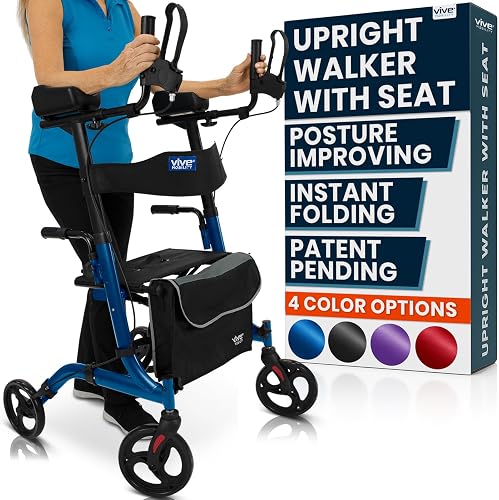
The best upright walkers for seniors include the ELENKER Upright Walker for adjustable support, the Helavo Upright Walker with Seat for outdoor breaks, and the Vive Mobility Upright Walker with Seat for taller users.
On this page (7 sections)
- How did these upright walkers for seniors compare?
- Which upright walker fits your support and travel needs?
- What should you measure before choosing an upright walker?
- How do you choose between a seated and non-seated frame?
- How should you set up and use an upright walker?
- What common upright walker buying mistakes should you avoid?
- Which upright walker should you choose?
The best upright walker for seniors depends on fit, support style, and daily routes. ELENKER is a versatile seated pick, Agrish suits tighter indoor spaces, and the wide Helavo is designed for people who need more seat width and a higher capacity.
An upright walker offers forearm supports and vertical handles for an upright walking position. Decide if you need a seat, how much room you have to turn, and whether you can operate the brakes and lift the frame when folded.
If you’re comparing mobility aids, our walkers and rollators buying guide explains common frame styles. You can also review what an upright walker is called to compare terms used for similar designs.
Our picks at a glance
-
1

-
2

-
3
- 4
 Check it
Agrish Narrow Walker Folding Upright Walker
Best for narrow doorways - 5
 Check it
Helavo 28.3" Extra Wide Bariatric Upright Walker
Best for wider seating - 6
 Check it
ELENKER Upright Rollator Walker
Best for storage on outings - 7
 Check it
BlessReach Heavy Duty Upright Rollator Walker
Best for adjustable brakes - 8
 Check it
CareCrew Upright Walkers for Seniors
Best for indoor grip options - 9
 Check it
VOCIC Z22 Upright Walkers for Seniors
Best for cushioned armrests
How did these upright walkers for seniors compare?
We compared adjustability, arm support, seating, wheel type, stated capacity, folding, and weight. The most useful choice depends on how those details match your body and routine.
A long feature list cannot make a poor fit comfortable. Measure your doorways, check how far the frame extends when turning, and consider whether you can manage its brakes and folded weight without help.
| Product | Best for | Wheels | Weight | Seat | Our score |
|---|---|---|---|---|---|
| ELENKER Upright Walker | adjustable support | 8 in solid PVC | 27 lb | Height-adjustable padded seat with backrest | 9.7 |
| Helavo Upright Walker with Seat | outdoor breaks | 10 in rubber front wheels | 22.7 lb | 9.7 | |
| Vive Mobility Upright Walker with Seat | taller users | 20 lb | 9.5 | ||
| Agrish Narrow Walker Folding Upright Walker | narrow doorways | 11 lb | 9.4 | ||
| Helavo 28.3" Extra Wide Bariatric Upright Walker | wider seating | 24.91 lb | 9.2 | ||
| ELENKER Upright Rollator Walker | storage on outings | 10 in | 26 lb | 9.1 | |
| BlessReach Heavy Duty Upright Rollator Walker | adjustable brakes | 8 in PU | 21 lb | 8.3 | |
| CareCrew Upright Walkers for Seniors | indoor grip options | 11.36 lb | 8.1 | ||
| VOCIC Z22 Upright Walkers for Seniors | cushioned armrests | 22.4 lb | 8.0 |
Which upright walker fits your support and travel needs?
The right pick depends on how you walk, where you plan to go, and whether you need to rest. These models cover adjustable seated support, narrower indoor routes, larger seating, and different grip arrangements.
ELENKER Upright Walker: Best for adjustable support
- Adjustable forearm tubes, handlebar, and leg tubes
- Padded seat and backrest
- 8 in solid PVC wheels
- One-hand folding
Adjustable forearm tubes, handlebar, and leg tubes let you set the frame for a more natural posture. A padded seat and backrest provide a place to rest.
Pros
- Several frame sections adjust
- Padded seat and backrest
- Folds flat with one hand
Cons
- Weighs 27 lb
- Seat and frame dimensions need to fit your home and transport space
ELENKER is a good starting point if you want several frame sections to adjust. The forearm tubes, handlebar, and leg tubes can each be set to suit your posture.
Its padded seat and backrest provide a place to pause, and the under-seat pouch keeps personal items close. A cane or umbrella holder and one-hand folding are useful for errands or storage.
The 8 in solid PVC wheels and dual brake system are designed for rolling and seated use. Check the route and frame fit before taking it through narrow rooms or over uneven ground.
Choose it if you want adjustable forearm support and a seat. Skip it if lifting a 27 lb frame would be difficult and no one can help with transport.
Helavo Upright Walker with Seat: Best for outdoor breaks
- 10 in rubber front wheels
- Padded armrests and seat
- Height-adjustable handles
- Parking brake
The rubber front wheels and padded armrests suit buyers who want upright support on outdoor trips. It also has an adjustable seat and backrest for breaks.
Pros
- 10 in rubber front wheels
- Padded seat and adjustable backrest
- Cup holder and cane holder
Cons
- Frame is 26.4 in wide
- Confirm seat height and doorway clearance before choosing
Helavo suits seniors who want rubber front wheels and a seat for outdoor trips. Its 10 in front wheels pair with padded armrests and height-adjustable handles.
The walker weighs 22.7 lb and supports users up to 300 lb. Its adjustable seat and backrest give you a place to rest, while a cup holder and cane holder keep essentials nearby.
At 26.4 in wide, it may not pass through every doorway or turn easily in a crowded room. Measure the narrowest opening and route before buying.
Choose it for outdoor outings with planned rest stops. Skip it if your home has tight doorways and you cannot store it elsewhere.
Vive Mobility Upright Walker with Seat: Best for taller users
- Handle height adjusts from 45 to 52 in
- For heights 5 ft 2 in to 6 ft 4 in
- 8 in flat-free wheels
- Folds for transport
Vive gives a stated height range of 5 ft 2 in to 6 ft 4 in, plus a 17.5 in seat. Its 20 lb frame folds for storage or car transport.
Pros
- Published handle and user height ranges
- 17.5 in seat
- Folds for transport
Cons
- Handle adjustment may not fit users outside its stated range
- Check folded size against your vehicle
Vive Mobility publishes a user height range of 5 ft 2 in to 6 ft 4 in, with handles that adjust from 45 to 52 in. That makes it easier to screen for fit before weighing other features.
The walker weighs 20 lb and folds for storage in a trunk or back seat. It has 8 in flat-free wheels, forearm pads that adjust forward and backward, loop brakes, and a 17.5 in seat.
Its stated capacity is 300 lb. Choose it if you fall within the stated height range and want a folding seated walker.
Skip it if you need a setting outside that range; compare the actual handle and seat heights with your posture first.
Agrish Narrow Walker Folding Upright Walker: Best for narrow doorways
- Adjustable width from 18 to 22 in
- 10 handle-height settings from 42 to 51 in
- Removable armrests
- One-touch folding
Agrish lets you adjust the frame width from 18 to 22 in and remove the armrests to switch to standard walker mode. Its 11 lb weight is the lowest among these picks.
Pros
- Width adjusts for tighter spaces
- Armrests can be removed
- One-touch folding
Cons
- No seat
- Check the correct width and support mode for each use
Agrish is a strong fit if you need a narrow frame or want removable armrests. Its width adjusts from 18 to 22 in, and removing the armrests changes it to standard walker mode.
The 11 lb frame folds with a one-touch button. Handle height has 10 settings from 42 to 51 in, and it supports up to 450 lb.
This walker has no seat, so it is a poor match if you need to rest during longer outings. Check the chosen width in your walking configuration, since the narrowest setting may not suit your stance.
Choose it for narrow routes and easier lifting. Skip it if a seat is essential or its height range does not fit you.
Helavo 28.3" Extra Wide Bariatric Upright Walker: Best for wider seating
- 28.3 in frame width
- 20.1 in seat width
- 500 lb capacity
- Height-adjustable handles and seat
The extra-wide frame has a 20.1 in seat and a stated 500 lb capacity. Handle height adjusts from 41.5 to 47.6 in.
Pros
- Wider seat than the other listed seated picks
- Highest stated capacity here
- Adjustable padded backrest
Cons
- 28.3 in width needs careful doorway checks
- Weighs 24.91 lb
Helavo’s extra-wide model is intended for people who need a wider seat and higher capacity. Its seat is 20.1 in wide, and it supports users up to 500 lb.
Handle height adjusts from 41.5 to 47.6 in, and seat height adjusts from 20.9 to 22.8 in. The walker weighs 24.91 lb, folds for storage, and has a 28.3 in frame width.
That width can rule it out in a home with narrow doorways or limited turning space. Measure the entry, halls, and the path to your usual resting place before choosing.
Choose it when seat width and capacity lead your priorities. Skip it if the frame cannot clear your home’s tightest passage.
ELENKER Upright Rollator Walker: Best for storage on outings
- 10 in wheels
- Cushioned seat and backrest
- Adjustable handlebar and seat heights
- Front pouch and under-seat basket
ELENKER pairs 10 in wheels with adjustable handlebar and seat heights. A cushioned seat, backrest, front pouch, and under-seat basket support trips with rest stops.
Pros
- 10 in wheels
- Cushioned seat and backrest
- Several storage options
Cons
- Weighs 26 lb
- Confirm the frame fits your doorways
This ELENKER pairs 10 in wheels with a cushioned seat and backrest. It suits seniors who want to rest during outings and keep more items close at hand.
The handlebar and seat height adjust, and you can set the handgrip angle. A front pouch, under-seat basket, cup holder, and cane holder make it easier to carry daily essentials without holding them.
It is designed for users from 5 to 6 ft tall. Compare that range with your measurements, and check whether the 27 in frame width works for your doorways.
Choose it for wheel size and storage options. Skip it if lifting a 26 lb walker into a vehicle would be a problem.
BlessReach Heavy Duty Upright Rollator Walker: Best for adjustable brakes
- 8 in PU wheels
- Padded seat and adjustable backrest
- 6-level adjustable handles
- 300 lb capacity
BlessReach combines padded armrests and 6-level adjustable handles with a seat and 8 in PU wheels. It weighs 27.2 lb.
Pros
- Adjustable handles and backrest
- Seat and storage bag
- Dual braking system
Cons
- Confirm frame dimensions for your home
- Check that the brake controls suit your grip
BlessReach combines padded armrests, 6-level adjustable handles, and a seat with an adjustable backrest. It has 8 in PU wheels and supports up to 300 lb.
The walker includes a storage bag and cup holder. Its dual braking system uses a lever for gradual slowing and a pull-down lock for stopping or parking.
The listed dimensions do not clearly give the full operating width and depth. Confirm the assembled size before relying on it in a tight space.
Choose it if you want a seated model with adjustable handles and two brake actions. Skip it if the controls are hard for you to grip or operate.
CareCrew Upright Walkers for Seniors: Best for indoor grip options
- Padded forearm supports
- Three grip levels
- Narrow indoor frame
- Folding steel frame
CareCrew offers forearm supports, standard handgrips, and lower grips for standing from a chair or bed. Its steel frame folds for storage.
Pros
- Three support positions
- Narrow frame for indoor spaces
- Tool-free height adjustment
Cons
- No seat
- Rear glide feet differ from a four-wheel rollator
CareCrew has a different layout from the seated rollators: padded forearm supports, standard handgrips, and lower grips for standing from a chair or bed. You can choose the position that fits the task.
Its steel frame folds and weighs 11.36 lb. The narrowest outside width is about 20 in, which may suit indoor hallways, but measure the full route and turns.
This model has two front wheels and rear glide feet rather than four rolling wheels. It has no seat, so it is not a good choice if you need to sit during longer trips.
Choose it for indoor use and multiple support positions. Skip it if you need four rolling wheels or a seat.
VOCIC Z22 Upright Walkers for Seniors: Best for cushioned armrests
- GelSoft armrests
- 8 in wheels
- Handle height adjusts from 44 to 50 in
- 300 lb capacity
VOCIC describes gel armrests designed to spread elbow pressure. The Z22 also has a seat, 8 in wheels, and a stated need for hand-grip strength to use its hand brakes.
Pros
- Gel armrests
- Adjustable handle and seat heights
- Seat width can expand by 4.7 in
Cons
- Hand brakes require enough grip strength
- Confirm its dimensions and fit before buying
VOCIC’s Z22 has a seat and GelSoft armrests that VOCIC describes as spreading pressure across the elbows. Its handles adjust from 44 to 50 in, and the seat height adjusts from 20 to 22 in.
The walker weighs 22.4 lb and has 8 in wheels. VOCIC notes that this model uses hand brakes only and requires enough grip strength and upper-body mobility to operate them.
That brake requirement should guide the decision. Choose it if you want cushioned armrests and adjustable seating and can manage hand brakes.
Skip it if your grip strength is limited unless a clinician confirms the controls are suitable.
What should you measure before choosing an upright walker?
Measure your clear doorway width, turning areas, handle position, and seat height before you buy. A frame that fits your body but cannot pass through your home will be difficult to use where you need it most.
Measure the opening at its narrowest point, including handles or wheels that extend beyond the frame. Leave room to steer, and measure tight turns as well as straight passages.
For adjustable handles, consider your posture while standing with your arms resting on the supports. You should not need to hunch forward or reach up to hold the grips.
If a seat is included, check its height and width against how you can sit and stand.
The best upright walkers with arm rests may help you compare forearm support styles. If carrying or lifting is a concern, compare the best lightweight upright walkers and make sure the frame is still the right fit for your route.
How do you choose between a seated and non-seated frame?
Choose a seated model if you need planned rest stops, and choose a non-seated frame if a compact, simple setup matters more. A seat adds another measurement and means you need to understand how the brakes lock before sitting.
For a seated walker, check the seat height and width along with the handle settings. Practice engaging the parking brake and sitting down only after the walker is positioned securely according to its instructions.
Do not assume every seat or brake system works the same way.
The best upright walkers with a seat cover more seated options. If height is your main concern, see the best upright walkers for short people and compare the adjustment range with your own measurements.
A walker may not provide enough support for every person or route. If you need more help covering distance, compare mobility scooters for walkers who need extra support.
How should you set up and use an upright walker?
Set up the frame according to its instructions, adjust the supports before walking, and practice in a clear space. A short practice session helps you learn the brake action, turning radius, and any folding or seat mechanism before using it on a busy route.
Unfold the frame fully and confirm its locking parts are engaged as directed. Adjust the handles and forearm supports so you can stand comfortably without leaning or reaching, then check that both sides are set evenly.
If it has a seat, learn how to set the parking brake before sitting. Practice stopping, starting, turning, and sitting with someone nearby if you are unsure about balance or brake operation.
Ask a clinician or physical therapist to help check fit if the support position feels awkward.
Before each trip, check that the frame is open and secure, the wheels move freely, and the brakes respond as expected. Follow the maker’s care instructions, keep the frame clean, and arrange service if a brake, fastener, or wheel is damaged or loose.
What common upright walker buying mistakes should you avoid?
The most common mistakes are choosing by a single feature, skipping measurements, and overlooking the brake style. A higher capacity or larger wheel does not guarantee that a walker fits your body, home, or abilities.
Do not judge fit by “adjustable” alone. Check the actual handle and seat ranges, and see whether the forearm pads can be positioned where you need them.
Do not measure only the doorway. Check the path after the doorway, including hallway corners, furniture gaps, and the place where you plan to turn or sit.
Do not assume a walker’s brakes will feel manageable. Some use loop or squeeze controls, while others have distinct slowing and parking actions.
If hand strength is limited, have a clinician or physical therapist help assess the controls before you depend on them.
Finally, do not overlook lifting weight. A frame can be easy to roll but difficult to put in a car, so decide who will fold and move it before buying.
Which upright walker should you choose?
Choose the ELENKER Upright Walker if you want several adjustable frame sections and a padded seat. Pick Agrish for a lighter frame that can narrow and switch to standard walker mode, or choose the wider Helavo if seat width and stated capacity come first.
For outdoor outings with a seat, consider Helavo’s rubber front wheels; for a published taller-user height range, compare Vive. Before regular use, adjust the frame to your body and practice stopping, turning, and sitting in a clear area.
The best upright walker for seniors is the one that fits your height, home, and brake abilities. If you are unsure whether an upright frame suits your balance or strength, ask a clinician or physical therapist to assess the fit.
Our top 3 picks at a glance
-
1
-
2
-
3
Frequently asked questions
What is the best upright walker for seniors?
The best upright walker for seniors depends on fit, support style, and where you'll use it. ELENKER is a flexible seated option because its forearm tubes, handlebar, and leg tubes adjust, and it has a padded seat.
Measure your doorways and compare handle and seat heights with your body before choosing.
Are upright walkers better than standard walkers?
An upright walker supports your forearms higher than many standard walkers, which may suit someone who wants a more upright walking position. A standard walker can be narrower or offer a simpler grip setup.
The right choice depends on your balance, strength, fit, and advice from a clinician or physical therapist.
Can you sit on an upright walker?
Some upright walkers have a seat, while others are walking frames without one. The ELENKER, Helavo, Vive, and several other picks here include seats.
Use the parking brakes and follow the maker's instructions before sitting, and make sure the seat height and width suit you.
How do I know if an upright walker will fit through my doorway?
Measure the clear opening at the narrowest point, including handles or wheels that extend beyond the frame. Compare it with the walker's full outside width, then leave room to steer through without scraping your hands or frame.
For halls and turns, check the space needed to pivot as well as the doorway.
What should I check before using a seated upright walker?
Check that the walker is fully assembled, the seat and handles are set to a suitable height, and the brakes lock as instructed. Practice turning, stopping, and sitting in a clear area before using it outdoors.
Ask a clinician or physical therapist to help assess whether the frame matches your balance and strength.


