9 Best Upright Walkers With Arm Rests (November 2026)
The best upright walkers with arm rests include the Helavo Upright Walker with Seat for outdoor breaks, the Agrish Narrow Walker Folding Upright Walker for tight passages, and the Vive Mobility Upright Walker with Seat for changing arm lengths.
On this page (7 sections)
- Which upright walkers with arm rests suit different needs?
- How do you choose arm rests that fit?
- Should you choose a walker with a seat?
- How should you set up and use an upright walker with arm rests?
- What routine checks help keep a walker ready to use?
- What common mistakes should you avoid?
- Which upright walker with arm rests should you choose?
The best upright walker with arm rests for most shoppers is the Helavo Upright Walker with Seat, which combines padded armrests, rubber front wheels and a seat for breaks. It suits people who want forearm support while walking and a place to pause without leaving the walker behind.
Choose Agrish if you need a narrower adjustable frame, or CareCrew if you want forearm platforms and several grip positions. Those two take a different approach, because neither includes a seat for resting during an outing.
Arm rests give your forearms a place to rest while you walk, but the right fit matters. Pads that sit too high can lift your shoulders, and pads set too low can pull you forward, so height and length need care.
Compare pad adjustment, overall width, brake access and whether you want a seat before choosing. A walker that feels comfortable in a shop may still be too wide for a hallway or too heavy to lift into a car.
Think about where you will use it most. Outdoor paths, smooth floors, tight doorways and turning space all affect which frame and wheel setup will work day to day.
Also check the height range and the seat size against the person who will use it. A short pause is easier when the seat fits well and the brakes are easy to reach.
This guide compares nine models on those practical points. Use the measurements and trade offs in each write up to narrow the list to one or two that match your home, your routes and your preferred way of resting your arms.
Our picks at a glance
-
1

-
2
 Best for tight passages
Agrish Narrow Walker Folding Upright Walker
9.4/10 our score
See it on Amazon -
3
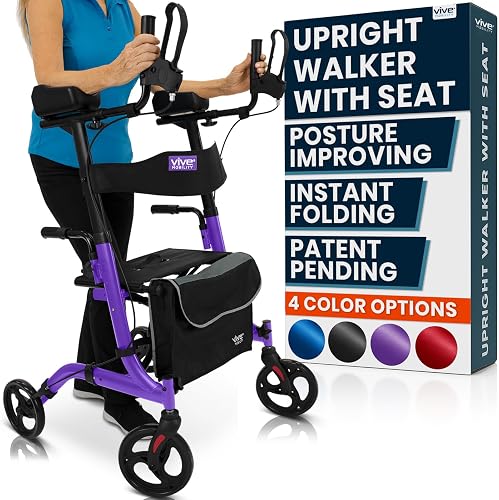 Best for changing arm lengths
Vive Mobility Upright Walker with Seat
9.2/10 our score
See it on Amazon
- 4
 Check it
Helavo 28.3" Extra Wide Bariatric Upright Walker
Best for higher capacity - 5
 Check it
ELENKER Upright Rollator Walker
Best for storage access - 6
 Check it
ELENKER All Terrain Upright Rollator Walker
Best for no-inflation tires - 7
 Check it
Aliseniors Upright Walker for Seniors
Best for open homes - 8
 Check it
HOMLAND Upright Walker with Seat for Seniors
Best for varied heights - 9
 Check it
CareCrew Upright Walkers for Seniors
Best for multiple grips
Which upright walkers with arm rests suit different needs?
The Helavo is the strongest fit for shoppers who want padded arm support, outdoor-oriented wheels and a seat; the other picks address narrower routes, higher capacity, storage or different support positions. Our scores reflect each model’s fit with the needs behind this search.
Helavo Upright Walker with Seat: Best for outdoor breaks
- Soft padded armrests
- 10 in rubber front wheels
- Seat and adjustable backrest
- 300 lb capacity
Padded armrests and adjustable ergonomic handles suit users who want forearm support with seated breaks. The rubber front wheels are puncture-proof and have cushioning characteristics.
Pros
- Soft padded armrests
- Seat, backrest, cup holder and cane holder
- Parking brake
Cons
- Frame is 26.4 in wide, so check doorways
- Weighs 22.7 lb
Helavo combines soft padded armrests with height-adjustable ergonomic handles, so you can rest your arms while keeping the handgrips available. That mix suits users who want support without giving up control of the brakes.
The rubber front wheels are puncture-proof and have cushioning characteristics. Larger rubber wheels can roll more calmly over uneven ground than small hard wheels, which helps on paths and pavement.
A padded seat and adjustable backrest provide a place to pause. The seat measures 18.9 in wide and 9.1 in deep, so it is best viewed as a short rest seat rather than a deep chair.
The walker includes a cup holder and cane holder. Those small features keep a drink or a cane within reach, so your hands stay free for the handgrips and brakes.
The aluminum frame weighs 22.7 lb and is 26.4 in wide. Measure your narrowest doorway and turning space before choosing it, especially if you plan to use it indoors.
Its weight is near the middle of this group, so check whether you can lift it for transport. A second person can help the first time you load it into a car.
Choose this if you want a rollator with both forearm support and a seat. Skip it if you need to lift a walker often or your routes include tight turns and narrow doorways.
Agrish Narrow Walker Folding Upright Walker: Best for tight passages
- Adjustable width from 18 to 22 in
- Removable armrests
- 450 lb capacity
- Folds with one touch
A width-adjustable frame can narrow to 18 in for tighter passages, and the armrests can be removed to convert it to standard walker mode. It has no seat.
Pros
- Narrowest stated width is 18 in
- Removable armrests
- Tool-free assembly
Cons
- No seat for resting
- Check which width setting suits your path
Agrish is the narrow-frame choice in this roundup, with width adjustment from 18 to 22 in. That range lets you narrow the frame for a doorway and widen it again for more room at home.
Its removable armrests let you switch to standard walker mode when you don't need forearm support. That can suit people whose needs change during the day or who share the walker with standard grips.
The PU armrests adjust in 4 lengths, and the frame has 10 height positions. More positions can help you find a fit for different arm lengths and seated heights.
It supports users up to 450 lb and folds with one touch. Folding helps with storage in a corner or in a car, though you should still check the folded size before travel.
For lighter options, see best lightweight upright walkers.
This walker has no seat, so it suits people who want walking support for tight routes and don't need seated breaks. Its tool-free assembly may also appeal if you want a simpler setup.
Measure your narrowest passage and set the frame to a width that clears it while leaving room to steer. Choose Agrish for adjustable width and removable armrests; skip it if you need a seat for outings.
Vive Mobility Upright Walker with Seat: Best for changing arm lengths
- Forearm pads adjust forward and backward
- 8 in flat-free wheels
- Seat and shoulder bag
- 300 lb capacity
Forward and backward forearm pad adjustment offers more positioning choice for different arm lengths. It also folds and includes a seat.
Pros
- Adjustable forearm-pad position
- Loop brakes and stable seating
- Folds for storage
Cons
- Height range is intended for users 5 ft 2 in to 6 ft 4 in
- No wheel size smaller than 8 in is specified
Vive lets you move the forearm pads forward or backward to suit different arm lengths. Fore and aft movement can matter more than height alone, because it changes where your elbows rest.
Its handle-height range of 45 to 52 in is intended for users from 5 ft 2 in to 6 ft 4 in. Check that range against your own height in the shoes you usually wear.
The rollator has 8 in flat-free wheels, a 17.5 in wide seat and a detachable shoulder bag. Flat-free wheels remove the worry of a flat, while the bag keeps small items close.
Contoured armrests and length-adjustable handgrips pair with loop brakes that lock the wheels for seated breaks. Loop brakes can be easier to use than squeeze levers for some hands.
It folds for storage and weighs 20 lb. The 300 lb capacity and user-height range make it a fit to check closely before choosing.
Choose Vive if you want a seat and forearm pads you can position front to back. Skip it if its height range does not suit you or you need a wider seat.
Helavo 28.3" Extra Wide Bariatric Upright Walker: Best for higher capacity
- 500 lb capacity
- 20.1 in wide seat
- Adjustable padded backrest
- 8 in flat-free rubber wheels
A 500 lb capacity and 20.1 in wide seat distinguish this model for shoppers who need more room and higher stated support capacity. Its frame is 28.3 in wide.
Pros
- Highest stated capacity in this roundup
- Wide seat and adjustable backrest
- Includes cup holder and cane holder
Cons
- Wide frame may not suit narrow doorways
- Weighs 24.91 lb
This Helavo model has a stated capacity of 500 lb and a 20.1 in wide, 14.2 in deep seat. That depth gives more thigh support than a shallow seat, which can help during longer pauses.
Padded armrests and an adjustable backrest add support for walking and seated breaks. The backrest helps you lean back instead of sitting on the edge of the seat.
Its frame is 28.3 in wide, so check doorway and turning clearance. A wider seat and frame take up more floor space, so test the route from bedroom to bathroom.
The 8 in flat-free rubber wheels are shock absorbing, and the model includes hand brakes with a parking function. Shock absorbing wheels can soften bumps on pavement and paths.
The seat height adjusts from 20.9 to 22.8 in, while the handle height adjusts from 41.5 to 47.6 in. It is recommended for users between 4 ft 9 in and 6 ft 3 in.
Choose it if you need the stated capacity and a roomier seat. Skip it if your home has narrow passages or you need a lighter walker to lift.
ELENKER Upright Rollator Walker: Best for storage access
- Cushioned armrests
- 10 in anti-slip tread wheels
- Adjustable handle and seat heights
- Seat and backrest
Adjustable handle and seat heights, plus an adjustable handgrip angle, give users several ways to tailor the fit. A seat and padded backrest add rest options.
Pros
- 10 in wheels with tread pattern
- Several adjustable points
- Includes pouch, basket and holders
Cons
- Frame width is 24 in
- Weight capacity is not specified
ELENKER pairs cushioned armrests with a frame that adjusts at the handlebar and seat, plus an adjustable handgrip angle. Several points of adjustment let you change not only height but also how your hands meet the grips.
Its 10 in anti-slip tread wheels have enhanced traction patterns. A tread pattern can help the wheels grip better on wet or loose surfaces than a smooth tire.
A padded seat and backrest support seated breaks. Padding helps for short pauses, though the comfort will depend on how the seat height suits your legs.
A backrest pouch, under-seat basket, cup holder and cane holder keep small items close. Storage within reach can reduce the need to bend or twist while you pause.
The model is intended for users from 5 ft to 6 ft. The frame is 24 in wide, so check passage and turning space alongside your fit at the handles.
Choose this if you want several adjustment points and storage accessories within reach. Skip it if you need a confirmed weight capacity before buying, since that figure is not specified here.
ELENKER All Terrain Upright Rollator Walker: Best for no-inflation tires
- Solid treaded tires
- Cushioned armrests
- Seat and backrest
- Adjustable frame
Solid tires with tread patterns are described as suitable for various road surfaces. The walker also has padded armrests, a seat and an adjustable frame.
Pros
- Solid tires do not need inflation
- Seat and backrest
- Includes basket, pouch and holders
Cons
- Weight capacity is not specified
- Assembled dimensions are not specified
ELENKER’s all-terrain model uses solid tires with tread patterns and includes padded armrests, a seat and backrest. Solid tires do not need inflation, so a slow puncture will not leave you stranded.
The tires are non-inflatable and are described as suitable for various road surfaces. A tread can help with grip on grass, gravel and pavement, though very soft ground may still be hard work.
The adjustable frame is intended for users from 5 ft to 6 ft. Set height and grip angle with your usual shoes on, then check that you can still reach the brakes.
Storage includes an under-seat basket and backrest pouch, plus a cup holder and cane holder. Keeping items in a pouch at the back can be easier than reaching down to a low basket.
Assembled frame dimensions are not specified, so check them if you need to pass through a doorway. Confirm the weight capacity if it is a deciding factor.
Choose it if you want non-inflatable tires and a seated rollator. Skip it if you need a confirmed frame width or capacity before making your choice.
Aliseniors Upright Walker for Seniors: Best for open homes
- 20.6 in wide mesh seat
- Adjustable padded armrests
- 8 in solid tires
- 300 lb capacity
The 20.6 in wide mesh seat and adjustable padded armrests offer room for seated breaks. Its 28.7 in frame needs careful doorway measurement.
Pros
- Wide mesh seat
- One-hand folding design
- Includes storage bag and cane holder
Cons
- Doorways of at least 30 in are recommended
- Height range is intended for users 5 ft 2 in to 6 ft 2 in
Aliseniors has a 20.6 in wide mesh seat and padded armrests that adjust from 40.4 to 45 in. It is intended for users 5 ft 2 in to 6 ft 2 in.
A mesh seat can feel cooler than a solid padded seat in warm weather. Its breathable surface may suit longer pauses, though cushioning remains thinner than a deep chair.
The walker’s 28.7 in frame is wide, and doorways at least 30 in wide are recommended for smooth indoor movement. Measure the doorway and the space needed to turn around furniture.
It has 8 in solid polyurethane tires, a one-hand fold design and a 300 lb capacity. Solid tires avoid flats, and one-hand folding can help when you need to store it quickly.
The mesh seat is 9.4 in deep, and sit-to-stand handles are included. Those handles give you a place to push from when you rise, which can reduce strain on the arms.
Choose this for a roomy mesh seat and adjustable armrests if your home has open routes. Skip it if your doorways or turns are tight, or if you are outside the recommended height range.
HOMLAND Upright Walker with Seat for Seniors: Best for varied heights
- Adjustable padded arm support
- Seat and backrest
- 8 in puncture-proof wheels
- Height range for users 4 ft 9 in to 6 ft 4 in
Separate arm-support and seat-height adjustments make this a candidate for users who need a wider height range. It has a steel frame and folds for storage.
Pros
- Arm support adjusts in length and height
- Seat and backrest
- Storage bag included
Cons
- Weight capacity is not specified
- Frame weighs 24.5 lb
HOMLAND offers a stated user-height range of 4 ft 9 in to 6 ft 4 in, with separate adjustments for arm support and seat height. Separate controls can help taller users while keeping the seat at a comfortable level.
The arm support adjusts from 37 to 47 in, while the seat adjusts from 20 to 23 in. That wide span is useful across different users, but it also means you should set each part carefully.
A steel frame, padded arm support, extra-wide memory foam seat and widened breathable backrest are among its features. Memory foam can feel softer than a thin pad, and a wider backrest gives more support across the back.
The 8 in wheels are puncture-proof, and a storage bag is included. Puncture-proof wheels reduce flat worries on paths, and a bag keeps personal items off the floor.
The frame weighs 24.5 lb and is 23.6 in wide. Check whether that width works through your doorways and whether you can lift the walker for transport.
Choose HOMLAND if a broad height range and a seat are central to your decision. Skip it if you need a confirmed weight capacity or a lighter frame.
CareCrew Upright Walkers for Seniors: Best for multiple grips
- Padded forearm platforms
- Three grip levels
- Narrow steel frame
- Folds for storage
Three support positions let users switch between forearm platforms, standard handgrips and lower grips for standing. The narrow frame uses two front wheels and rear glide feet.
Pros
- Three grip positions
- Narrow frame for indoor spaces
- Tool-free push-button adjustments
Cons
- No seat
- Two front wheels and rear glide feet differ from four-wheel rollators
CareCrew uses padded forearm platforms with vertical handles, and adds three support levels: forearm platforms, standard handgrips and lower grips for standing. Having several positions can help you change support as you walk, pause or rise.
The frame has two front wheels and rear glide feet. Two wheels with glide feet can feel different from a four-wheel rollator, so think about how you will turn and stop.
Its steel frame folds, and tool-free push-button adjustments change leg and forearm-support height. Push-button settings can be quick to change, and folding helps with storage at home.
The narrowest front-wheel spacing is about 18 in inside and 20 in outside. That narrow front can help in tight indoor spaces, though you should still measure your tightest turn.
There is no seat, so this design provides walking support for indoor spaces without seated breaks. Its weight capacity is not specified.
Choose CareCrew if you want several hand and forearm support options in a narrow frame. Skip it if you need a four-wheel rollator or a seat for resting during outings.
How do you choose arm rests that fit?
The best arm rests let your forearms rest without pushing your shoulders up or making you lean forward. Check the adjustment range while wearing the shoes you normally use.
Arm supports differ: some adjust in height, others move forward and backward, and some can be removed. For broader help comparing walker and rollator styles, see our walkers and rollators buying guide.
What should you check on upright walker arm rests?
Check pad height, length and angle, then make sure you can still reach the handgrips and brake levers. Vive’s forearm pads move forward and backward, while Agrish has removable armrests.
A walker that fits your arms can still be too wide for your home. Measure the narrowest doorway, hallway and turn, then compare those numbers with the walker’s assembled width.
How do upright walker arm rests differ from standard walker grips?
Forearm platforms give your arms a broader resting surface, while a standard walker usually asks you to hold its handgrips. Some models combine both support styles, as CareCrew does.
If you want more options with seats, our best upright walkers for seniors roundup covers additional fit and feature differences. For setup help, see how to assemble an upright walker.
Should you choose a walker with a seat?
Choose a seat if you want a place to rest during an outing and can use the brakes and sitting position safely. A seat adds size and weight, so compare those factors with how you plan to store and move the walker.
Helavo, Vive, ELENKER, Aliseniors and HOMLAND include seats. Agrish and CareCrew do not.
Compare seat width and depth with your needs, then measure doorways, turning space and vehicle storage before deciding. Our upright walkers with seats guide includes more seated options.
If walking support alone is not enough for your trips, discuss whether mobility scooters for walkers who need extra support or a mobility scooter for an older adult with weak arms may suit you with a clinician or mobility specialist.
How should you set up and use an upright walker with arm rests?
Set the walker’s height and arm supports so you can stand upright, rest your forearms comfortably, and reach the handles and brakes without straining. Make adjustments according to the manual before walking.
Assemble the frame and attachments in the order shown by the instructions, then check that adjustment points and folding parts are secure. A second person can help hold the walker steady during setup if needed.
Before your first walk, practice starting, stopping, turning and using the parking brake in a clear area. Keep both hands near the controls, and make sure your arms do not slide off the pads when you turn.
Engage the parking brake before sitting. Stand close to the seat, use the handles as directed, and avoid sitting until the walker is stable and the brakes are locked.
Check the wheels and brakes on the surface where you will walk first. A walker that feels steady on smooth flooring may behave differently on carpet, grass or a slope.
Use the upright position only as the instructions describe. If pain increases or the walker feels unstable, stop, sit down safely and seek advice from a clinician or the maker.
What routine checks help keep a walker ready to use?
Check the brakes, wheels, arm pads, seat and frame before regular use. A quick daily look can spot a loose part before it becomes a problem on a walk.
If a part feels loose, damaged or harder to operate, stop and consult the manual or the manufacturer before relying on the walker. Do not try to force a brake or a folding joint back into place.
Keep the tires and glide surfaces free of debris, and wipe the frame and padded areas as the care instructions allow. Small stones or wrapped thread can affect rolling and braking.
Don't use harsh cleaners unless the manufacturer says they are safe for the materials. Strong cleaning products can damage padding, paint or rubber and can leave a slippery surface.
Check brake cables, levers and any clips that hold them in place. Worn cables or loose clips can change how firmly the brakes hold when you sit down.
Inspect arm pads and the seat for tears, cracks or flattened padding. Padding that has lost its shape may no longer spread support evenly across your arms.
Tighten or adjust only the fittings the maker allows you to adjust. If a bolt, pin or brace seems worn, ask about a replacement part rather than using the walker as it is.
Fold the walker only as instructed and store it where it will not block a walkway. Folding it the wrong way can pinch cables or damage joints over time.
Before lifting it into a vehicle, check the folded size and make sure you can handle its weight safely. Ask for help if the folded walker is awkward to lift or carry.
Store the walker in a dry place away from direct heat. Damp storage can affect metal parts and padding, and heat can harm rubber tires.
Keep a note of any repairs or replacements and when they were done. That record helps you and the maker track wear and decide when a part needs attention.
If you are unsure about any check, ask a mobility specialist or the seller for guidance. A short inspection is easier than dealing with a failure on a busy route.
What common mistakes should you avoid?
The most common buying mistake is choosing by the arm pads alone and overlooking frame width, turning space, user height, capacity or seat fit. A comfortable pad cannot make a walker usable if it does not clear your doorway.
Another mistake is assuming that every upright walker has four wheels or a seat. CareCrew uses two front wheels and rear glide feet, while Agrish and CareCrew have no seat.
Don't assume that a higher capacity or wider seat automatically means a better fit. Check the full set of measurements and the intended height range, then compare them with the person who will use the walker and the routes they take.
Finally, don't lean heavily on armrests that are set at the wrong height or use the walker before you can reach the brakes. Adjust it and practice in a clear area before taking it into a busy or uneven space.
Which upright walker with arm rests should you choose?
Choose Helavo for padded armrests, a seat and rubber front wheels; pick Agrish for an adjustable narrow frame, Vive for forearm pads that move forward and backward, or CareCrew for three grip positions without a seat.
For a higher stated capacity and roomy seat, choose the wider Helavo bariatric model if your home has enough clearance. If seat fit, frame width or height range is uncertain, measure first and ask a clinician or mobility specialist which support style fits your walking needs.
For more walker options, compare our best upright walkers for seniors guide.
Work through your own list of needs before you decide. Note your height in your usual shoes, the width of your narrowest doorway and the space you need to turn at home.
Think about how far you walk and where you walk. A seat matters more on longer outings, while a narrow frame matters more in a small home.
Check how you will store and transport the walker too. Folding size and weight can decide whether it fits in a car or in a corner by the door.
If two models seem close, compare the details that affect daily use. Arm pad position, brake access, wheel type and seat dimensions often matter more than a single headline feature.
Take your time and measure twice before you buy. A walker that fits your body and your home will be easier to use every day, and that fit is what makes the arm rests worthwhile.
Our top 3 picks at a glance
-
1
-
2
Best for tight passages
Agrish Narrow Walker Folding Upright Walker
9.4/10 our score
See it on Amazon -
3
Best for changing arm lengths
Vive Mobility Upright Walker with Seat
9.2/10 our score
See it on Amazon
Frequently asked questions
Do arm rests on an upright walker reduce wrist pressure?
Forearm supports can shift some support away from the hands, depending on pad shape and fit. Vive has contoured armrests, while CareCrew uses padded forearm platforms.
Ask a clinician which support style suits you if you have ongoing pain or a medical condition.
Adjust the walker and follow its instructions.
How should upright walker arm rests fit?
Your forearms should rest comfortably without forcing your shoulders upward or making you lean forward. Adjustable models offer different ways to set pad height or position, but ranges vary by walker.
Check the adjustment instructions and make sure you can reach the handgrips and brakes safely before walking.
Are upright walkers with arm rests suitable for narrow hallways?
Some are narrower than others, so measure the tightest doorway and turn before choosing. Agrish adjusts from 18 to 22 in wide, while Aliseniors has a 28.7 in frame and recommends doorways at least 30 in wide.
Leave room to turn and operate the brakes.
Should I choose a walker with a seat?
Choose a seat if you want a place to pause during outings and can use the brakes and sitting position safely. Several rollators here include seats, while Agrish and CareCrew do not.
Compare seat dimensions, frame width and total weight with your home and transport needs.
What is the difference between a forearm walker and an upright rollator?
A forearm walker supports the arms on padded platforms, while an upright rollator is a wheeled walker with forearm supports, handgrips and often a seat. Designs vary, so check the wheel and glide-foot setup.
Our guide explains what an upright walker is called.


