8 Best Wheelchairs for Narrow Doorways (November 2026)
The best wheelchairs for narrow doorways include the Drive Medical Blue Streak Lightweight Wheelchair for self-propelled users, the Medline Lightweight Foldable Transport Wheelchair with Handbrakes for caregiver turns, and the Medline Comfortable Folding Wheelchair with Swing-Back Desk-Length for table access.
On this page (7 sections)
- Which wheelchair is the best for narrow doorways?
- How do you measure for a wheelchair in a narrow doorway?
- Which wheelchair width matters most?
- Are transport wheelchairs easier to steer through tight spaces?
- How should you set up and use a wheelchair in a tight home?
- What mistakes make doorway fit harder?
- Which wheelchair should you choose for a narrow doorway?
The best wheelchair for narrow doorways depends on the chair's widest open point, not its seat or folded width. The Medline Lightweight Foldable Transport Wheelchair is a sensible first option for caregiver-assisted movement because its 12-inch rear wheels are designed to help around tight corners and doorways, but its assembled width still needs confirmation.
Measure the narrowest clear opening before comparing models. A chair can have a compact fold and still be too wide to pass through a doorway while open.
Start with our wheelchair size chart to understand seat sizing, and use the wheelchairs and power chairs buying guide to compare caregiver-pushed and self-propelled styles.
Our picks at a glance
-
1
 Best for self-propelled users
Drive Medical Blue Streak Lightweight Wheelchair
9.7/10 our score
See it on Amazon -
2
 Best for caregiver turns
Medline Lightweight Foldable Transport Wheelchair with Handbrakes
9.6/10 our score
See it on Amazon -
3
 Best for table access
Medline Comfortable Folding Wheelchair with Swing-Back Desk-Length
9.4/10 our score
See it on Amazon
- 4
 Check it
Drive Medical Blue Streak Foldable Wheelchair
Best for leg positioning - 5
 Check it
VOCIC Ultra Lightweight Foldable Wheelchairs for Adults
Best for removable wheels - 6
 Check it
Invacare Transport Wheelchair for Adults
Best for compact storage - 7
 Check it
DR. DUNLEY Dr Dunley Folding Transport Wheelchair
Best for padded transport - 8
 Check it
WHLICKS Wheelchairs for Adults Ergonomic Transport Chair
Best for adjustable handles
Which wheelchair is the best for narrow doorways?
The Medline Lightweight Foldable Transport Wheelchair with Handbrakes is the best starting point for a caregiver who needs to steer around indoor corners and doorways. Its rear wheels are 12 inches, but the assembled width is not specified, so get that measurement before relying on it for a close fit.
A doorway fit is a measurement problem, not a seat-size guess. Compare the opening with the chair's full width at its widest point, including wheels, hand rims and armrests.
| Product | Best for | Chair width | Fold width | Seat width | Our score |
|---|---|---|---|---|---|
| Drive Medical Blue Streak Lightweight Wheelchair | self-propelled users | Not confirmed by the listed dimensions | 12.5 in | 18 in | 9.7 |
| Medline Lightweight Foldable Transport Wheelchair with Handbrakes | caregiver turns | Not specified | 12 in | 19 in | 9.6 |
| Medline Comfortable Folding Wheelchair with Swing-Back Desk-Length | table access | 26.5 in in product dimensions | 18 in | 9.4 | |
| Drive Medical Blue Streak Foldable Wheelchair | leg positioning | Not specified | 16 in | 9.2 | |
| VOCIC Ultra Lightweight Foldable Wheelchairs for Adults | removable wheels | Not specified | 17.7 in | 8.9 | |
| Invacare Transport Wheelchair for Adults | compact storage | Not confirmed by the product dimensions | 9 in | 19 in | 8.9 |
| DR. DUNLEY Dr Dunley Folding Transport Wheelchair | padded transport | Not specified | 19 in | 8.3 | |
| WHLICKS Wheelchairs for Adults Ergonomic Transport Chair | adjustable handles | Not specified | 16.5 in in description | 8.1 |
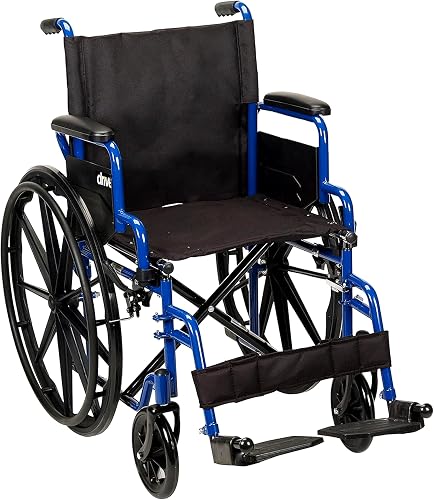
Drive Medical Blue Streak Lightweight Wheelchair: Best for self-propelled users
- Swing-away footrests
- Flip-back desk arms
- Folds to 12.5 in wide
A folding self-propelled chair with swing-away footrests and flip-back desk arms. The 12.5-inch fold width is for storage, not doorway clearance.
Pros
- Self-propelled rear wheels
- Flip-back desk arms
- Folds to 12.5 in wide
Cons
- Assembled width is not confirmed
The Drive Medical Blue Streak Lightweight Wheelchair is the self-propelled option here, with swing-away footrests and flip-back desk arms. Its 12.5-inch folded width helps with storage, but says nothing about whether the open chair clears a narrow door.
The dimensions shown for this model do not confirm the widest assembled point. Its 18-inch seat, 41.3 lb weight, push-to-lock brakes and solid wheels help you assess seating and handling, but ask Drive Medical for the open width before buying for a tight route.
Choose it if the user needs to push the large rear wheels independently and the chair's confirmed width fits. Skip it if caregiver propulsion is the priority or the width cannot be confirmed.
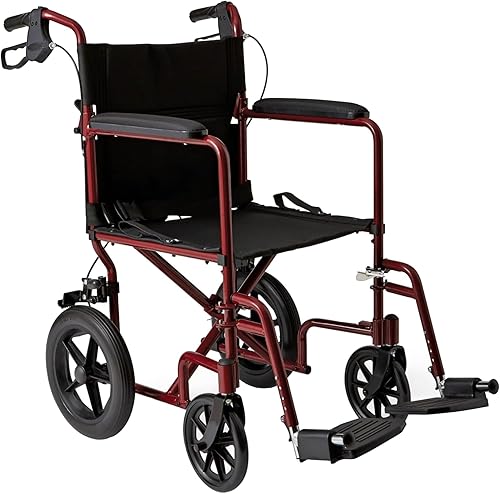
Medline Lightweight Foldable Transport Wheelchair with Handbrakes: Best for caregiver turns
- 12 in rear wheels
- Handbrakes and rear-wheel locks
- Folds to 12 in wide
This transport chair has 12-inch rear wheels and a 19-inch seat. Medline describes its wheels as helping it maneuver around tight corners, doorways and ramps.
Pros
- 12-inch rear wheels
- Handbrakes for the caregiver
- Compact folded width
Cons
- Assembled width is not specified
The Medline Lightweight Foldable Transport Wheelchair is caregiver-pushed and has 12-inch rear wheels with swivel front wheels. Medline describes this wheel arrangement as helping the chair maneuver around tight corners, doorways and ramps.
Its assembled width is not specified. The 19-inch seat does not settle the doorway question, so request the chair's maximum open width and compare it with your measurement before ordering.
Hand brakes and rear-wheel locking brakes give the caregiver separate control for movement and stopping. Swing-away, detachable footrests also make it easier to approach for a transfer.
Choose it for caregiver-assisted indoor trips when the measured width works. Skip it if the user needs to self-propel or if its width remains unknown for a very tight opening.
Medline Comfortable Folding Wheelchair with Swing-Back Desk-Length: Best for table access
- 18 in seat
- Swing-back desk-length arms
- Folds flat
Swing-back desk-length arms make transfers and table access easier. Its product dimensions give an assembled width of 26.5 inches, while the folded width is 11.5 inches.
Pros
- Arms swing back for transfers
- Desk-length arms fit under tables
- Folds to 11.5 in wide
Cons
- 26.5 in stated assembled width may exceed a tight doorway
The Medline Comfortable Folding Wheelchair pairs an 18-inch seat with swing-back desk-length arms. The arms move away for side transfers and allow closer access to desks and tables.
Its assembled width is given as 26.5 inches, while its folded width is 11.5 inches. Use the open measurement for doorway planning; the narrow folded measurement is only useful for storage and loading.
Swing-away footrests and rear wheel locks support everyday transfers and parking. The carbon steel frame has a 300 lb weight capacity.
Choose it when table access and side transfers matter and your doorway has enough clear width. Skip it for an opening narrower than the stated assembled width.
Drive Medical Blue Streak Foldable Wheelchair: Best for leg positioning
- 16 in seat
- Elevating leg rests
- Folding frame
A 16-inch seat and elevating leg rests suit users who need that positioning option. The overall chair width is not specified.
Pros
- 16-inch seat
- Elevating leg rests
- Padded desk arms
Cons
- Widest assembled point is not specified
The Drive Medical Blue Streak Foldable Wheelchair has a 16-inch seat and elevating leg rests. The padded desk arms and swing-away leg rests are useful when the user needs those positioning and transfer features.
The chair's widest assembled point is not specified. Its listed dimensions do not confirm the open width, and the 12.5-inch fold measurement belongs to the other Blue Streak model, not this one.
This is a self-propelled chair with push-to-lock brakes. Choose it for elevating leg rests and a 16-inch seat only after confirming open width.
Skip it if doorway clearance is the primary requirement and the measurement is unavailable.
VOCIC Ultra Lightweight Foldable Wheelchairs for Adults: Best for removable wheels
- 23 lb frame without leg rests and quick-release wheels
- Quick-release wheels
- 17.7 in seat width
Quick-release wheels and a 17.7-inch seat are useful details for transport and fit planning. The overall chair width is not specified.
Pros
- Quick-release wheels
- Flip-back armrests
- Swing-in and swing-out leg rests
Cons
- Overall width is not specified
The VOCIC Ultra Lightweight Foldable Wheelchairs for Adults has quick-release wheels, flip-back armrests and leg rests that swing inward or outward. The seat is 17.7 inches wide, and the frame weighs 23 lb without the leg rests and quick-release wheels.
The open and folded widths are not specified. Its detachable wheels may help with lifting and storage, but they do not guarantee doorway clearance while assembled.
A dual braking system and adjustable safety belt are included, along with an anti-tip device. Choose it when removing wheels or easing transfers matters and you can confirm the open width.
Skip it if you need a documented fit before purchase and cannot get that measurement.
Invacare Transport Wheelchair for Adults: Best for compact storage
- Folds to 9 in wide
- 19 x 16 in seat
- Fold-down backrest
The one-handed folding mechanism narrows this transport chair to 9 inches for storage, and its backrest folds down. The assembled chair's widest point is not confirmed.
Pros
- Folds to 9 in wide
- Fold-down backrest
- Seatbelt included
Cons
- Assembled width is not confirmed
The Invacare Transport Wheelchair for Adults is suited to caregivers who need a compact chair to store between trips. It folds to 9 inches wide, and its backrest folds down, but neither feature tells you how wide the chair is open.
The listed product dimensions do not identify its widest assembled point. Confirm that width with Invacare, then compare it with the doorway opening.
The 19 x 16-inch seat, seatbelt and swing-away footrests fit caregiver-assisted transport. The chair arrives assembled, so setup begins by unfolding it.
Choose it for compact storage and transport if the confirmed chair width clears your route. Skip it if you are treating the 9-inch folded width as proof that it fits an open doorway.
DR. DUNLEY Dr Dunley Folding Transport Wheelchair: Best for padded transport
- 19 in padded seat
- Swing-away footrests
- Folds flat
The 19-inch padded seat and swing-away footrests address comfort and entry needs. The assembled chair width is not specified.
Pros
- Padded 19-inch seat
- Swing-away footrests
- Folds flat
Cons
- Overall width is not specified
The DR. DUNLEY Folding Transport Wheelchair has a 19-inch padded seat, full-length armrests and swing-away footrests.
It is a caregiver-pushed transport model with a stated 250 lb weight capacity.
The assembled and folded widths are not specified. Ask for the maximum open width before choosing it for a narrow doorway, especially if the chair must approach through a short hallway or turn.
It folds flat for storage and transport, but that convenience is separate from doorway fit. Choose it for the padded transport seat if the chair clears your opening.
Skip it if you need self-propulsion or a known narrow frame.
WHLICKS Wheelchairs for Adults Ergonomic Transport Chair: Best for adjustable handles
- 12 in rear wheels
- 23.1 lb stated weight
- Folds to 20 x 11 x 26 in
Adjustable handle and footrest heights help tailor the chair to the caregiver and user. Its folded dimensions are compact, but the assembled width is not specified.
Pros
- 12-inch rear wheels
- Adjustable handles and footrests
- Removable washable cushions
Cons
- Assembled width is not specified
The WHLICKS Ergonomic Transport Chair has adjustable handle and footrest heights, removable washable cushions and a 16.5-inch seat. Its 12-inch rear wheels and dual-action brake system are designed for caregiver use.
It folds to 20 x 11 x 26 inches, but its assembled width is not specified. Confirm the widest point before buying for a particular doorway.
The seat and back cushions can be removed for machine washing. Choose it when adjustable handles and washable cushions matter for regular caregiver-assisted trips.
Skip it if the seller cannot confirm the open width you need.
How do you measure for a wheelchair in a narrow doorway?
Measure the clear opening with the door open, then compare it with the chair's maximum assembled width. Take the doorway measurement at its narrowest point, accounting for trim, handles, hinges or other hardware that reduces the usable space.
Measure every part of the route that could constrain movement. A hallway turn, nearby furniture, raised threshold or door swing can cause trouble even when the chair's width is less than the opening.
For a chair, ask for the widest open measurement rather than relying on seat width. Include wheels, hand rims and armrests in the comparison, and leave enough room to steer without scraping.
If the chair's width is available only as a broad product dimension, ask the manufacturer which side that number measures and whether it includes the wheels. Do not assume the fold measurement is the same as its open width.
Which wheelchair width matters most?
The maximum assembled width matters for doorway clearance. Seat width is for choosing a suitable sitting space, while folded width helps you plan storage and transport.
A 19-inch seat does not mean a 19-inch chair. Wheels, armrests and hand rims add width, and designs with the same seat width can have different overall dimensions.
Use our wheelchair size chart to assess seat fit, and compare the fit considerations in our guide to wheelchairs for tall people. If a smaller, lighter frame is important, see our guide to lightweight wheelchairs for small adults.
For a specific model, write down the doorway's clear width and ask for the chair's maximum assembled width. That gives you a direct comparison instead of relying on a product name or a compact fold.
Are transport wheelchairs easier to steer through tight spaces?
A transport wheelchair can be easier for a caregiver to steer around corners because the caregiver pushes it, but its width still determines whether it passes through the opening. A self-propelled wheelchair has large rear wheels the user can push, which gives the user a different level of control.
Choose based on who will move the chair most often. If the user needs independent mobility, prioritize a self-propelled model and verify the open width; if a caregiver will push, consider a transport style with hand brakes and footrests that swing away.
A wheelchair is not interchangeable with a mobility scooter for every home or user. If you are weighing both options, compare our guide to the best mobility scooter for narrow doorways and its advice on fitting a mobility scooter through a narrow door.
How should you set up and use a wheelchair in a tight home?
Set up the chair in an open area and check that it is fully unfolded before the user sits down. Engage the wheel locks before transfers, then release them before moving.
For a transport chair, confirm that the caregiver can reach and operate the hand brakes comfortably. Keep the footrests out of the way during entry and exit, then return them to position before movement.
Practice the doorway approach slowly in a clear space. A straight approach usually gives the most predictable clearance; avoid trying to force a turn through an opening when the wheels or armrests are close to the frame.
Check thresholds and floor transitions before the user crosses them. Keep loose rugs and small objects out of the path, and pause where the caregiver has room to reposition the chair rather than turning sharply at the door.
Fold the chair only as its instructions direct, and keep fingers clear of moving frame parts. For models with removable wheels, confirm that each wheel is secure again before use.
What mistakes make doorway fit harder?
The most common mistake is comparing the seat width with the doorway. The seat is only one part of the chair, so compare the full assembled width at the widest point instead.
Another mistake is using the folded width as if the chair travels through the doorway folded. Unless the chair is meant to be used folded, doorway clearance is based on the open chair.
Buyers also overlook the route after the door. Measure the hallway and turns, note thresholds, and check whether the door can stay open without blocking the chair's approach.
Finally, do not pick a smaller seat just to solve a doorway problem without checking the user's fit. Choose a seat that suits the person, then find a chair whose complete frame fits the home.
Which wheelchair should you choose for a narrow doorway?
Choose the Medline transport wheelchair for caregiver-pushed indoor use if Medline confirms that its assembled width clears the measured opening. Choose the Drive Medical Blue Streak when the user needs a self-propelled chair and its open width is confirmed to fit.
For transfers and table access, the Medline Comfortable Folding Wheelchair has useful swing-back arms, but its stated 26.5-inch assembled width rules it out for narrower openings. For compact storage, the Invacare's 9-inch fold is convenient, but it is not evidence of doorway fit.
The decision rule is simple: measure the doorway, confirm the chair's widest open point, and choose the propulsion style that matches the user's needs. For more sizing help, use our wheelchair size chart.
Our top 3 picks at a glance
-
1
Best for self-propelled users
Drive Medical Blue Streak Lightweight Wheelchair
9.7/10 our score
See it on Amazon -
2
Best for caregiver turns
Medline Lightweight Foldable Transport Wheelchair with Handbrakes
9.6/10 our score
See it on Amazon -
3
Best for table access
Medline Comfortable Folding Wheelchair with Swing-Back Desk-Length
9.4/10 our score
See it on Amazon
Frequently asked questions
How wide should a wheelchair be for a narrow doorway?
Measure the clear opening at its narrowest point, then compare it with the wheelchair's widest assembled point, including wheels and armrests. Leave extra room to turn and avoid scraping the frame.
Seat width and folded width don't tell you the chair's assembled width.
Can a wheelchair with a 19-inch seat fit through a 24-inch doorway?
It may, but seat width alone cannot confirm the fit. Wheels, hand rims and armrests add to the chair's overall width, and the approach angle can affect clearance.
Check the manufacturer's assembled width and compare it with your measured clear doorway opening.
Are transport wheelchairs narrower than standard wheelchairs?
Some transport chairs have compact frames, but chair width varies by model. A transport chair is pushed by a caregiver, while a self-propelled wheelchair has large rear wheels for the user to push.
Compare overall assembled widths rather than assuming one style is always narrower.
Does a narrow wheelchair doorway require a smaller seat?
Not always. The seat is only one part of the chair's width, and models with the same seat width can have different wheel and frame dimensions.
Choose a seat that fits the user, then confirm the chair's full width and doorway clearance before buying.
What should I measure before buying a wheelchair for a tight doorway?
Measure the clear doorway width with the door open, including trim or hardware that reduces the opening. Also check the hallway approach, nearby turns and floor thresholds.
Compare the chair's assembled width at its widest point with the doorway opening, then leave room to steer.


