Step Ramp vs Threshold Ramp: What Is the Difference? (November 2026)
A threshold ramp suits a small, fixed doorway lip; a step ramp suits a taller rise that needs a longer sloped surface. Measure the rise and check the user’s mobility device, door swing and available floor space before choosing.
On this page (6 sections)
A threshold ramp suits a small, fixed doorway lip; a step ramp suits a taller rise that needs a longer sloped surface. Measure the rise and check the mobility device, door swing and available floor space before choosing.
The names can overlap, so compare each ramp’s rise, length and placement rather than relying on its label. A short rubber piece may make a low doorway transition, while a folding aluminum ramp can span a higher step.
A ramp must fit both the obstacle and the person or device using it. Check the maker’s height guidance, the doorway width and whether the door can still open.

Step ramp vs threshold ramp: what is the difference?
A step ramp creates a longer approach over a raised step; a threshold ramp bridges a smaller change in floor height. The right choice depends on the rise and available room.
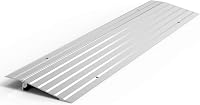
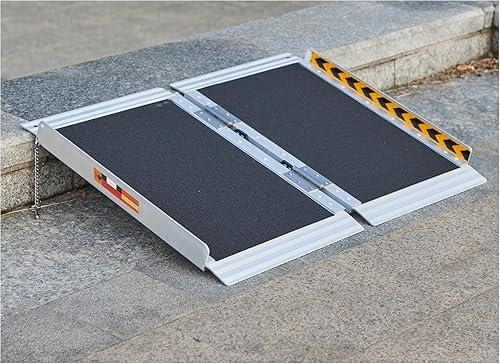
A threshold ramp is often a solid piece for a doorway or other fixed transition. A step ramp is often longer and may fold for storage or transport.
These labels aren’t consistent across all products. Some makers call a small doorway ramp a threshold ramp even when it can also span a low step, so use the dimensions and height guidance to compare.
When does a step ramp make sense?
A step ramp may suit a step that is too high for a low-profile threshold piece. Its longer surface gives the user or mobility device more distance to climb.
That length needs space. Measure the clear approach in front of the step and the landing area at the top, then check the ramp maker’s guidance for the rise.
The FACHNUO 2FT Portable Wheelchair Ramp for Home measures 24 in unfolded and is intended for height adjustments from 2 to 6 in. For wheelchair access, FACHNUO recommends a step height no higher than 4 in.
{{product B09PYBP9YF}} The listing describes a folding 2 ft ramp for a low step when its height guidance, wheelbase limit and door clearance fit.
The FACHNUO 6FT Portable Wheelchair Ramp for Home is recommended for heights from 6 to 18 in. FACHNUO advises against choosing a ramp shorter than 4 times the step height, so confirm the available run before choosing it.
{{product B09PYKD48B}} The listing describes a 6 ft folding ramp for taller rises when you have room for its longer approach and can meet the height guidance.
When is a threshold ramp the better fit?
A threshold ramp may fit a small lip at a doorway, where a full step ramp would take more room than needed. Measure the threshold height and doorway width, then check the door and frame for clearance.
For a rise up to 1.2 in, the VEVOR 1.2 inch Rise Cuttable Threshold Ramp is a low-profile option. It measures 35.4 in wide by 7.9 in long, and its length can be cut to fit the opening.
{{product B0C8DBC79P}} The listing describes a low-profile rubber option for a doorway lip up to 1.2 in, with a cuttable length and included double-sided tape.
For a 3 in rise, the VEVOR 3" Rise Rubber Threshold Ramp measures 35.5 in long by 17.7 in wide. Its beveled edges provide an approach from multiple sides.
{{product B09FJZRT4K}} The listing describes a one-piece rubber ramp sized for a 3 in threshold or step, with beveled edges and a grooved tread surface.
How do height and slope affect the choice?
Match the ramp’s stated height guidance to the measured rise, then check its length and the device maker’s guidance. A ramp that reaches the top of a step can still be too steep for the user.
Measure from the lower floor to the top surface where the ramp will sit. Check more than one spot if the threshold or floor is uneven.
A longer ramp spreads the same rise over more distance, but needs more clear floor space. If you need height flexibility, compare adjustable threshold ramps.
A short threshold ramp uses less space, though it may not suit a taller rise.
For wheelchair access, FACHNUO recommends a step height no more than 4 in for its 2 ft ramp. For its 6 ft ramp, FACHNUO recommends a ramp length at least 4 times the step height.
Confirm that the setup fits your space and use.
Don’t apply one ramp’s guidance to another model. Follow the manufacturer’s instructions for the exact ramp and mobility device, including limits on rise, load or setup.
Will the ramp fit the doorway and mobility device?
Measure the clear opening, device width and wheelbase before you buy. The ramp needs to fit the route without blocking a door, track or nearby walking space.
Check the clear width between the door frame and any trim or hardware. Then compare it with the ramp width and the device’s width at its widest point.
The FACHNUO 2FT Portable Wheelchair Ramp for Home has a stated wheelbase limit of 27 in. Its vertical side walls and extension plate may also affect how a door opens when it is placed at a threshold.
For a sliding door, check that the extension plate won’t block the track. See threshold ramps for sliding glass doors for options to compare.
For a hinged door, check the door’s full swing against the ramp position and handle.
If you’re comparing a threshold piece with a longer modular setup, see threshold ramp vs modular ramp for how their layouts differ. For broader stair lift options, compare the space and access needs of each approach.
What should you check before using a ramp?
Check that the ramp fits securely, sits flush at its ends and gives the user a clear path. Follow the manufacturer’s instructions and don’t use a ramp that shifts, rocks or blocks a door.
Place the ramp on a stable surface and inspect both ends. For safer, more stable use, FACHNUO says the 2 ft ramp’s front extension plate should sit fully flush with the ground.
The 1.2 in VEVOR ramp includes double-sided tape for smooth surfaces. Follow the installation directions and check the fit after placement, especially in a busy doorway.
Keep the route clear of loose rugs, cords and clutter. Check for water, debris or wear on the ramp surface, and reassess the setup if the floor, threshold or mobility device changes.
A ramp’s stated load capacity is only one part of fit. Check the load and device dimensions against the ramp’s instructions, and arrange help if the user cannot manage the slope independently.
Would another access option work better?
A ramp fits only when its slope and footprint suit the entry and the person using it. If the rise is too high for the available run, consider a different access plan.
A stair lift may suit a staircase when a ramp would need too much length. Compare stair lift alternatives for seniors if the stairs, transfer needs or available space make a lift worth considering.
For larger height changes, a lift may also be part of the decision. Read wheelchair ramp vs wheelchair lift to compare the space and access questions involved.
If you need a longer ramp for a mobility scooter or wheelchair, our Best Mobility Scooter Ramp guide covers ramp options and fit checks. For budgeting, see How Much Does a Mobility Scooter Ramp Cost?.
Which ramp should you choose?
Choose a threshold ramp for a small doorway lip that matches its rise; choose a step ramp when a taller step needs a longer approach and you have room for it. If the dimensions or slope don’t fit the user and device, look at another access option.
Start with the vertical rise, then measure width, approach space and door clearance. Check the manufacturer’s guidance for the exact ramp, and make sure its surface and placement suit the route.
For a low lip, a short rubber threshold ramp may be enough. For a higher step, a folding ramp may provide more length, but only if the landing and approach allow a secure setup.
Frequently asked questions
What is the difference between a step ramp and a threshold ramp?
A step ramp usually provides a longer sloped path over a step, while a threshold ramp is a shorter transition piece for a doorway lip or small level change. Product names can overlap, so compare the actual rise, length, width, door clearance and device guidance rather than relying on the label.
How do I choose a ramp length for a step?
Measure the vertical rise first, then check the ramp maker’s guidance for that height and the mobility device being used. A longer ramp takes more floor space but creates a gentler approach.
Confirm the top and bottom can sit securely and that the user can travel up and down safely.
Can a threshold ramp go over a step?
It can cover a step only if its height and shape suit that rise and the device can approach it safely. A compact threshold ramp may be too steep for a taller step.
Check the ramp’s height guidance, slope, width and placement, and ask a qualified access professional if the fit is uncertain.
Do rubber threshold ramps need to be attached?
Attachment depends on the ramp design and floor surface. The 1.2 in VEVOR ramp includes double-sided tape for smooth surfaces, while the 3 in model is a one-piece ramp with no tools needed to assemble or dismantle.
Follow the product instructions and check that the ramp stays in place before each use.
What should I measure before buying a ramp?
Measure the vertical rise, clear doorway width, available approach length and space for the door to open. Also check the mobility device’s width and wheelbase, the ramp’s capacity, and whether the top and bottom can sit flush on stable surfaces.
Sliding doors need track clearance.