Vive Upright Walker Review: Worth It? (November 2026)
The Vive Bariatric Upright Walker suits users who need a wider base and support up to 400 lb, while the standard Vive model weighs 20 lb and folds for transport. Measure doorways and check fit before choosing.
On this page (8 sections)
- Is the Vive upright walker worth buying?
- What stands out about the Vive Bariatric Upright Walker?
- How does the standard Vive upright walker compare?
- How does Vive compare with Helavo?
- Which Vive walker fits your body and home?
- What should you check before buying an upright walker?
- What are the main trade-offs?
- Which Vive upright walker should you choose?
The Vive Bariatric Upright Walker is the better match for users who need a wider frame and support up to 400 lb. The standard Vive model weighs 20 lb and folds for transport, but supports up to 300 lb.
Measure doorways and turning spaces, then compare the walker’s handle and arm support with your height and walking posture.
Is the Vive upright walker worth buying?
Vive upright walkers are worth considering if the frame, support and seat fit your needs. The bariatric model offers the higher capacity and wider seat, while the standard model is lighter and folds.
We compared their features and dimensions with a Helavo alternative. The best choice depends on your weight capacity needs, doorway width, transport plans and preferred arm support.
A walker should fit your body and home before comfort features decide the choice. If you’re comparing a walker for seniors, include the route from the storage area to the places you use it most.
What stands out about the Vive Bariatric Upright Walker?
The Vive Bariatric Upright Walker stands out for its 400 lb capacity, wide base and padded wide seat. It is designed for users from 5 ft to 6 ft 4 in.
Vive Bariatric Upright Walker for Seniors: Best for a wider fit

- Supports up to 400 lb
- Fits heights 5 ft to 6 ft 4 in
- Wide base and padded wide seat
- 25 lb
A wide-base option for tall and larger users who need a higher stated weight capacity. Its 30 in width may be a poor fit for narrow doorways.
Pros
- Supports up to 400 lb
- Wide padded seat
- Stated height range covers 5 ft to 6 ft 4 in
Cons
- May not fit through all doorways
- Weighs 25 lb
At 30 in wide and 25 lb, it needs room to maneuver. Vive says it may not fit through all doorways, so measure the narrowest point on your route before choosing it.
Who should consider the bariatric Vive?
Consider it if the stated capacity and height range match your needs and the wide base fits your home. Its wide seat may suit someone who wants more seating width than a compact walker provides.
Skip it if you need to carry the walker often or use narrow doorways. The 25 lb weight and 30 in width make route and transport checks especially important.
How does the standard Vive upright walker compare?
The standard Vive Mobility Upright Walker is lighter and foldable, with a 20 lb weight and stated support up to 300 lb. It is intended for users from 5 ft 2 in to 6 ft 4 in.
Vive Mobility Upright Walker with Seat: Best for a lighter frame
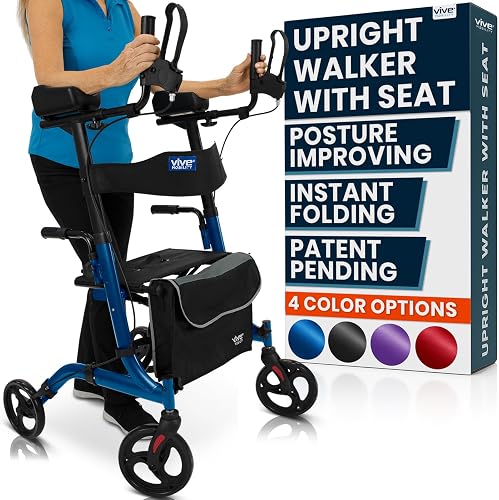
- Supports up to 300 lb
- 20 lb
- Folds for compact storage
- 8 in flat-free wheels
The standard Vive model weighs 20 lb and folds for storage or car transport. Its 300 lb capacity is lower than the bariatric model's.
Pros
- Lighter than the bariatric Vive
- Folds for transport
- Forearm pads adjust forward and backward
Cons
- Supports up to 300 lb
- Height range is intended for users 5 ft 2 in to 6 ft 4 in
Its handles adjust from 45 to 52 in, and its forearm pads move forward and backward to accommodate different arm lengths. It also has 8 in flat-free wheels, loop brakes and a 17.5 in seat.
The folding design can help with storage and car transport. Check your vehicle’s opening and storage space before buying, since folded dimensions aren't specified.
Is the standard Vive a better choice for travel?
It may be a better fit if you need a lighter frame that folds for transport. At 20 lb, it weighs 5 lb less than the bariatric model.
Choose the bariatric model if you need its higher stated capacity or wider seat. The standard Vive’s 300 lb limit and intended height range are important fit checks.
How does Vive compare with Helavo?
The Helavo Upright Walker offers 10 in rubber front wheels, padded armrests and a parking brake, with a 300 lb capacity. It weighs 22.7 lb and measures 26.4 in wide.
Helavo Upright Walker with Seat: Best for outdoor cushioning

- 10 in rubber front wheels
- Supports up to 300 lb
- 22.7 lb aluminum frame
- Padded armrests and adjustable handles
A useful alternative if you want 10 in rubber front wheels and a parking brake. Its frame weighs less than the bariatric Vive, but it supports up to 300 lb.
Pros
- 10 in puncture-proof rubber front tires
- Parking brake
- Cup holder and cane holder
Cons
- Supports up to 300 lb
- Wider than the standard Vive model
Helavo’s larger front wheels and rubber tires may suit outdoor paths. It also includes a cup holder and cane holder, plus a padded backrest and seat.
For a closer look, read our Helavo upright walker reviews. Consider the Vive standard model if folding and lower weight matter more, or the bariatric Vive if you need its 400 lb capacity.
Which Vive walker fits your body and home?
Choose by weight capacity, height range and doorway clearance first. A walker that fits those basics is more useful than one with features you can’t use comfortably in your home.
| Model | Weight capacity | Height or handle range | Width | Weight |
|---|---|---|---|---|
| Vive Bariatric Upright Walker | 400 lb | 5 ft to 6 ft 4 in | 30 in | 25 lb |
| Vive Mobility Upright Walker | 300 lb | Users 5 ft 2 in to 6 ft 4 in; handles 45 to 52 in | 25 in | 20 lb |
| Helavo Upright Walker with Seat | 300 lb | Height-adjustable handles | 26.4 in | 22.7 lb |
The bariatric Vive is widest and has the highest capacity. The standard Vive weighs the least, while Helavo has larger front wheels and a parking brake.
Check that the handle and forearm supports adjust to a comfortable position. If you’re unsure which arm support style suits you, compare an upright walker vs platform walker and discuss fit with a mobility professional.
What should you check before buying an upright walker?
Measure your route and check the walker’s fit before choosing accessories or color. Doorways, turns and storage space can rule out a model even when its capacity and seat look right.
Measure the narrowest doorway, then check hall turns and the space where you plan to sit. The bariatric Vive measures 30 in wide and may not fit through all doorways.
Compare handle height and arm support with your posture. The standard Vive’s adjustable handles and forearm pads suit a different range than the bariatric model’s stated height range.
Think about where you’ll use the walker. Larger wheels may suit outdoor paths, while a folding frame can help with car transport and storage.
If you’re still deciding between frame styles, our guide to upright walker vs rollator explains how the support positions differ. Ask a qualified mobility professional to help assess fit if you have balance concerns or need advice on using a walker.
What are the main trade-offs?
The bariatric Vive gives you more stated capacity and a wider seat, with a heavier and wider frame. The standard Vive is lighter and folds, with a lower capacity.
Helavo weighs 22.7 lb and measures 26.4 in wide. Its 10 in rubber front wheels and parking brake may suit outdoor use, and its 300 lb capacity is below the bariatric Vive’s.
For any model, follow its instructions before using it for support. Engage the brakes before sitting, as directed in the product instructions.
Which Vive upright walker should you choose?
Choose the Vive Bariatric Upright Walker for Seniors if its 400 lb capacity, wide seat and height range fit you, and your doorway measurements allow it. Choose the Vive Mobility Upright Walker with Seat if a 20 lb folding walker better suits your storage and transport needs.
Consider the Helavo Upright Walker with Seat if you want 10 in rubber front wheels and a parking brake. If walking support alone isn’t enough for the distances you travel, compare mobility scooters for walkers who need extra support.
Our score weighs specs, features and buyer feedback against what you’re shopping for.
Frequently asked questions
What is the difference between the Vive upright walkers?
The Vive Bariatric Upright Walker has a wide base, a padded wide seat and a stated 400 lb capacity; it weighs 25 lb and measures 30 in wide. The Vive Mobility Upright Walker weighs 20 lb, folds for transport and supports up to 300 lb.
Compare fit and doorway width before deciding.
Will the Vive Bariatric Upright Walker fit through a doorway?
It may not fit through all doorways. It measures 30 x 28 x 50 in, so measure the narrowest doorway, hall and turning space on your usual route before choosing this model.
Is the standard Vive upright walker foldable?
Yes. The Vive Mobility Upright Walker folds for compact storage and transport, and weighs 20 lb.
Its handles also fold, and the model supports users up to 300 lb.
Check your car opening and storage space, since folded dimensions aren't specified.
How do I choose between an upright walker and a rollator?
Choose based on your posture, arm support, balance needs and where you walk. Upright walkers use forearm supports, while many traditional rollators use lower handles; designs vary.
Compare the features of each model and ask a qualified professional for help assessing fit if needed.


