
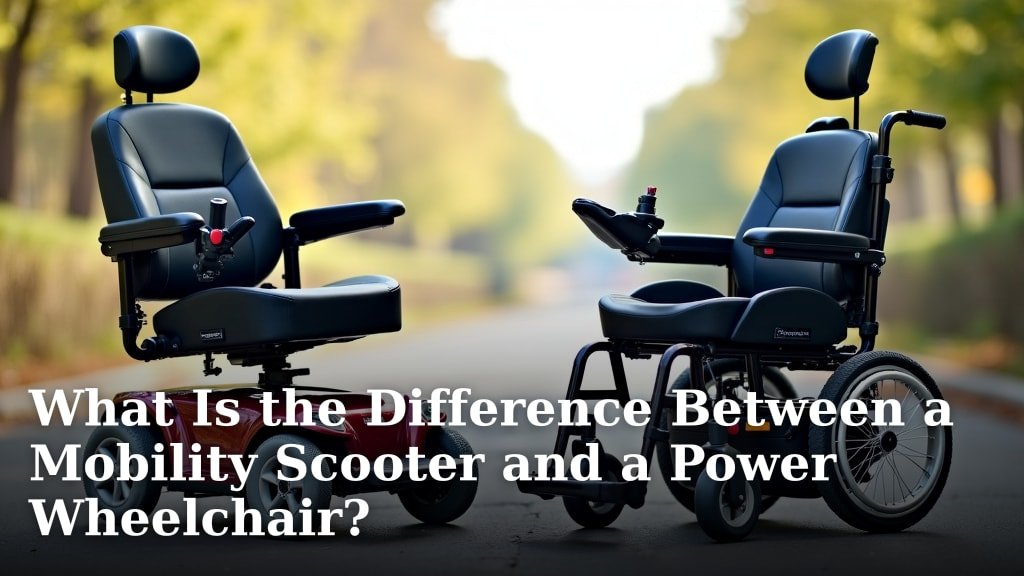
The main difference between a mobility scooter and a power wheelchair is how they are controlled and what each is designed to do. A mobility scooter uses a tiller for steering, much like a bicycle, and is ideal for people who can walk short distances and need help with longer trips. A power wheelchair uses a joystick for steering and is best for those who need continuous, full-time mobility assistance.
You might be wondering, “Which one is right for me?” Simply put, it depends on your mobility needs and dexterity. We found that scooters generally offer more speed and can be taken apart for transport. Power wheelchairs, conversely, provide superior maneuverability indoors and offer more seating options for comfort and support.
TL;DR:
- Mobility scooters use tiller steering, ideal for short-term use.
- Power wheelchairs use joystick control, great for full-time use.
- Scooters offer portability; power wheelchairs offer better indoor navigation.
- Your physical ability helps decide which device is best for you.
Let’s walk through everything you need to know about these essential mobility aids. We’ll help you understand the features and benefits of each one.
Understanding Mobility Aids: Scooters vs. Power Wheelchairs
Choosing between a mobility scooter and a power wheelchair can feel a bit like comparing apples and oranges, even though both help you move around. We found that the core differences lie in their design, how you control them, and the situations they’re best suited for. Your physical needs will often be the biggest deciding factor.
Mobility Scooter Insights
Mobility scooters are designed for people who can walk short distances or stand for transfers. Think of them as a personal vehicle for when your legs get tired. They often look like a three or four-wheeled scooter with a seat and handlebars.
How Do You Drive a Mobility Scooter?
You steer a mobility scooter with a tiller, much like steering a bicycle or a lawnmower. You use your hands and arms to guide the machine. Most models have a “delta” tiller, which offers a wrap-around handle, making it easier for those with limited hand dexterity. You typically press a lever with your thumb or finger to go forward or backward.
Scooter Structure and Design
Scooters usually come with a captain’s seat, which is comfortable for trips to the store or around the house. They often have a foot platform for your feet. This setup means your body is usually facing forward, making them great for navigating open spaces. Many models can be disassembled, or “portable,” allowing you to put them in a car trunk for travel (NIH).
When is a Mobility Scooter the Right Choice?
If you’re still quite active but need help with longer distances, a scooter might be perfect. You can walk into a restaurant, sit down, and then use your scooter to get across a large parking lot. We often see people using them for shopping, outdoor events, or exploring their neighborhood.
- You can stand and walk short distances.
- You have good upper body and hand strength.
- You need assistance for longer trips, not constant support.
- You prioritize portability and easy transport.
- You mostly use your device outdoors or in open indoor spaces.
Power Wheelchair Insights
Power wheelchairs are built for individuals who need more continuous, comprehensive mobility support. They offer a higher level of customization and are often prescribed when someone has significant limitations in walking or standing.
How Do You Drive a Power Wheelchair?
Power wheelchairs are typically controlled by a joystick. This small device allows for very precise movements with minimal effort. You can often operate it with just a finger or even a chin, which is a major benefit for people with conditions affecting their hands or arms. You can spin in place, something a scooter can’t do (Mayo Clinic).
Power Wheelchair Structure and Design
These chairs often feature more advanced seating systems, including specialized cushions and backrests, to provide pressure relief and postural support. Your feet usually rest on footplates that swing away for transfers. They are designed for stability and can come with various drive systems (front, mid, or rear-wheel drive) to suit different terrains.
When is a Power Wheelchair the Right Choice?
A power wheelchair is ideal if you need full-time mobility assistance. If walking or standing is difficult or unsafe for you, or if you need assistance with posture, a power wheelchair provides continuous support. We find they are excellent for navigating tighter indoor spaces, like homes or offices, due to their superior maneuverability.
- You need full-time mobility assistance.
- You have limited upper body strength or dexterity.
- You require postural support or pressure relief.
- You primarily use your device indoors or in confined areas.
- You need a device that can spin in its own footprint.
Key Differences at a Glance
Let’s break down the major distinctions between these two helpful devices. Thinking about how you spend your day can really help you choose the right one. Do you need to get around tight corners, or cruise through wide aisles?
| Feature | Mobility Scooter | Power Wheelchair |
|---|---|---|
| Control Mechanism | Tiller (like handlebars) | Joystick |
| Maneuverability | Wider turning radius, better in open spaces | Tight turning radius, excellent indoors |
| Seating Options | Standard captain’s seat | Highly customizable, postural support |
| Portability | Often disassembles for transport | Generally heavier, less portable |
| User Need | Can walk short distances, stands for transfers | Cannot walk or stand independently |
| Usage Environment | Shopping, outdoor activities, longer distances | Full-time use, home, medical appointments |
| Upper Body Strength | Requires more arm and hand strength | Requires minimal finger/hand movement |
Maneuverability and Control
Imagine trying to navigate a narrow hallway. With a scooter, you’d likely need to do a multi-point turn. A power wheelchair, however, can often swivel 360 degrees in place. This is a game-changer for getting around inside your home or a busy office (Cleveland Clinic).
Steering Limitations and Benefits
The tiller on a scooter requires you to use both arms to turn. This is fine if you have good arm strength. A joystick needs only one hand, or even just a finger, to operate. This makes power wheelchairs more accessible for those with conditions like arthritis or paralysis that affect arm movement.
Comfort and Seating
Scooters offer a pretty standard seat. They are comfortable for many, but they don’t usually provide much in the way of advanced support. Power wheelchairs, conversely, can be fitted with special cushions and backrests to prevent bedsores and maintain proper posture, which is vital for full-time users.
Adjustability Factors
You can often adjust the height and angle of a power wheelchair’s seat, leg rests, and even the backrest. Some models allow you to recline or stand up. These features are usually not found in scooters and are essential for those who spend many hours a day in their device.
Portability and Transport
If you love to travel and your mobility aid needs to go with you, this is a big one. Many scooters are designed to be quite portable. You can often break them down into lighter pieces that fit into a car trunk. Other scooters have folding mechanisms, making them even easier to transport.
Taking Your Mobility Aid on the Go
Power wheelchairs, while some smaller ones exist, are generally much heavier and bulkier. Transporting them often requires a wheelchair lift or ramp-equipped vehicle. This is because they contain larger batteries and more complex mechanics (National Institute on Aging).

Making Your Decision: A Helpful Checklist
Choosing the right mobility aid is a personal journey. Consider your daily routine, your physical capabilities, and where you’ll use the device most. Talk with your doctor or a physical therapist. They can offer personalized advice.
Here’s a checklist to help guide your thoughts:
- Can you stand and walk independently for short distances?
- Do you have enough upper body strength to steer a tiller?
- Do you prioritize portability for car transport?
- Will you primarily use your device outdoors or in open areas?
- Do you need advanced seating or postural support?
- Will you be using the device for most of your waking hours?
Answering these questions honestly can point you in the right direction. Remember, the best mobility aid is the one that best fits your life and helps you maintain your independence.
Conclusion
Choosing between a mobility scooter and a power wheelchair boils down to your specific needs and daily activities. We’ve seen that scooters offer portability and suit those who can walk short distances, making them great for shopping trips and outdoor events. Power wheelchairs, on the other hand, provide superior maneuverability and continuous support for individuals needing full-time assistance, especially indoors. Think honestly about your physical capabilities and your lifestyle.
The right choice will help you maintain independence and move through life with greater ease. We encourage you to consult with a healthcare professional or an occupational therapist. They can offer personalized recommendations to ensure you select the perfect mobility aid for you.
Frequently Asked Questions
Can a mobility scooter be used indoors?
Yes, some compact mobility scooters can be used indoors. However, their wider turning radius means they might struggle in tight spaces or narrow doorways.
Power wheelchairs generally offer much better maneuverability for indoor environments due to their joystick control and ability to turn in place.
Are mobility scooters and power wheelchairs covered by insurance?
Often, yes. Medicare Part B typically covers 80% of the approved cost for power wheelchairs and scooters as durable medical equipment (DME), if deemed medically necessary by a doctor. Private insurance plans vary, so always check with your provider.
What is the typical battery life for these devices?
Battery life varies widely depending on the model, terrain, user weight, and battery type. We found that most mobility scooters and power wheelchairs can travel between 10 to 20 miles on a single charge. Heavier use or rougher terrain will reduce this range.
Can I transport both devices in a regular car?
Transporting a mobility scooter is often easier, as many models disassemble or fold to fit into a car trunk. Power wheelchairs are generally heavier and bulkier.
You might need a specialized vehicle lift or ramps to transport most power wheelchairs, especially the larger, more robust models.
Is one device safer than the other for outdoor use?
Both devices can be safe for outdoor use, but their suitability differs. Scooters often handle varied outdoor terrains better, given their design for wider spaces and sometimes larger wheels. Power wheelchairs, especially those with larger tires and robust suspension systems, also perform well outdoors.
Ultimately, safety depends on the specific model and the environment you’re navigating.
