8 Best Rubber Threshold Ramps (November 2026)
The best rubber threshold ramps include the VEVOR Rubber Threshold Ramp for adjustable door widths, the VEVOR 3" Rise Rubber Threshold Ramp for taller door sills, and the Silver Spring Solid Rubber Threshold Ramp for wide doorways.
On this page (11 sections)
- Which rubber threshold ramp suits your doorway?
- How we chose these rubber threshold ramps
- How do the rubber threshold ramps compare?
- Best rubber threshold ramps reviewed
- What should you measure before choosing a rubber threshold ramp?
- How do you set up a rubber threshold ramp?
- Are rubber threshold ramps right for every doorway?
- What mistakes should you avoid with a threshold ramp?
- How should you care for and use a rubber ramp?
- Should you choose rubber or another ramp style?
- Which best rubber threshold ramp should you choose?
The VEVOR Rubber Threshold Ramp is the best rubber threshold ramp for many modest door sills, with a 1.6 in rise, cuttable width and grooved surface. For a low strip, broad opening or taller step, choose a pick whose height and footprint match the doorway.
Rubber threshold ramps bridge small level changes for wheelchairs, walkers, scooters, carts and other wheeled items. For more options, see ramps for wheelchairs.
The right choice depends on the measured threshold, the clear opening, the available floor space and how the ramp will stay in place.
For a broader look at access options, see our guide to ramps, lifts and stair lift options. If the rise is your main concern, start with threshold ramp height.
Our picks at a glance
-
1

-
2

-
3

- 4
 Check it
Nuvium 1" Rise Rubber Threshold Ramp
Best for low door sills - 5
 Check it
Linkloos 1.5" Rise Rubber Threshold Ramp
Best for custom 1.5 in fits - 6
 Check it
Heonay Threshold Ramps for Doorways Self-Adhesive Rubber
Best for tiny sill edges - 7
 Check it
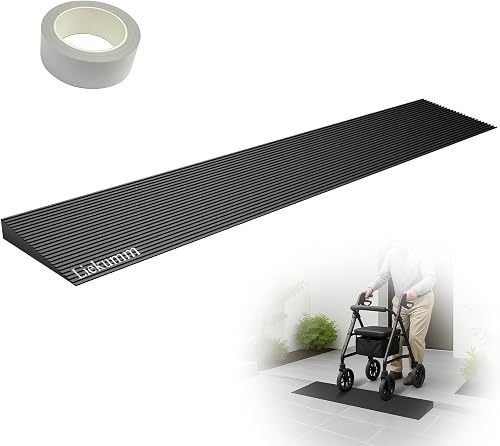
LIEKUMM 3/4" Rubber Threshold Ramp for Doorways
Best for shallow approaches - 8
 Check it
Silver Spring Rubber 3-Channel Threshold Ramp
Best for cable crossings
Which rubber threshold ramp suits your doorway?
The best rubber threshold ramp depends on its rise, width and depth, along with how you plan to use the doorway. These eight options cover very small sill edges, low transitions, wider openings and 3 in rises.
How we chose these rubber threshold ramps
We compared each ramp's stated dimensions, surface, placement details and intended use. The picks cover different threshold heights and doorway needs, so the best fit depends on your measurements rather than one feature in isolation.
A load capacity does not confirm that a ramp will fit your device or doorway. Check the ramp dimensions and instructions, then account for the approach and the door's swing.
How do the rubber threshold ramps compare?
Compare rise first, then check width and depth against the opening and available floor space. The comparison below helps you shortlist a suitable shape and size before checking the individual picks.
| Product | Best for | Rise | Width | Material | Our score |
|---|---|---|---|---|---|
| VEVOR Rubber Threshold Ramp | adjustable door widths | 1.6 in | 35.4 in, cuttable | Solid rubber | 9.7 |
| VEVOR 3" Rise Rubber Threshold Ramp | taller door sills | 3 in | Rubber | 9.5 | |
| Silver Spring Solid Rubber Threshold Ramp | wide doorways | 1.5 in | 43.5 in | Molded rubber | 9.4 |
| Nuvium 1" Rise Rubber Threshold Ramp | low door sills | 1 in | Rubber | 9.4 | |
| Linkloos 1.5" Rise Rubber Threshold Ramp | custom 1.5 in fits | 1.5 in | Solid rubber | 9.2 | |
| Heonay Threshold Ramps for Doorways Self-Adhesive Rubber | tiny sill edges | 0.4 in | Rubber | 9.1 | |
| LIEKUMM 3/4" Rubber Threshold Ramp for Doorways | shallow approaches | 0.8 in | Rubber | 9.0 | |
| Silver Spring Rubber 3-Channel Threshold Ramp | cable crossings | 3 in | Rubber | 8.9 |
Best rubber threshold ramps reviewed
The VEVOR 1.6 in model is the leading general pick for a modest rise and adjustable width. The other ramps fit distinct situations, including taller sills, low strips, broad doorways and cable crossings.
VEVOR Rubber Threshold Ramp: Best for adjustable door widths
- 1.6 in rise
- 35.4 in wide and cuttable
- Grooved non-slip surface
- Double-sided tape included
The cuttable 35.4 in width and 1.6 in rise suit doorways with a modest step. Grooves and included double-sided tape help with traction and placement.
Pros
- Cuttable width
- Double-sided tape included
- Grooved surface
Cons
- 7.9 in depth may not suit every approach
- Rubber may have a slight smell at first
The VEVOR Rubber Threshold Ramp suits a doorway with a modest rise when the standard width needs trimming. Its 1.6 in rise works for thresholds near that height, while its 35.4 in width can be cut to fit a narrower opening.
The grooved surface is designed to add traction, and the included double-sided tape helps secure it to smooth tile or floors. The ramp is 7.9 in deep, so check that it leaves enough room for a clear approach.
This pick is a practical match for someone who wants one solid ramp that can be sized to the doorway. Skip it if the threshold is far below or above 1.6 in, the approach needs more depth, or the floor is unsuitable for the included tape.
VEVOR 3" Rise Rubber Threshold Ramp: Best for taller door sills
- 3 in rise
- 35.5 in long and 17.7 in wide
- Beveled edges
- Grooved tread surface
A broad 3 in ramp with beveled edges gives a gradual approach from multiple sides. The grooved surface is designed to add traction.
Pros
- Beveled edges on all sides
- Grooved tread
- One-piece design
Cons
- 17.7 in depth needs more floor space
- Confirm the 3 in rise matches the threshold
The VEVOR 3" Rise Rubber Threshold Ramp is meant for a taller 3 in threshold with enough room for a broad approach. Its 35.5 x 17.7 in footprint uses considerably more floor space than a low sill strip.
Beveled edges on all sides provide an approach from multiple directions, and the grooved tread is designed for traction. Its one-piece design needs no assembly, which can be useful when the ramp will be moved between locations.
Choose it when a 3 in rise and wide approach suit the doorway. Skip it when floor depth is limited or the threshold is much shorter.
For more options at this height, compare our best rubber threshold ramps for a 3 inch rise.
Silver Spring Solid Rubber Threshold Ramp: Best for wide doorways
- 1.5 in rise
- 43.5 in wide platform
- Built-in drainage channels
- Beveled side edges
Its 43.5 in width and beveled edges suit wide openings. Drainage channels and a textured surface are designed to support traction.
Pros
- Wide platform
- Drainage channels
- 1-year manufacturer warranty
Cons
- Fixed size
- Measure doorway width before ordering
The Silver Spring Solid Rubber Threshold Ramp fits a 1.5 in rise and a wide opening where trimming the ramp is not needed. Its 43.5 in width provides a broad platform, with beveled side edges and a 12.5 in depth.
Molded drainage channels run through the textured surface, a useful feature where rain or tracked-in water may reach an outdoor entrance. Silver Spring includes a 1-year manufacturer warranty.
Choose this ramp when the fixed width fits your doorway and a broad platform matters. Skip it if you need to trim the ramp, have a narrow approach, or need a different rise.
Nuvium 1" Rise Rubber Threshold Ramp: Best for low door sills
- 1 in rise
- 35.5 in wide and cuttable
- Grooved surface
- Adhesive strips included
This low-profile ramp suits a 1 in threshold and can be trimmed for a narrower opening. Adhesive strips are intended for clean, dry, smooth surfaces.
Pros
- Low 1 in rise
- Can be cut to fit
- Adhesive strips included
Cons
- Check floor compatibility before use
- May bend slightly after packaging
The Nuvium 1" Rise Rubber Threshold Ramp is a fit for a low sill near 1 in and a doorway that needs a width adjustment. It measures 35.5 in wide and 5.3 in deep, and can be trimmed.
Grooves are designed to add traction in wet or dry conditions. Adhesive strips are included for clean, dry, smooth surfaces, so check flooring compatibility before placing them.
Choose it when the 1 in rise is close to your measurement and the shallow depth suits the doorway. Skip it if the floor may absorb color or the ramp's adhesive is unsuitable.
A slight curve may appear after packaging; pressing the ramp flat with a heavy object can help it recover.
Linkloos 1.5" Rise Rubber Threshold Ramp: Best for custom 1.5 in fits
- 1.5 in rise
- 35.4 in wide
- Beveled edges
- Can be cut to fit
The 1.5 in rise and cuttable width give you room to adjust the ramp to a doorway. Beveled edges provide an approach from multiple sides.
Pros
- Can be cut to fit
- Beveled edges
- Indoor and outdoor use
Cons
- Measure both rise and opening width
- No adhesive is specified
The Linkloos 1.5" Rise Rubber Threshold Ramp is a cuttable choice for a moderate rise. It measures 35.4 in wide and 7.87 in deep, with beveled edges that allow an approach from multiple sides.
Its textured surface is designed to increase friction, and the one-piece ramp can be moved without assembly. Linkloos describes it for indoor and outdoor use with wheelchairs, scooters and carts.
Choose it when you want a 1.5 in ramp that can be trimmed to the opening. Skip it if you need an included adhesive or a fixed, very broad platform.
Measure the threshold and available depth before deciding.
Heonay Threshold Ramps for Doorways Self-Adhesive Rubber: Best for tiny sill edges
- 0.4 in rise
- 39.4 in long
- Self-adhesive backing
- Can be cut to length
The narrow 2 in strip can reduce a small sill edge. Its self-adhesive backing and cuttable length support a custom fit.
Pros
- Narrow profile
- Self-adhesive backing
- Can be cut to length
Cons
- Only 0.4 in high
- Measure the threshold and opening first
The Heonay Threshold Ramps for Doorways Self-Adhesive Rubber is a narrow strip for a very small edge, not a full-height doorway ramp. It measures 39.4 in long, 2 in wide and 0.4 in high.
Grooves are designed to create drainage paths and add friction, while the self-adhesive backing is intended to secure the strip without nails or glue. It can be cut to length for the opening.
Choose it when the sill is only about 0.4 in and a narrow strip is enough for the wheel path. Skip it for a larger rise or when a wider, more gradual approach is needed.
LIEKUMM 3/4" Rubber Threshold Ramp for Doorways: Best for shallow approaches
- 0.8 in height
- 6 in depth
- 35.5 in wide and cuttable
- Adhesive strips included
A shallow 6 in depth and low profile suit small transitions where a taller ramp is unnecessary. You can trim it to fit a narrower opening.
Pros
- Low profile
- Cuttable width
- Adhesive strips included
Cons
- Measure the threshold height before choosing
- Check the door clearance
The LIEKUMM 3/4" Rubber Threshold Ramp for Doorways suits a low sill where floor space is tight. It measures 35.5 in wide and 6 in deep, with a listed height of 0.8 in.
The grooved surface is designed to improve traction, and the ramp can be cut to a narrower width. Adhesive strips are included for smooth floors.
Choose it when the shallow depth matters and the sill is close to 0.8 in. Skip it if the threshold is taller or if the door clearance is too low; check both before fitting the ramp.
Silver Spring Rubber 3-Channel Threshold Ramp: Best for cable crossings
- 3 in rise
- Three underside channels
- Grooved rubber texture
- 600 lb capacity
Three channels underneath route hoses, cables and small wires across an entryway. Its 3 in rise is designed for wheelchairs, scooters and power chairs.
Pros
- Three cable channels
- Grooved texture
- Indoor and outdoor use
Cons
- 600 lb stated capacity
- Large footprint needs space
The Silver Spring Rubber 3-Channel Threshold Ramp is the specialized option for entryways where small cables, hoses or wires need to cross. Three channels underneath route those items, while the grooved rubber texture is designed for traction.
Its footprint is 42 in wide and 24 in deep, with a 3 in rise. The stated capacity is 600 lb, so compare that limit with the intended load.
Choose it when the channels solve a real crossing problem and the large footprint fits the entryway. Skip it for a simple low sill or when you need a higher capacity.
What should you measure before choosing a rubber threshold ramp?
Measure the threshold rise, clear doorway width and available floor depth before choosing a rubber threshold ramp. These dimensions rule out ramps that are too high, too narrow or too large for the space.
For the rise, measure vertically from the lower floor to the top of the threshold. Measure the clear opening between the sides of the doorway, rather than the outer door frame.
Depth matters because the ramp occupies floor space and determines how much room remains for an approach. For a sliding glass door, compare threshold ramps for sliding doors.
Check both sides of the threshold if the user must cross it from either direction, and account for the door swing.
If the rise is close to 2 in, compare your measurements with the best rubber threshold ramps for a 2 inch rise. For a higher step, review the options for a 5 or 6 inch rise.
How do you set up a rubber threshold ramp?
Set up a rubber threshold ramp on a firm, level surface after checking that its height and width fit the doorway. Follow the instructions for the specific model, since adhesive, cutting and placement can differ.
- Clear the area. Remove grit, loose items and anything that could catch a wheel or prevent the ramp from sitting flat.
- Place the ramp without securing it. Center it in the intended path and check that its edges meet the floor and threshold as intended.
- Check the door. Open and close it through its normal swing. Make sure it clears the ramp and that the ramp does not block the doorway.
- Secure it as directed. Use included adhesive only on suitable surfaces. Press it into place as instructed, and do not assume tape will work on dusty, damp, rough or unsuitable flooring.
- Check stability before regular use. Confirm that the ramp does not rock or shift. Recheck it after moving it or cleaning the area.
For cuttable models, measure twice and follow the product instructions before trimming. Cutting too much can leave the ramp too narrow for a stable path.
Are rubber threshold ramps right for every doorway?
Rubber threshold ramps work for many small level changes, but a fixed ramp can block a door or sit poorly on an uneven floor. Compare threshold and modular ramps when choosing a ramp type.
Check the ramp's dimensions, door swing, surface and placement instructions before use.
Some models here are cuttable, while the Silver Spring wide platform is fixed size. Adhesive strips can help reduce movement on suitable smooth surfaces, but they do not replace checking that the ramp stays in place.
A narrow strip suits only a very small edge. A 3 in rise needs a deeper ramp and more clear floor space, while a larger or longer access route may call for another ramp style.
If you need a height-adjustable option, compare a best adjustable threshold ramp.
What mistakes should you avoid with a threshold ramp?
The most common mistake is choosing by doorway width alone and overlooking rise or depth. A ramp can span the opening yet still leave an abrupt edge or crowd the approach.
Avoid these errors:
- Guessing the rise: Measure from the lower floor to the top of the threshold. Do not choose a ramp just because its height sounds close.
- Ignoring the door: Check the full swing and clearance. A ramp that prevents the door from closing may make the doorway less useful.
- Assuming every surface accepts adhesive: Included tape is intended for particular surfaces. Follow the instructions and check the floor first.
- Trimming before checking the path: Mark the clear opening and the user’s wheel path before cutting. Keep enough width for the device to cross safely.
- Treating traction as a substitute for stability: Grooves can support grip, but the ramp still needs to sit flat and stay in position.
- Overlooking capacity: Compare the stated load limit with the intended user and equipment, and follow the product instructions.
- Using a shallow strip for a tall step: A 0.4 in strip cannot bridge a much higher threshold. Match the rise to the measured step.
If a ramp shifts, rocks or leaves an unexpected edge, stop using it until you can correct the fit and placement. A poorly seated ramp can create a new obstacle.
How should you care for and use a rubber ramp?
Keep a rubber threshold ramp clean, dry where possible and clear of loose dirt. Check its position and surface regularly, especially after moving it or after outdoor use.
Wipe or rinse away dirt according to the product instructions, then let the ramp and floor dry before relying on adhesive placement. Clear grooves and channels so debris does not build up and interfere with traction or cable routing.
Inspect the edges and underside for movement, curling or damage. If the ramp no longer lies flat or stays in place, reassess its position and attachment before use.
Some rubber ramps may have a slight odor when new. Ventilating the area can help it fade.
For a ramp that arrives curved, follow the product guidance; Nuvium describes pressing it flat with a heavy object for a while.
Should you choose rubber or another ramp style?
Choose rubber when a solid threshold piece can bridge the small level change and fit the available floor space. A different ramp style may be more appropriate for a longer route, a portable setup or access between floors.
For an extended mobility scooter route, see our Best Mobility Scooter Ramp guide. If you're weighing a ramp against a lift for a larger access problem, our complete guide covers ramps, lifts and stair lift options.
Which best rubber threshold ramp should you choose?
Choose the VEVOR 1.6 in model for a modest rise and a width you can trim. Pick the 3 in VEVOR when the threshold is taller and the 17.7 in depth fits; choose the Silver Spring wide platform when the opening is broad and its fixed size works.
For a low sill, compare the Nuvium 1 in ramp with the LIEKUMM 0.8 in ramp by exact rise and available depth. Choose Heonay only for a very small edge, or Silver Spring 3-Channel when its cable channels are useful.
Measure the rise, clear width and approach space before buying. If the right height remains unclear, use our threshold ramp height guide to narrow the choice.
Our top 3 picks at a glance
-
1
-
2
-
3
Frequently asked questions
How do you choose the right rubber threshold ramp?
Measure the threshold rise, clear doorway width and available floor depth, then choose a ramp that fits all three. Match the ramp height to the rise and check the device path, door swing, surface and placement method before you buy.
A ramp that is too tall or too short can leave an awkward edge.
Are rubber threshold ramps suitable for wheelchairs?
A rubber threshold ramp can suit a wheelchair when its rise, depth and width match the doorway and the chair's approach. Check the ramp's stated capacity and placement, then make sure the chair can approach and cross it without a door or nearby furniture blocking the path.
For longer routes, see our Best Mobility Scooter Ramp guide.
Can you cut a rubber threshold ramp to fit?
Several options here are described as cuttable, including the VEVOR, Nuvium, Linkloos and Heonay models. Measure the clear opening and follow the product's cutting instructions before trimming, since a cut changes the ramp's width or length.
The Silver Spring wide platform is fixed size.
How do you measure for a threshold ramp?
Measure vertically from the lower floor to the top of the threshold for the rise. Then measure the clear doorway width and the floor depth available on each side, including any space needed for a door to swing.
Our threshold ramp height guide explains how to use those measurements.


