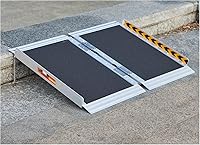
Portable Wheelchair Ramp for 2 to 6 Steps: Which Length?
For a portable wheelchair ramp for 3 steps, measure the total rise and choose a ramp length that fits the user, device and available run. Step count alone can’t tell you whether a ramp is long enough or gentle enough.
On this page (7 sections)
- How do you choose a portable wheelchair ramp for 3 steps?
- What should you check besides the number of steps?
- When is a threshold ramp a better fit?
- How should you set up and care for a portable ramp?
- What common ramp-buying mistakes should you avoid?
- Which ramp length should you choose?
- What length portable wheelchair ramp do you need for 3 steps?
A portable wheelchair ramp for 3 steps should be chosen by total rise and suitable slope, not by step count alone. Measure from the lower approach to the top landing, then check the available run and whether the mobility device fits.
Step count gives only a rough idea of the job ahead. Two shallow steps can be easier to cross than three tall ones, and the same number of steps can point to very different ramp lengths.
That is why total rise matters more than the number printed in a search term. Rise tells you how high the ramp must climb, and slope tells you how much ground it needs to do that climb in a manageable way.
The available run is the clear ground length where the ramp can sit at its intended angle. A ramp may be long enough on paper yet fail in real use if a path, parked vehicle, door swing or tight landing cuts into that run.
Device fit matters just as much as the entrance measurement. A wheelchair, scooter or walker needs usable width and enough room for its wheels to travel without catching on raised edges or guide rails.
Load also belongs in the early checks. The combined weight of the user, the mobility device and any items carried with them should sit within the ramp limit stated for the model under consideration.
Start with our guide to ramps, lifts and stairlifts for an overview of access choices. That overview helps place a portable ramp beside fixed ramps, lifts and stair lifts, so you can see when a portable model is a stopgap and when a more permanent change makes more sense.
If the entrance has a smaller rise at the doorway, compare wheelchair ramps for front door steps. A sill or low landing may need a different style from a short flight of steps, even when both sit at the front door.
For three steps, work through the entrance in order. Measure the rise, pace out the run, picture the top and bottom landings, and test whether the device can approach and leave without a sharp turn.
If any one of those checks fails, do not force the fit. A ramp that is too steep, too narrow or unable to sit as instructed can make daily use harder rather than easier.
Also think about who will move and store the ramp. A portable model that folds for storage still needs to be lifted, carried and placed correctly each time it is used.
Weather and surface can change the decision too. A ramp for outdoor use should suit the ground where it will sit, and its surface should be kept clear of dirt and moisture that reduce traction.
When the rise is small and the space is clear, a short portable ramp may be the practical answer. When the rise is larger or the run is limited, a longer ramp or another access option may be needed.
Getting the measurements right first saves you from buying by step count and hoping the entrance will cooperate. The entrance will not change to suit the ramp, so the ramp has to match the entrance, the user and the device together.
How do you choose a portable wheelchair ramp for 3 steps?
Measure the total rise first, then choose a ramp length that follows its guidance for the person and mobility device. Count the steps only as a rough clue until you know the actual height.
Measure vertically from the lower approach surface to the top landing. For a step-by-step method, see how to measure a wheelchair ramp.
Don’t measure along the stair noses, and measure at the spot where the ramp will sit if the ground slopes.
A longer ramp generally spreads the same rise over more distance, creating a gentler slope. It also occupies more ground, so the entrance needs clear space at the bottom and top.
| Step count | What to measure | Length decision |
|---|---|---|
| 2 steps | Combined vertical rise | Check whether a short ramp’s height guidance covers the rise |
| 3 steps | Ground to top landing | Compare the rise with ramp guidance and available run |
| 4 steps | Ground to top landing | Expect to need more length as the rise increases |
| 5 steps | Ground to top landing | Check whether a portable ramp fits without blocking the route |
| 6 steps | Ground to top landing | Consider a longer ramp or fixed access option if space is limited |
This is a measuring prompt, not a length chart. Step heights differ, and the slope a person can manage depends on their mobility device, abilities and setting.
For more length and style options, see our guide to portable ramps for steps.
What does a portable wheelchair ramp for 2 steps need to cover?
A portable wheelchair ramp for 2 steps must cover the combined rise and leave enough room for a practical approach and landing. Two tall steps can require more ramp than several shallow ones.
The FACHNUO 2 ft ramp is intended for height adjustments from 2 to 6 in. Its guidance recommends a step height no greater than 4 in for wheelchair access, so compare your measurements with that limit and the ramp’s instructions.
The ramp weighs 10.9 lb and has a carrying handle. Its guidance gives a maximum wheelbase of 27 in and calls for the front extension plate to sit fully flush with the ground.
Choose this model only when the rise and chair dimensions match its guidance. Skip it if the slope would be too steep, if the wheelchair wheelbase exceeds its limit, or if the ramp cannot sit securely.
What about a portable wheelchair ramp for 4 steps or 5 steps?
A portable wheelchair ramp for 4 or 5 steps needs to match the measured rise, not an estimated step count. More steps often mean a greater rise, which calls for more ramp length and more clear space.
The FACHNUO 6 ft ramp is recommended for heights from 6 to 18 in. Its guidance advises against choosing a ramp shorter than four times the step height, so check both the actual rise and the available run before deciding.
This ramp unfolds to 72 in and weighs 35.2 lb. It has an 800 lb maximum load, a non-slip layer and a pleated surface.
Consider it when the rise is within its stated range and there’s enough room to place it as instructed. Skip it if the measured rise falls outside its guidance, the route is too short for its length, or its weight makes routine setup impractical.
Can a portable wheelchair ramp for 6 steps fit?
A portable wheelchair ramp for 6 steps may need a long run, so check the site before choosing a portable model. The entrance’s rise may exceed a compact ramp’s guidance, and a longer ramp needs more room at both ends.
Measure the full distance from the lower approach to the top landing, including space for the ramp ends to rest. Check for doors, paths, parked vehicles and turning space that could conflict with the ramp.
Longer ramps can be harder to position and carry. If the necessary length won’t fit, compare a fixed ramp, lift or stair lift with an access professional.
Our ramps, lifts and stairlifts buying guide describes those options.
What should you check besides the number of steps?
Check the rise, run, usable width, landing space and device fit before using a ramp. A ramp can reach the landing and still be unsuitable if it shifts, blocks a door or exceeds its load limit.
Measure and verify these points before you buy:
- Total rise: vertical height from the lower surface to the upper landing.
- Available run: clear ground length for the ramp at its intended slope.
- Usable width: enough room for the chair or mobility aid, with its wheels clear of side barriers.
- Top and bottom space: room to approach, leave and turn without a sharp maneuver.
- Door movement: clearance for a swinging door or sliding door track.
- Loaded weight: the user, chair and carried items together.
- Chair fit: wheelbase and overall dimensions within the ramp’s stated limits.
The FACHNUO 2 ft model has raised side walls and an extension plate. Near a threshold, those parts can affect door movement; next to a sliding door, the plate can obstruct the track.
The 6 ft model’s guidance says some sinking during use is normal and that it should rebound afterward. Follow its placement and use instructions, and stop if the ramp feels unstable or cannot be positioned as directed.
Match the device as carefully as the rise. A ramp’s overall width isn’t always the same as its clear travel width, so check where its rails, edges and wheel paths fall.
When is a threshold ramp a better fit?
A threshold ramp is for a small doorway rise, not a flight of stairs. Compare threshold and modular ramps for doorway access.
It can help with a raised sill or landing when the height and doorway layout match the ramp.
The EZ-ACCESS TRANSITIONS modular threshold ramp has height options from 1 to 6 in, with a pivoting flap that allows adjustment up to 6 1/4 in. Removable sections can lower it, and extension pieces can build it higher.
This version measures 34 in long by 9.5 in wide by 1.5 in high and has a 700 lb load capacity. Check the selected height configuration and doorway width against your space.
Choose this style for a sill or small rise. Skip it for multiple full-height steps, where a longer ramp or another access method is needed.
How should you set up and care for a portable ramp?
Set up a portable ramp on a stable surface, with both ends seated as its instructions require. Check the position before each trip, especially if the ramp has been moved or the ground is wet.
A careful setup routine helps catch fit and clearance problems before someone uses the ramp:
- Clear the route of loose items, cords, leaves and other obstructions.
- Confirm that the lower and upper surfaces are stable and that the ramp reaches both.
- Position the ramp in line with the approach, without a sharp turn at either end.
- Make sure the front extension plate and other contact points sit as instructed.
- Check that rails or raised edges won’t catch the device or interfere with a doorway.
- Keep the door, sliding track and landing clear.
- Confirm that the chair fits and the combined load is within the stated limit.
Avoid placing a portable ramp on loose gravel, an uneven surface or a slick area if it can move or rock. Don’t add blocks or make other changes to the ramp’s support unless its instructions allow them.
Keep the surface clear of dirt, moisture and debris that could reduce traction. After outdoor use, wipe it dry before folding and storing it, and check the hinge, surface and edges for visible damage.
Don’t use the ramp if it’s damaged, unstable or out of position. Follow the care instructions for the specific model, and ask the manufacturer or an access professional about a concern that affects safe setup.
What common ramp-buying mistakes should you avoid?
The most common mistake is buying by step count instead of measured rise. A second is choosing a length without checking whether it fits the site and the user’s mobility device.
Watch for these errors:
- Guessing the height: Measure the full vertical rise instead of multiplying a guessed step height.
- Choosing the shortest ramp that reaches: A ramp that fits the entrance may still create a slope the user can’t manage.
- Ignoring the run: Check ground length before buying a longer model.
- Checking width but not wheelbase: The FACHNUO 2 ft ramp has a 27 in wheelbase limit, so a chair that exceeds it won’t fit its guidance.
- Forgetting combined weight: Compare the user, chair and carried items with the ramp’s load limit.
- Missing door clearance: A ramp end or extension plate can interfere with a swinging door or sliding track.
- Assuming portable means easy to carry: The FACHNUO 6 ft model weighs 35.2 lb, which may make repeated setup difficult for one person.
- Using a threshold ramp on stairs: A doorway ramp for a small rise doesn’t replace a ramp designed for a stair run.
If someone else will set up the ramp, include their ability to lift, carry and position it in the buying decision. A ramp that fits on paper may not be practical if the person responsible for it cannot handle it safely.
Which ramp length should you choose?
Choose the shortest model that meets its height guidance, suits the user and device, and leaves room for a manageable slope and secure landings. If that length doesn’t fit the site, move to another access solution instead of forcing a steep ramp into the space.
Use this decision path:
- Measure the full vertical rise.
- Check the ramp’s height and length guidance.
- Confirm that the user’s mobility device fits its usable width and wheelbase limits.
- Compare the ramp length with clear run and landing space.
- Check the user, chair and belongings against the load limit.
- Confirm that the ramp can be positioned as instructed without blocking a door or route.
For a small rise within the stated range, the FACHNUO 2 ft ramp is the compact choice, provided the chair fits its wheelbase limit. For a larger rise that fits its 6 to 18 in guidance and has enough clear run, the FACHNUO 6 ft ramp is the portable option.
For a doorway sill or small threshold, the EZ-ACCESS modular ramp offers adjustable height options. If none of these fits the rise, user, device and space together, consider a fixed ramp or lift assessment.
For ramp options with a platform, see wheelchair ramps with platforms.
If you’re still comparing access equipment, see our guides to portable wheelchair ramps for steps and portable wheelchair ramps. If you’re selecting a device for the route, our portable mobility scooter guide and portable mobility scooters guide can help you compare mobility options.
What length portable wheelchair ramp do you need for 3 steps?
For a portable wheelchair ramp for 3 steps, measure the rise and select a length that follows the ramp’s guidance for the user and mobility device. Step count doesn’t give the exact height, and a 6 ft ramp may or may not fit the entrance.
Three steps can mean a gentle climb or a steep one. Measure vertically from the lower approach to the top landing, at the exact spot where the ramp will sit.
Then check whether the ground has room for a ramp that spreads that rise over a manageable slope. A longer ramp needs more clear run, plus space at both ends for the device to arrive and leave safely.
Confirm that the mobility device fits the ramp width and wheelbase guidance. Also compare the combined weight of the user, the device and carried items with the stated load limit.
Think about setup and storage as part of the choice. The person who will lift, carry and place the ramp needs to be able to do so each time, not only on the first day.
Choose by measured rise, manageable slope, clear run and landing space. If the ramp is too steep or can’t be positioned as instructed, ask an access professional to review the site.
Frequently asked questions
What length wheelchair ramp do I need for 3 steps?
Measure the vertical rise from the lower surface to the top landing, then check ramp length guidance for the user and mobility device. Three steps can have different total heights, so the step count alone can’t determine a safe fit.
Check the ramp’s instructions, available run and landing space.
Ask an access professional to review the site if the route is steep or uncertain.
Can a 2 ft ramp work for two steps?
A 2 ft ramp may suit a small rise if the user, device and setup match its guidance. The FACHNUO 2 ft model is intended for height adjustments from 2 to 6 in, and its guidance says wheelchair step height should not exceed 4 in.
Measure the rise and verify the chair’s wheelbase before use.
How much longer should a ramp be than the step height?
The right ramp length depends on the rise and the slope appropriate for the user, mobility device and setting. A longer ramp spreads the rise over more distance, but it also needs more clear ground space and stable placement.
Follow the ramp’s guidance and applicable accessibility requirements instead of using one length rule for every situation.
Can a portable ramp be used with a power wheelchair?
Some portable ramps are designed for power wheelchairs, but fit depends on usable width, load limit, wheelbase and slope. Check the chair’s dimensions and the combined weight of the user, chair and carried items against the ramp’s instructions.
Have an access professional assess a steep or frequently used route.
What should I measure before buying a portable ramp?
Measure the vertical rise, available ramp run, usable width, top and bottom landing space, and the door’s swing or track. Also compare the chair’s wheelbase and total loaded weight with the ramp limits.
A ramp can match the rise and still block a door or leave too little room for safe transitions.