9 Best Upright Walkers for Parkinson's (November 2026)
The best upright walkers for Parkinson's include the ELENKER Upright Walker for adjustable fit, the Helavo Upright Walker with Seat for outdoor walks, and the Vive Mobility Upright Walker with Seat for taller walkers.
On this page (7 sections)
- Which upright walker for Parkinson's fits your needs?
- What should you check before buying an upright walker for Parkinson's?
- How should you set up and practice with a new upright walker?
- What common upright-walker mistakes should you avoid?
- Should you compare an upright walker with a rollator?
- When could a mobility scooter make more sense?
- Which is the best upright walker for Parkinson's?
The ELENKER is our top pick among upright walkers for Parkinson's because its forearm tubes, handlebar and leg tubes adjust to help you find a comfortable position. Ask a physical therapist to assess fit, balance, grip and brake control before you rely on a new walker.
The best upright walker for Parkinson's depends on the person's walking pattern and daily routes. Some people value forearm support and a seat for short rests, while others need a narrow frame to get through a doorway or a lighter walker to lift into a car.
A walker can support walking, but it doesn't address every change in movement. In particular, if you experience freezing, trouble turning or difficulty stopping, get advice from a clinician or physical therapist about the aid and strategies that fit your needs.
If you're still comparing frame and support styles, start with our walkers and rollators buying guide and guide to the safest walker for seniors. For other options, see walkers for seniors with balance problems.
Our picks at a glance
-
1
-
2

-
3
- 4
 Check it
Agrish Narrow Walker Folding Upright Walker
Best for tight doorways - 5
 Check it
Helavo 28.3" Extra Wide Bariatric Upright Walker
Best for extra seat room - 6
 Check it
StrollAid Upright Walkers for Seniors with Seat
Best for mixed terrain - 7
 Check it
Aliseniors Upright Walker for Seniors
Best for roomy breaks - 8
 Check it
HOMLAND Upright Walker with Seat for Seniors
Best for varied heights - 9
 Check it
BlessReach Heavy Duty Upright Rollator Walker
Best for carpet routes
Which upright walker for Parkinson's fits your needs?
The right choice depends on fit, routes, brake control and whether you need a seat. We compared the adjustment points, wheels, brakes, frame dimensions and other features described for each walker.
Scores help sort the options by how their stated features match common buying needs. They can't predict how a walker will work with an individual person's Parkinson's symptoms, so use the comparisons to narrow the field and then check fit with a professional.
| Product | Best for | Seat | Wheels | Weight | Our score |
|---|---|---|---|---|---|
| ELENKER Upright Walker | adjustable fit | Padded seat with backrest | 8 in solid PVC | 9.7 | |
| Helavo Upright Walker with Seat | outdoor walks | 22.71 lb | 9.7 | ||
| Vive Mobility Upright Walker with Seat | taller walkers | 17.5 in wide | 20 lb | 9.5 | |
| Agrish Narrow Walker Folding Upright Walker | tight doorways | 9.4 | |||
| Helavo 28.3" Extra Wide Bariatric Upright Walker | extra seat room | 20.1 in wide x 14.2 in deep | 9.2 | ||
| StrollAid Upright Walkers for Seniors with Seat | mixed terrain | 21.6 lb | 8.6 | ||
| Aliseniors Upright Walker for Seniors | roomy breaks | 18.76 lb | 8.4 | ||
| HOMLAND Upright Walker with Seat for Seniors | varied heights | 8.3 | |||
| BlessReach Heavy Duty Upright Rollator Walker | carpet routes | 8 in PU | 21 lb | 8.3 |
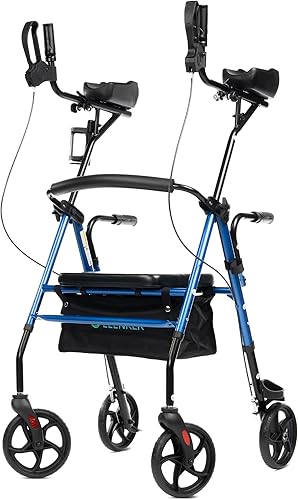
ELENKER Upright Walker: Best for adjustable fit
- Adjustable forearm tubes, handlebar and leg tubes
- Padded seat and backrest
- 8 in solid PVC wheels
- Dual brake system
Multiple adjustment points make this a flexible choice when you need to fine-tune arm and handle positions. It also folds flat and includes a seat for rest breaks.
Pros
- Several frame adjustments
- One-hand folding
- Under-seat pouch and cane or umbrella holder
Cons
- Confirm the full frame dimensions fit your storage space
The ELENKER stands out for adjustment at the forearm tubes, handlebar and leg tubes. That flexibility makes it the strongest starting point if you need to fine-tune more than one part of the frame to get a comfortable upright position.
A padded seat and backrest provide a place for a planned rest. The 8 in solid PVC wheels are described as easy to maneuver on most surfaces, and its dual brake system lets you squeeze to slow or push to lock the rear wheels.
The frame measures 25 x 28 x 47 in. It folds flat with one hand, and an under-seat pouch plus cane or umbrella holder keep small items close.
Choose this model when flexible adjustment matters more than keeping the carry weight low. Skip it if you need a very light frame to lift often, or if its dimensions won't fit your storage area.
Before buying, confirm the height and brake reach with a therapist, especially if your posture or grip changes during the day.
Helavo Upright Walker with Seat: Best for outdoor walks
- 10 in rubber front wheels
- Height-adjustable ergonomic handles
- Padded armrests
- Parking brake
Large rubber front wheels and padded armrests suit buyers who want an upright walker for outdoor use. It includes a seat, backrest, cane holder and cup holder.
Pros
- 10 in front wheels
- Padded armrests and adjustable handles
- Parking brake
Cons
- Check the frame width against doorways and storage areas
- Assembly is required
The Helavo pairs padded armrests and height-adjustable handles with 10 in rubber front wheels. Those larger front wheels make it a useful option to compare if your routine includes outdoor pavement or other varied surfaces.
It has a seat, an adjustable padded backrest and a parking brake. The walker weighs 22.71 lb, measures 26.38 x 26.38 x 46.85 in and supports up to 300 lb.
A cane holder and cup holder come with the walker. Helavo describes its tires as puncture-proof rubber with cushioning characteristics.
Pick this model if outdoor walks and a cushioned ride are priorities, and its frame fits your route. Skip it if you need a compact frame for tight indoor spaces without first measuring.
Assembly is required, so plan to set it up and check every adjustment before your first walk. Practice parking the walker and sitting only after the brakes are locked.
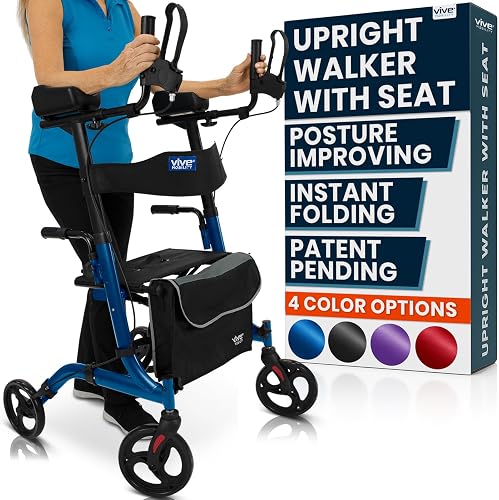
Vive Mobility Upright Walker with Seat: Best for taller walkers
- Handle height adjusts from 45 to 52 in
- Suggested for heights 5 ft 2 in to 6 ft 4 in
- 8 in flat-free wheels
- Folding aluminum frame
The stated handle range and height guidance make this a candidate for taller users who want an upright position. The frame folds for transport and includes a seat and detachable shoulder bag.
Pros
- Handle height adjusts across a wide range
- 20 lb frame
- Forearm pads move forward and backward
Cons
- Check whether the stated height range fits your body and posture
- Confirm folded storage dimensions before buying
Vive is a candidate for taller users: its handles adjust from 45 to 52 in, with a suggested user height range of 5 ft 2 in to 6 ft 4 in. The forearm pads also move forward and backward to accommodate different arm lengths.
It has 8 in flat-free wheels, loop brakes and a 17.5 in wide seat. The aluminum frame weighs 20 lb, folds for transport and supports up to 300 lb.
A detachable shoulder bag keeps essentials close. The stated height range gives a useful first filter, but your standing posture and arm position still matter.
Check that the handles let you stay upright without shrugging your shoulders or leaning, and confirm that you can reach and operate the brakes.
Choose the Vive if its handle range suits your body and you want a lighter folding model with a seat. Skip it if you need more seat width than 17.5 in or the handles don't fit your posture.
Confirm the folded size against your car or storage space before buying.
Agrish Narrow Walker Folding Upright Walker: Best for tight doorways
- Width adjusts from 18 to 22 in
- Height adjusts from 42 to 51 in
- Removable armrests
- One-touch folding
Adjustable width can help when you need to pass through narrow doorways. It has arm supports and a folding frame, but no seat is included in the product name or features.
Pros
- Width has 5 adjustment levels
- Height adjusts in 10 positions
- Quick-release armrests convert to standard walker mode
Cons
- No seat for rest breaks
- Confirm the arm support and brake setup suits your needs
Agrish is the narrow-space pick, with a width that adjusts from 18 to 22 in. Five width settings and 10 height positions give you room to adapt the frame to your doorways and standing position.
Its armrests release quickly to convert it to standard walker mode. The walker folds at the touch of a button, weighs 11 lb and has a stated 450 lb capacity.
This model differs from the seated rollators in this roundup: its listed features don't include a seat. Choose it if narrow clearance, a lighter frame and the option to remove the armrests matter more than sitting down for rest breaks.
Skip it if fatigue means you need an attached seat or if you need a walker with a specified seat and backrest. Before choosing it, verify that the arm support and brake arrangement work for you, and check the narrowest door and turn on your daily route.
Helavo 28.3" Extra Wide Bariatric Upright Walker: Best for extra seat room
- 20.1 in wide seat
- 500 lb capacity
- Adjustable armrests and backrest
- 8 in flat-free rubber wheels
The extra-wide seat and stated capacity make this an option for people who need more seat room. Its 28.3 in frame calls for careful doorway measurements.
Pros
- Wide seat with adjustable backrest
- Step assist and reflectors
- Cup holder, cane holder and storage bag
Cons
- Wide frame may not suit narrower rooms
- Check seat and handle heights against your needs
The Helavo extra-wide model provides a 20.1 in wide and 14.2 in deep seat and a stated 500 lb capacity. Its armrests and backrest adjust, while the 8 in flat-free rubber wheels are designed for indoor and outdoor surfaces.
The 28.3 in frame is wider than the other options here, so measure every doorway and turning area on your route. Its handle height adjusts from 41.5 to 47.6 in, and the seat height adjusts from 20.9 to 22.8 in.
Other features include a step assist, reflectors, cup holder, cane holder and storage bag. Choose it when seat room and capacity are priorities and you have enough clearance at home.
Skip it if narrow halls or tight turns are part of your daily route.
The step assist can help with a curb, but it doesn't make every curb or uneven surface suitable. Ask a physical therapist to assess the routes you plan to use and how to handle obstacles safely.
StrollAid Upright Walkers for Seniors with Seat: Best for mixed terrain
- 10 in front and 8 in rear wheels
- Adjustable seat and handles
- Seat height adjusts from 21 to 24 in
- Suggested for heights 5 ft 5 in to 6 ft 5 in
The larger front wheels and adjustable seat make this worth comparing for outdoor outings and planned rest breaks. Check the stated height range before choosing it.
Pros
- 10 in front wheels
- Seat and handles adjust separately
- Folds for storage and transport
Cons
- Height guidance starts at 5 ft 5 in
- Confirm the frame width works in your home
StrollAid has 10 in front wheels and 8 in rear wheels, plus a seat and handles that adjust separately. Its suggested height range is 5 ft 5 in to 6 ft 5 in, so check that range before considering it.
The seat adjusts from 21 to 24 in, and the handle height adjusts from 41.7 to 48.2 in. It weighs 21.6 lb and measures 25.2 in wide.
The 1.6 in thick breathable seat, widened backrest, storage bag and cup holder support outings with rest breaks. The brand describes its textured tires as providing grip on damp surfaces, but you should still use care on wet ground.
Choose this walker if you fall within its stated height guidance, want a seat and expect to use it on routes with uneven pavement. Skip it if you're shorter than 5 ft 5 in or need a narrower frame.
Ask a therapist whether the wheel layout and frame fit your movement and home.
Aliseniors Upright Walker for Seniors: Best for roomy breaks
- 20.6 in wide mesh seat
- Adjustable armrests
- 8 in solid polyurethane tires
- One-hand folding
The wide mesh seat and sit-to-stand handles suit buyers who want room for seated breaks. Measure indoor doorways because the frame is 28.7 in wide.
Pros
- Wide seat
- One-hand folding
- Cane or umbrella holder
Cons
- The brand recommends doorways at least 30 in wide
- Height guidance is 5 ft 2 in to 6 ft 2 in
Aliseniors combines a 20.6 in wide mesh seat with sit-to-stand handles and an adjustable backrest. It weighs 18.76 lb and folds with one hand, but its 28.7 in frame needs room to pass.
Aliseniors recommends doorways at least 30 in wide for smooth maneuvering. The armrests adjust from 40.4 to 45 in, with suggested height guidance of 5 ft 2 in to 6 ft 2 in.
Its 8 in solid polyurethane tires, anti-tip frame and dual hand brakes are features for indoor and outdoor use. Choose it if a roomy seat and sit-to-stand handles are priorities and you have wide routes at home.
Skip it if a key doorway is narrower than the recommended clearance or if the armrest height doesn't fit you.
Measure doorways, corners and the space beside your usual chair before choosing it. Confirm the brake handles are manageable, then practice standing and sitting with someone nearby until the routine feels controlled.
HOMLAND Upright Walker with Seat for Seniors: Best for varied heights
- Suggested for heights 4 ft 9 in to 6 ft 4 in
- Arm support adjusts from 37 to 47 in
- Seat height adjusts from 20 to 23 in
- 8 in puncture-proof wheels
Its stated height guidance covers a broad range, with separate adjustments for arm support and seat height. A folding frame and storage bag support everyday use.
Pros
- Separate arm and seat adjustments
- Sit-to-stand handles
- 8 in puncture-proof wheels
Cons
- Confirm overall dimensions and fit before choosing
HOMLAND gives separate adjustments for the arm support and seat: 37 to 47 in for the arm support and 20 to 23 in for the seat. HOMLAND gives a suggested height range of 4 ft 9 in to 6 ft 4 in.
The steel frame has 8 in puncture-proof wheels, sit-to-stand handles and a storage bag. It folds for transport.
Consider this option if you need a broad stated height range with separate arm and seat settings. The frame measures 30.3 x 23.6 x 47 in, so compare its footprint with your halls, doorways and storage space.
Choose it if the adjustments suit your body and the walker fits your routes.
Check the seat and brake arrangement in person with a therapist before using it alone.
BlessReach Heavy Duty Upright Rollator Walker: Best for carpet routes
- 8 in all-terrain PU wheels
- Adjustable handles
- Padded seat and backrest
- Folds after lifting the seat
The 8 in wheels are described for carpets, sidewalks and uneven ground. It includes a padded seat, adjustable backrest, cup holder and storage bag.
Pros
- Seat flips up for folding
- Dual braking system
- Padded seat and adjustable backrest
Cons
- Confirm handle height and frame width before buying
- Check whether the brake controls are easy for you to use
BlessReach has 8 in PU wheels described for carpets, sidewalks and uneven ground. It also has adjustable handles, a padded seat and an adjustable breathable backrest.
The walker weighs 21 lb and supports up to 300 lb. Its dual braking system has controls for gradual slowing and stopping, while the seat flips up before folding.
A cup holder and large storage bag are included. Choose it if your routes include carpet and uneven outdoor ground, and you want a seat for breaks.
Skip it if you can't operate the brake controls reliably or haven't confirmed the handle height and frame width suit you.
The brake arrangement has separate actions for slowing and stopping. Ask a therapist or mobility specialist to show you how to use them, then practice starting, slowing, stopping and locking the walker on a clear, level surface.
What should you check before buying an upright walker for Parkinson's?
Check your standing position, arm support, brake control and home clearance before choosing an upright walker. A physical therapist can assess whether a frame suits your body and usual walking pattern.
Start with fit. Your forearms should rest comfortably without forcing your shoulders up, and you should be able to look ahead rather than lean heavily on the supports.
A walker that fits someone else may not suit your arm length, posture or balance.
Next, check the brakes. You need to reach and operate them while standing, and you should know how to lock them before sitting.
If hand control varies or the brake action feels difficult, discuss that with a therapist before selecting a model.
Measure the routes you use most, not just the front doorway. Include the narrowest interior doorway, hallway, turn around a table and the space where you intend to sit or store the walker.
If you want a seat, compare its height and width with your needs. You should be able to approach the seat, lock the brakes and sit in a controlled way.
A seat is for planned rest breaks; it doesn't make walking while seated or sitting without locking the brakes safe.
Finally, consider weight and folding. A walker may fit through your home but still be difficult for you or a caregiver to lift into a vehicle.
Check both its dimensions when open and how it folds.
For more options matched to balance needs, see walkers for seniors with balance problems. If carpet is part of your daily route, compare walkers for seniors on carpet.
How should you set up and practice with a new upright walker?
Set up the walker according to its instructions, then have a clinician or physical therapist check its fit before regular use. Practice on a clear, level area until the adjustments, brakes and turns feel familiar.
Begin with the manufacturer's assembly instructions and check that each part is secure. Set the handle and forearm support positions with professional guidance rather than choosing a height from appearance alone.
Confirm that the walker opens and folds as intended, and identify how its brakes work before you start walking.
Practice walking in a quiet area with another person nearby. Work on starting, stopping, making a gradual turn and moving through a doorway.
If your symptoms change during the day, ask your therapist how to handle periods when balance or movement is less predictable.
If the walker has a seat, rehearse the whole sequence: stop, lock the brakes, turn carefully, check the seat position and sit with control. Stand only after confirming you can use the support and brakes in the way your therapist recommends.
Keep small items in a bag or holder made for the walker. Carrying objects in your hands can interfere with grip and brake control.
Don't hang heavy bags from the handles unless the manufacturer allows it, since extra weight can affect how the walker handles.
What common upright-walker mistakes should you avoid?
The most common mistakes are choosing by a feature alone, skipping home measurements and using the walker without practicing the brakes. A good match must fit both the person and the places where they walk.
Don't assume a tall frame will automatically improve posture. If the arm supports are too high or too low, you may raise your shoulders, lean forward or struggle to steer.
Get help setting the supports and repeat the check if your posture or mobility changes.
Don't buy a wide-seat walker before measuring doorways and turns. Models with wider frames may suit open spaces but can be difficult to use in a narrow home.
Measure the route from the room where you store the walker to the places you visit most.
Don't sit before locking the brakes. A seat can be useful for planned rests, but only when you know how to stop and secure the walker and can get into position safely.
Practice with support nearby.
Don't treat large wheels or all-terrain descriptions as permission to cross every curb, slope or rough patch. Different surfaces and obstacles create different risks.
Ask a therapist to review the surfaces on your regular routes, and follow the model's instructions.
Don't carry items in both hands while walking with the walker. Use an included bag or holder when available, and keep the load light enough that it doesn't interfere with balance or control.
Should you compare an upright walker with a rollator?
Compare an upright walker with a rollator if you're weighing forearm support against other handle and seat styles. Your posture, balance, grip, walking pattern and brake control determine which design is a better fit.
Upright walkers support the forearms and position the hands higher than many standard rollators. A conventional rollator may feel more familiar to someone who prefers hand grips and a different walking posture.
The names alone don't tell you which will be easier to steer or stop.
Our rollator walkers for Parkinson's patients guide covers seated rollators for this condition. Ask a physical therapist to help you compare both designs using the movements and routes that matter in your day.
When could a mobility scooter make more sense?
A mobility scooter may suit longer trips when walking distance is the main challenge, but it doesn't replace a walker for standing and walking. Consider whether you can get on and off, steer and manage the scooter safely, and discuss it with a clinician if you have concerns.
Compare the mobility scooter for people with Parkinson's disease with the broader guide to mobility scooters for Parkinson's disease. An upright walker is generally the more relevant option when you want support while walking on your feet.
Which is the best upright walker for Parkinson's?
Choose the ELENKER if several adjustment points matter most, the Helavo with Seat if outdoor cushioning is a priority, or the Agrish if narrow doorways are your main constraint. For Parkinson's, ask a physical therapist to check the fit, brake control and walking pattern before you use a new walker independently.
Choose the wide Helavo if you need a larger seat and your home has enough clearance. Consider the Vive if its handle range suits a taller user, or the HOMLAND if its separate seat and arm adjustments match your fit needs.
If you're still weighing support styles, read our walker and rollator buying guide. The right choice is the one you can fit, control and use consistently on your everyday routes.
Our top 3 picks at a glance
-
1
-
2
-
3
Frequently asked questions
Can an upright walker help someone with Parkinson's?
An upright walker may provide forearm support and a more upright hand position, but it won't address every walking change linked to Parkinson's. Ask a physical therapist or clinician to assess fit, brakes and how the walker works with your walking pattern.
Practice with the recommended setup before relying on it outdoors.
What should I look for in the best upright walker for Parkinson's?
Start with a stable fit, reachable brakes, comfortable forearm support and a width that clears your usual routes. If you need rest breaks, compare seat height and width, then check whether you can lock the brakes before sitting.
A therapist can assess these details in the context of your mobility.
Are upright walkers safe for people who freeze while walking?
Freezing can make starting or continuing a step difficult, and a walker may not solve it. Ask a clinician or physical therapist about a mobility aid and strategies for your situation.
Practice turning, doorway approaches and stopping with supervision before using a new walker alone.
Is a rollator or an upright walker better for Parkinson's?
The better choice depends on your posture, balance, walking pattern, grip and ability to manage brakes. Upright walkers use forearm support, while many rollators use lower hand grips.
Compare the options in our rollator walkers for Parkinson's patients guide and ask a physical therapist to assess fit.
How do I check whether an upright walker fits my home?
Measure the narrowest doorway and turning space on the routes you use most. Compare those measurements with the walker's width, then consider storage space and whether you can fold it safely.
For soft flooring, see our guide to the best walkers for seniors on carpet.