9 Best Walkers for Seniors With Balance Problems (November 2026)
The best walkers for seniors with balance problems include the VOCIC Z21 Rollator Walker for Seniors for brake control, the Drive Medical Rollator Walker with Seat for seated outings, and the Medline Steel Rollator Walker with Seat for lighter lifting.
On this page (8 sections)
- Which walkers suit seniors who feel unsteady?
- Best walkers for seniors with balance problems
- Should you choose a rollator or a standard walker?
- How do you choose a walker for balance problems?
- How do you set up and use a walker safely?
- What common walker mistakes should you avoid?
- How should you care for a walker?
- Which walker is the best choice for balance problems?
The VOCIC Z21 Rollator Walker for Seniors is a leading choice among the best walkers for seniors with balance problems when the user can manage a rolling frame. It has adjustable handles and three brake modes, while the Drive Medical 2-Button Standard Foldable Walker offers four rubber-tipped legs and no wheels.
A walker adds a handhold, but the frame has to match how the person stands, steps, turns, and stops. If balance has changed recently or the user has fallen, ask a clinician or physical therapist to assess safe use and fit.
Our picks at a glance
-
1

-
2

-
3

- 4
 Check it
Drive Medical 2-Button Standard Foldable Walker
Best for planted support - 5
 Check it
HOMLAND Foldable Rollator Walker for Seniors
Best for wider seating - 6
 Best for tight storageCheck it
- 7
 Best for travel bagsCheck it
- 8
 Check it
Loyoda Folding Walker with 2 Skis
Best for basic folding - 9
 Check it
Vive Mobility Lightweight Walker for Seniors
Best for narrow hallways
Which walkers suit seniors who feel unsteady?
Rollators suit users who can control a wheeled frame and its brakes; standard walkers suit users who need the frame to stay still when paused. The right choice depends on walking pattern, hand strength, home layout, and need for a seat.
These picks cover rolling walkers with seats, compact wheeled frames, and standard folding walkers. Our scores weigh their listed features and fit for people seeking steadier support, including wheel or foot design, brake operation, frame weight, and handle adjustment.
| Product | Best for | Wheel size | Handle height | Weight | Our score |
|---|---|---|---|---|---|
| VOCIC Z21 Rollator Walker for Seniors | brake control | 8 in | 31.5–36.6 in | About 22 lb | 9.6 |
| Drive Medical Rollator Walker with Seat | seated outings | 7.5 in | 9.5 | ||
| Medline Steel Rollator Walker with Seat | lighter lifting | 6 in | 16.5 lb | 9.4 | |
| Drive Medical 2-Button Standard Foldable Walker | planted support | 9.3 | |||
| HOMLAND Foldable Rollator Walker for Seniors | wider seating | 8 in | 20.4 lb | 9.0 | |
| Stander Space Saver Rollator | tight storage | 14.5 lb | 8.9 | ||
| Stander Space Saver Walker | travel bags | 8 lb | 8.7 | ||
| Loyoda Folding Walker with 2 Skis | basic folding | 5 in | 8.5 | ||
| Vive Mobility Lightweight Walker for Seniors | narrow hallways | 6 in | 33–39 in | 9.5 lb | 8.3 |
Best walkers for seniors with balance problems
The VOCIC Z21 is the leading pick for users who can safely control a rollator and want several fit and braking options. Other choices here trade seat size, frame weight, storage, and rolling movement.
VOCIC Z21 Rollator Walker for Seniors: Best for brake control
- 8-inch puncture-proof wheels
- Three brake modes
- Adjustable handles and seat
- Supports up to 350 lb
Adjustable handles and free, deceleration, and stop brake modes let users choose a fit and pace that suit them. Its large puncture-proof wheels are designed for bumps and varied surfaces.
Pros
- Three brake modes
- Adjustable seat and handles
- 8-inch puncture-proof wheels
Cons
- About 22 lb to lift or carry
- A rolling frame may not suit everyone
The VOCIC Z21 Rollator Walker for Seniors is a strong match for someone who wants adjustable handles and a choice of free, deceleration, and stop brake modes. The handles adjust from 31.5 to 36.6 in, and the seat height has 3 settings from 20 to 22 in.
Its 8-inch puncture-proof wheels and rotating front wheels are designed for bumps and varied surfaces. Reflective strips on the front wheels and storage bag help make the frame more visible in low light.
The frame weighs about 22 lb and supports users up to 350 lb. Before each use, confirm that the frame is unfolded and locked, fasteners are secure, the wheels turn smoothly, and the brakes work.
Choose it if the user can steer and control a rollator and benefits from adjustable fit. Skip it if a rolling frame feels hard to control or lifting a 22 lb walker into a car would be difficult.
Drive Medical Rollator Walker with Seat: Best for seated outings
- 7.5-inch wheels
- Padded seat and fold-down backrest
- Locking hand brakes
- Height-adjustable handles
A padded seat and fold-down backrest provide a place to rest during an outing. Locking hand brakes keep the walker stationary for sitting.
Pros
- Padded seat and backrest
- Height-adjustable handles
- Under-seat pouch
Cons
- A seat and rolling wheels add setup considerations
- Check fit and brake reach before use
The Drive Medical Rollator Walker with Seat gives users a padded place to rest and a fold-down backrest for outings. Its 7.5-inch wheels roll indoors and outdoors, and the steel frame folds for storage.
Locking hand brakes help control speed and hold the frame still for sitting. The height adjustment lever and ergonomic handles help tailor the fit, while an under-seat pouch keeps everyday items nearby.
This suits someone who can keep a wheeled walker within reach and use its brakes before sitting. Skip it if the user needs a frame that remains planted during every pause or cannot reliably operate hand brakes.
Medline Steel Rollator Walker with Seat: Best for lighter lifting
- 16.5 lb frame
- 6-inch wheels
- Padded seat and backrest
- Handles adjust from 31–35 in
At 16.5 lb, this rollator is lighter than the other seated options here. It pairs a padded seat with push-down wheel locks.
Pros
- Lighter than the other seated rollators here
- Padded seat and backrest
- Handles adjust from 31–35 in
Cons
- 6-inch wheels are smaller than some alternatives
- Confirm the frame fits your usual routes
The Medline Steel Rollator Walker with Seat is the lightest seated rollator in this group at 16.5 lb. It has a 12 x 12 in padded seat and backrest, storage under the seat, and handles that adjust from 31 to 35 in.
Its 6-inch wheels are smaller than those on the VOCIC and HOMLAND models. Push the handles up to brake and down to lock the wheels before sitting or standing.
Choose this if a lighter seated rollator is a priority and the user can manage its wheels and locks. Skip it if the usual route has obstacles that call for larger wheels, or if the user's height falls outside the handle adjustment range.
Drive Medical 2-Button Standard Foldable Walker: Best for planted support
- Four rubber-tipped legs
- Aluminum frame
- Push-button folding
- Supports up to 350 lb
Four rubber-tipped legs stay planted when the user pauses. Its cross-frame brings the walker closer while standing, and push buttons allow folding.
Pros
- Four rubber-tipped legs
- Push-button folding
Cons
- No wheels for rolling between steps
- Check that lifting and advancing the frame feels manageable
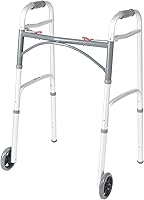
The Drive Medical 2-Button Standard Foldable Walker has four rubber-tipped legs instead of rolling wheels. Its cross-frame comes closer when standing, and the U-shaped frame gives more clearance as the user steps.
Push-button folding makes storage easier, and the frame supports up to 350 lb.
Choose it if the user can lift or advance the walker in a controlled way and wants the frame planted when paused. Skip it if lifting and moving the frame disrupts the user's step or causes them to reach too far ahead.
HOMLAND Foldable Rollator Walker for Seniors: Best for wider seating
- 16 x 12-inch seat
- 8-inch puncture-proof wheels
- Three brake modes
- Handles adjust from 33–40 in
Its roomy cushioned seat and adjustable handles suit users who want a seated rollator with a wider fit. Large puncture-proof wheels and three brake modes add rolling support.
Pros
- Wide cushioned seat
- Three brake modes
- Adjustable seat and handles
Cons
- 20.4 lb frame
- A wide frame needs space to turn
The HOMLAND Foldable Rollator Walker for Seniors suits users who want a wider seat and broad handle-height adjustment. The 16 x 12 in cushioned seat adjusts from 20 to 23 in, while the handles adjust from 33 to 40 in.
Its 8-inch puncture-proof wheels rotate at the front, and the braking system offers free, deceleration, and stop modes. The frame weighs 20.4 lb and folds with an under-seat storage bag attached.
Choose it if the user needs a wider seat and can manage a wheeled frame. Skip it if the frame is too wide for doorways or turning spaces; measure the home route before deciding.
Stander Space Saver Rollator: Best for tight storage
- Folds to a 10 x 11-inch footprint
- 14.5 lb
- 6-inch wheels
- Locking rear brakes
This rollator folds into a compact footprint for travel or tight storage. Its short perch seat offers a place for a quick rest.
Pros
- Compact folded footprint
- 14.5 lb
- Pre-assembled
Cons
- 250 lb capacity
- Perch seat is 18.5 x 6 in
The Stander Space Saver Rollator is designed for small storage spaces and trips where a compact fold matters. It weighs 14.5 lb and folds to a 10 x 11 in footprint, with 6-inch wheels and locking rear brakes.
Its perch seat measures 18.5 x 6 in and supports up to 250 lb. The handles adjust from 33 to 36 in, and it arrives assembled.
Choose it if the user needs a compact rollator for errands or travel and a short perch is enough for resting. Skip it if the user needs a broad, full-depth seat or exceeds its capacity.
Stander Space Saver Walker: Best for travel bags
- 8 lb aluminum frame
- 6-inch fixed front wheels
- Rear ski glides
- Folds to a 5 x 7-inch footprint
Fixed front wheels and rear ski glides let this walker move without lifting the full frame each step. Its small folded footprint suits travel and limited storage.
Pros
- 8 lb frame
- Folds to a 5 x 7-inch footprint
- Rear ski glides
Cons
- Fixed front wheels do not swivel
- Check handle height for a comfortable fit
The Stander Space Saver Walker combines fixed front wheels with rear ski glides, so the user can move forward without lifting the whole frame at every step. It weighs 8 lb and folds to a 5 x 7 in footprint.
Its padded handles adjust from 32.5 to 39 in, and the aluminum frame supports up to 300 lb. The fixed front wheels do not swivel, so turning requires a different motion from a rollator with rotating front wheels.
Choose it if the user wants a compact, light walker with some rolling assistance. Skip it if the user needs swivel wheels for tight turns or cannot move the frame through their usual route.
Loyoda Folding Walker with 2 Skis: Best for basic folding
- Two skis
- 5-inch wheels
- Folding frame
This folding walker combines two skis with 5-inch wheels. Its low stated weight may appeal if lifting a frame is a concern, but check fit and glide setup.
Pros
- Folding frame
- Includes two skis
Cons
- Few features are specified
- Confirm fit and setup before use
The Loyoda Folding Walker with 2 Skis pairs 5-inch wheels with two skis and weighs 6.03 lb. The available details do not give a handle-height range or weight capacity, so confirm both before choosing it for someone who feels unsteady.
Choose it if a folding frame with skis fits the user's stride and the fit and capacity are confirmed. Skip it if you need clear guidance on fit before ordering or cannot confirm that the walker matches the user's height and weight.
Vive Mobility Lightweight Walker for Seniors: Best for narrow hallways
- Narrow frame
- 9.5 lb
- 6-inch wheels
- Hand brakes
The narrow frame is designed for small hallways, crowded areas, and sharper turns. It adds hand brakes while keeping the walking space open.
Pros
- Narrow frame
- 9.5 lb
- Adjustable handles
Cons
- No seat
- Confirm the frame width against doorways
The Vive Mobility Lightweight Walker for Seniors is designed for narrow hallways, crowded spaces, and sharper turns. It weighs 9.5 lb, has 6-inch wheels and hand brakes, and its handles adjust from 33 to 39 in.
The narrow frame and open walking area suit homes where a wider rollator is difficult to turn. It has no seat, so a user who needs frequent rests may prefer one of the seated options.
Choose it if a narrow frame fits the home and the user can operate the brakes. Skip it if the user needs a seat or if the 33 to 39 in handle range does not fit.
Should you choose a rollator or a standard walker?
A standard walker stays still when the user pauses, while a rollator moves on wheels and relies on the user's control of its brakes. Choose the style that matches the person's ability to step, steer, stop, and handle the frame.
A standard walker needs to be lifted or advanced as the user walks. That can be useful when planted support is needed, but it may be hard for someone with weak arms or a shuffling step.
A rollator rolls forward without needing the user to lift it. That can make walking less effortful, but it can move away if the user leans heavily on it or cannot use the brakes reliably.
A two-wheel walker, such as the Stander Space Saver Walker, sits between these styles. Its fixed front wheels and rear glides let it move forward with less lifting than a standard walker, while the frame remains different from a four-wheel rollator.
For a fuller comparison of support styles, see rollator vs standard walker: which is safer. If the user is considering an upright frame, our guide to upright walker vs regular walker explains how the posture and support differ.
How do you choose a walker for balance problems?
Start with the user's walking pattern, then check fit, turning space, brake control, and whether a seat is useful. A feature is helpful only when the user can manage it in the places they walk.
How should the walker fit?
The handles should let the user stand upright with relaxed shoulders and slightly bent elbows, without leaning forward or reaching up. Adjustability helps, but the user still needs to test the actual handle position with their usual shoes.
Check the frame width against doorways, bathroom entries, and the path beside furniture. A frame that fits the hallway but cannot turn in the bathroom will be difficult to use safely there.
Seat height matters for rollators. The user should be able to sit down and stand up with the wheels locked, without the seat feeling too low or forcing a strained rise.
What should you check about brakes and grip?
For a rollator, the user needs enough hand strength and coordination to squeeze the brakes, slow the frame, and lock it before sitting. If the levers are hard to reach or hold, try a different style and discuss alternatives with a clinician.
A standard walker has no hand brakes because its rubber tips provide contact with the floor. Check the tips for wear and make sure they sit flat, so the frame does not slide unexpectedly.
When does wheel size matter?
Larger wheels can make it easier to cross small bumps and uneven spots, while smaller wheels may suit smoother indoor paths. Wheel size alone does not determine stability: turning, braking, frame fit, and the user's control still matter.
If the user's route includes carpet, compare the surface and frame together. Our guide to walkers for seniors on carpet covers what to consider when carpet is part of the daily route.
Should you choose a seat?
A seat helps when the user needs a place to rest during outings, but it adds weight and requires a reliable way to lock the wheels before sitting. A short perch seat is for a brief pause, not a broad, cushioned sitting surface.
Skip the seat if the user will not use it or if the added frame size makes the walker harder to steer and store. For frequent rests, compare seat dimensions and height in person when possible.
How do you set up and use a walker safely?
Set up the frame fully, adjust it to the user, and check the moving parts before every use. A walker that is not locked open, correctly fitted, and in working order cannot provide its intended support.
Unfold the walker according to its instructions, then confirm the frame locks in place. Secure the knobs and fasteners, check that wheels rotate freely, and inspect brake cables and levers before the first walk.
For a rollator, practise squeezing the brakes while standing still, then engage the locks and gently check that the wheels stay put. The user should lock the wheels before sitting or standing, and avoid using the seat while the frame is moving.
For a standard walker, place it close enough to reach without leaning forward. Move it only as far as the user can step comfortably, then bring the body forward into the frame rather than taking a long step behind it.
Keep the floor clear of loose rugs, cords, and clutter. Use the walker on the surfaces it is designed to handle, and slow down at thresholds and transitions between floor types.
What common walker mistakes should you avoid?
The most common mistakes are choosing a frame by features alone, setting it too high or low, and treating a rollator seat as safe before locking the wheels. Fit and practice are as important as the walker style.
Do not choose a rollator simply because it has more wheels or a seat. If the user cannot stop it reliably, a rolling frame may create more difficulty than support.
Do not let the user pull on a walker that is too far away or lean heavily on a frame while standing up. Place the frame within reach, and ask a clinician to show a safe transfer method when needed.
Do not assume a smaller, lighter frame is always easier. A narrow walker can fit a tight home but may not feel right for a taller user or someone who needs a wide base of support.
Do not skip the recurring checks. Loose fasteners, worn tips, misadjusted brakes, or a frame that does not lock open can change how it moves.
How should you care for a walker?
Check the frame, wheels, feet, and brakes regularly, and keep the walker clean and dry. Small problems are easier to spot before they affect the user's route.
Wipe the frame and handles with a soft cloth and a cleaner suitable for the materials. Dry wet parts before storing the walker, and avoid leaving it where it can be knocked over or block a walking path.
Inspect rubber tips for cracks or uneven wear, and make sure skis and wheels remain secure. If a wheel wobbles, a brake fails to hold, or a folding lock does not engage, stop using the frame until it is corrected.
Keep the instructions and any adjustment tools in a known place. If the user cannot check the walker independently, add the inspection to a caregiver's routine.
Which walker is the best choice for balance problems?
Choose the VOCIC Z21 Rollator Walker for Seniors if the user can control a rollator and wants adjustable handles with three brake modes. Choose the Drive Medical 2-Button Standard Foldable Walker if fixed feet fit the user's walking pattern better.
For a lighter seated rollator, compare the Medline. If compact storage matters, consider the Stander Space Saver models.
Review their capacity and fit carefully. If you are unsure which walker for seniors with balance problems fits best, ask a physical therapist or clinician to assess the user's walking pattern and safe use.
For a broader look at fit and frame types, read what is the safest walker for seniors and our complete walker and rollator buying guide. If budget is a key factor, see cheap walkers for seniors.
Our top 3 picks at a glance
-
1
-
2
-
3
Frequently asked questions
What is the safest walker for seniors with balance problems?
The safest walker depends on the person's strength, balance, walking pattern, and home layout. A standard walker has four feet that stay planted when the user pauses, while a rollator moves on wheels and has brakes.
Ask a physical therapist or clinician to help assess fit and safe use, especially after a fall or a change in balance.
Is a rollator or standard walker better for poor balance?
A standard walker may suit someone who can lift or advance the frame and wants it to stay still between steps. A rollator may suit someone who can control its movement and use hand brakes.
A clinician can help match the frame to the user's balance, grip, and walking pattern.
Are upright walkers good for balance problems?
An upright walker may be useful for someone who wants forearm support, but the handle and forearm position must fit the user. A tall frame does not automatically make walking safer.
Compare the fit and operation with a clinician, and see our guide to best upright walker for Parkinson's.
How do I choose a walker for balance problems?
Start with the user's walking pattern and strength, then check handle height, frame width, turning room, brakes, and whether wheels or fixed feet make sense. For a rollator, confirm that the user can squeeze and lock the brakes.
For more selection basics, read our walker for seniors buying guide.
Can a mobility scooter help someone with poor balance?
A mobility scooter may help with longer distances for someone who can sit, steer, and transfer safely. It does not replace a walker for standing or walking, and it may not suit every balance or coordination need.
Compare options with a clinician using our guides to mobility scooters for people with balance problems and mobility scooters for people with poor balance.