
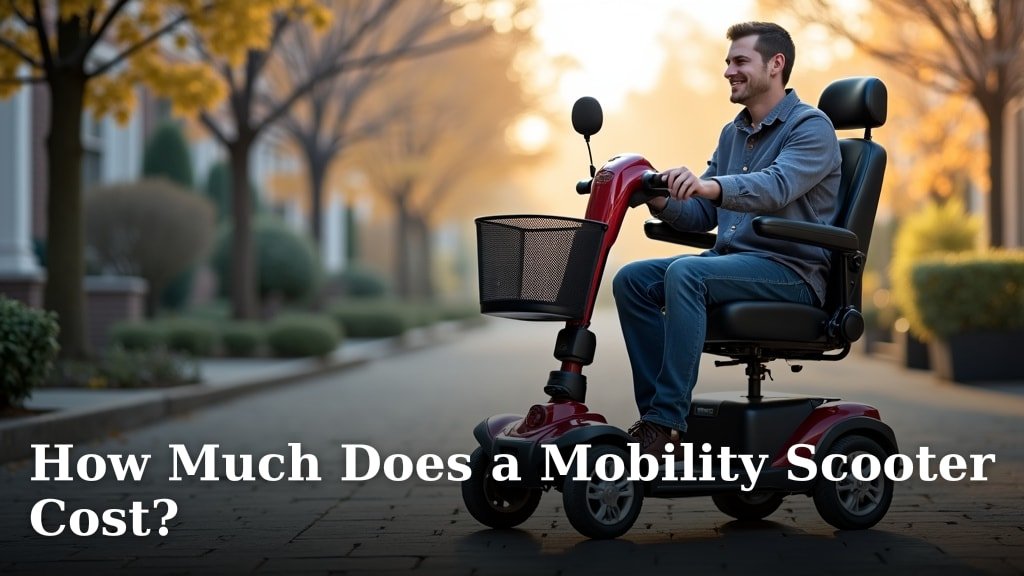
A mobility scooter can cost anywhere from $600 to $5,000 or more, depending on the model and features you choose. We found that most people spend around $1,500 to $2,500 for a reliable, everyday scooter.
The price really changes based on the type of scooter you need. A foldable travel scooter will be less expensive than a heavy-duty outdoor model. We’ll help you understand all the factors affecting cost so you can make a smart choice.
- Mobility scooters cost $600 to $5,000+.
- Most common price range is $1,500 to $2,500.
- Prices vary by scooter type (travel, 3-wheel, 4-wheel, heavy-duty).
- Key factors influencing cost include battery life, speed, and weight capacity.
- Understanding your needs helps you find the right scooter without overspending.
Ready to figure out what kind of scooter fits your life and your budget? Let’s take a closer look at the costs involved.
Understanding Mobility Scooter Price Ranges
Mobility scooters generally range from $600 to over $5,000. Most people find a quality scooter for their everyday needs costs between $1,500 and $2,500.
You might be wondering, why such a big difference? It’s like comparing a compact car to an SUV. Both get you around, but one has more features, power, and capacity. Your specific needs will really guide you to the right price point.
Entry-Level Scooters: Under $1,000
These are typically travel scooters or very basic models. They’re designed for occasional use or for people who need something lightweight and easy to transport. Think short trips around the house or a quick run to the mailbox.
- Usually 3-wheel designs for better maneuverability.
- Often feature lighter batteries and smaller motors.
- Ideal for flat surfaces and indoor use.
- Top speed might be around 3-4 mph.
You’ll find these are great if you’re looking for an affordable option and don’t need a lot of power or long-distance capabilities. We’ve seen many happy users find exactly what they need in this price bracket, particularly for travel and portability.
Mid-Range Scooters: $1,000 – $2,500
This is where most people find their perfect match. It includes many standard 3-wheel and 4-wheel scooters that offer a good balance of features, comfort, and durability. These are reliable for regular daily use.
- Better battery life and range, often 10-15 miles per charge.
- Higher weight capacities, typically up to 300 lbs.
- Improved suspension for a smoother ride.
- More comfortable seating and adjustable controls.
When you step into this range, you’re getting a scooter that can handle daily errands, trips to the park, or shopping outings. It’s a versatile choice for many individuals seeking independence without breaking the bank.
High-End Scooters: $2,500 – $5,000+
These are the workhorses of the mobility scooter world. They include robust 4-wheel models, heavy-duty scooters, and advanced outdoor designs. Expect superior performance, comfort, and specialized features here.
- Extended range, sometimes 20-30+ miles on a single charge.
- Higher ground clearance and better suspension for rough terrain.
- Weight capacities often exceed 350 lbs, some up to 500 lbs.
- Advanced seating, lighting, and safety features.
- Faster top speeds, up to 10-15 mph for some models.
If you live in an area with varied terrain, need to travel long distances, or require a higher weight capacity, a scooter in this range might be a worthwhile investment. Think of it as the luxury SUV of scooters, designed for ultimate comfort and capability.
Key Factors Influencing Mobility Scooter Cost
Many elements go into the final price tag of a mobility scooter. Understanding these can help you customize your choice and avoid paying for features you don’t need or missing out on essential ones.
Type of Scooter
The fundamental design of the scooter plays a huge role in its cost. Are you looking for something compact or something rugged?
Travel/Portable Scooters
These are generally the least expensive, often ranging from $600 to $1,500. They are designed for easy disassembly or folding, making them perfect for those who travel frequently or need to transport their scooter in a car (National Institute on Aging).
3-Wheel Scooters
Typically mid-range, from $1,000 to $2,500. They offer great maneuverability and are excellent for indoor use and navigating tight spaces. However, their stability can be less than a 4-wheel model on uneven outdoor terrain.
4-Wheel Scooters
These usually sit in the mid to high-end, from $1,500 to $4,000+. They provide superior stability and are better suited for outdoor use and varied terrain. Their wider turning radius means they may be less ideal for very confined indoor spaces.
Heavy-Duty/Outdoor Scooters
The most expensive category, often $2,500 to $5,000+. These are built tough, with powerful motors, large batteries, and robust suspensions for outdoor adventures and higher user weights. They are truly built for performance.
Battery Life and Range
The battery is a significant cost factor. A scooter with a longer range and better battery chemistry (like lithium-ion) will typically cost more. Think of it like a smartphone – a bigger battery often means a higher price.
- Shorter Range (5-10 miles): Common in entry-level scooters, using smaller batteries.
- Medium Range (10-20 miles): Found in mid-range models, offering more independence.
- Extended Range (20+ miles): Characteristic of high-end scooters, using powerful, long-lasting batteries.
We’ve noticed that while the upfront cost for a better battery might be higher, the convenience and peace of mind it offers are often worth it. Nobody wants to run out of power unexpectedly!
Weight Capacity
The amount of weight a scooter can safely carry affects its build and, consequently, its price. Scooters with higher weight capacities require stronger frames, more powerful motors, and sturdier components.
- Standard (up to 300 lbs): Most common and generally less expensive.
- Heavy-Duty (300-500 lbs): Requires reinforced construction and larger motors, increasing the cost.
If you’re close to a standard capacity limit, it’s always wise to opt for a model with a higher capacity for safety and durability. We recommend checking the manufacturer’s specifications carefully.
Speed and Motor Power
Faster scooters with more powerful motors generally cost more. Basic models might have a top speed of 3-4 mph, while more advanced outdoor scooters can reach speeds of 10-15 mph. This is directly related to the motor’s size and the battery’s output.
Suspension and Comfort Features
A good suspension system makes a huge difference in ride quality, especially outdoors. Entry-level scooters might have little to no suspension. Mid to high-end models will offer varying degrees of suspension for a smoother ride, which adds to the price.
Additional comfort features like padded seats, adjustable armrests, ergonomic controls, and enhanced lighting also contribute to the overall cost. Think about how much time you’ll spend on your scooter and prioritize comfort accordingly.
A Quick Look at Scooter Features and Their Impact on Price
To give you a clearer picture, here’s a table summarizing how different features affect the price. Remember, these are general guidelines.
| Feature | Low Cost ($600 – $1,500) | Mid Cost ($1,500 – $2,500) | High Cost ($2,500 – $5,000+) |
|---|---|---|---|
| Scooter Type | Travel, Basic 3-Wheel | Standard 3-Wheel & 4-Wheel | Heavy-Duty, Outdoor 4-Wheel |
| Battery Range | 5-10 miles | 10-20 miles | 20-30+ miles |
| Weight Capacity | Up to 250-300 lbs | Up to 300-350 lbs | 350-500+ lbs |
| Top Speed | 3-4 mph | 4-6 mph | 7-15 mph |
| Suspension | Minimal to None | Front or Basic Rear | Full Suspension (front & rear) |
| Comfort | Basic Seat, Fixed Arms | Padded Seat, Adjustable Arms | Deluxe Seat, Ergonomic Controls |
Beyond the Purchase Price: Hidden Costs to Consider
When budgeting for a mobility scooter, it’s easy to focus solely on the initial purchase price. However, there are other costs that can add up over time. It’s smart to plan for these so you’re not caught off guard.
Shipping and Assembly Fees
Many online retailers offer free shipping, but not all. For larger or heavy-duty scooters, shipping can sometimes be an extra charge. If you’re not comfortable with assembly, some companies offer “white glove” delivery and setup services, which come with an additional fee – often $100-$300.
Maintenance and Repairs
Like any motorized vehicle, mobility scooters need occasional maintenance. Batteries eventually wear out and need replacing every 1-3 years, which can cost $100-$500 depending on the type (Mobility Consumer Guide). Tires might also need replacing. We generally recommend budgeting a small amount annually for these possibilities.
Accessories and Upgrades
You might want to personalize your scooter or add features for convenience. These can include:
- Extra baskets or storage bags
- Oxygen tank holders
- Canopy for sun/rain protection
- Cup holders or phone mounts
- Upgraded seating or armrests
Each accessory, while small, will add to your total investment. We find that many people start with the basics and add accessories as they discover new needs.
Insurance (Optional)
While not always required, you might consider insurance for your mobility scooter. This can protect against theft, damage, or liability. The cost varies widely based on coverage and your location, but it’s something to think about, especially for higher-priced models.
Your Path to Finding the Right Scooter at the Right Price
Understanding the cost of a mobility scooter is the first step toward making an informed decision. We hope this breakdown helps clarify the range of options available to you.
Your goal is to find a scooter that meets your functional needs without overspending. Consider your daily routine, where you plan to use the scooter, and your personal comfort preferences. Don’t just look for the cheapest option; look for the best value for your specific situation.
To help you focus your search, ask yourself these key questions:
- Where will I use my scooter most often (indoors, outdoors, or both)?
- How far do I need to travel on a typical day?
- What is my weight, and what capacity do I need?
- Do I need to transport the scooter in a vehicle?
- What level of comfort and suspension do I prefer?
- What is my realistic budget, including potential extra costs?
By answering these, you’ll be well on your way to selecting the perfect mobility scooter that fits both your lifestyle and your budget. Remember, this is about enhancing your independence and quality of life!
Conclusion
Choosing a mobility scooter is a personal decision, balancing your needs with your budget. We’ve seen that prices range widely, from $600 for basic models to over $5,000 for high-end ones, with most everyday scooters landing between $1,500 and $2,500. Understanding factors like scooter type, battery life, and weight capacity helps you pinpoint the right fit. Don’t forget to factor in potential extra costs like maintenance or accessories. By considering your daily routine and specific requirements, you can confidently select the perfect scooter to enhance your independence and quality of life.
Frequently Asked Questions
What’s the typical lifespan of a mobility scooter?
A well-maintained mobility scooter generally lasts 3 to 5 years, but some can go for 6 or more. The battery usually needs replacement every 1 to 3 years, which is a common maintenance item.
Can I use my health insurance to help pay for a mobility scooter?
Sometimes, yes! If your doctor prescribes it as medically necessary, Medicare Part B or private insurance might cover a portion of the cost. You’ll typically rent it first, and if criteria are met, they may then cover the purchase.
Are refurbished or used mobility scooters a good option?
They can be a great way to save money, often costing 30-50% less than new. Make sure to buy from a reputable dealer who offers a warranty and has thoroughly inspected the scooter and its battery.
What’s the best way to transport a mobility scooter in a car?
For travel scooters, they often fold or disassemble to fit in a trunk. For larger scooters, you’ll likely need a vehicle lift or a ramp, which can be installed on most cars, vans, or SUVs.
Do I need a license to operate a mobility scooter?
No, you generally do not need a driver’s license to operate a mobility scooter in the United States. They are considered medical devices, not motor vehicles. Always check local regulations, though, as rules can vary.
