How to Choose the Right Walking Cane Length
A walking cane should usually reach your wrist crease when you stand upright with your arms relaxed. Measure in your usual shoes, then check that your elbow bends slightly when you hold the handle.
On this page (9 sections)
- How do you measure walking cane length?
- What posture should you use when measuring?
- How can you check the cane’s height after adjusting it?
- What if your left and right sides measure differently?
- Does a quad cane need a different height?
- Which adjustable canes cover your measurement?
- What should you do if the measurement falls outside the cane’s range?
- When should you ask someone to check the fit?
- What is the quickest way to choose the right walking cane length?
A walking cane should generally reach the crease of your wrist when you stand upright with your arms relaxed. Measure in the shoes you usually wear, then check that your elbow bends slightly while holding the handle.
This starting point can help you avoid a cane that makes you hunch, reach down or lift a shoulder. A cane that adjusts to your measurement can make it easier to maintain a natural stance.
If you are comparing mobility aids for seniors, fit is one part of the choice. The handle, tip and cane style also matter for your daily routine.
For a replacement, check cane tip sizes.
How do you measure walking cane length?
Measure from the floor to your wrist crease while standing upright in your usual shoes. Let your arms rest at your sides so the measurement reflects your natural standing height.
Ask someone to measure if possible. Keep your shoulders level, look ahead and stand on a firm, even surface.
- Put on the shoes you expect to wear with the cane.
- Stand tall with your arms relaxed at your sides.
- Find the crease at the base of your wrist.
- Measure from the floor to that crease.
- Record the measurement and compare it with the cane’s adjustment range.
If you measure alone, mark your wrist height against a wall or use a mirror to check your posture. Repeat the measurement once to make sure the first reading was not affected by leaning or raised shoulders.
A cane’s stated length may refer to its maximum height. Check the adjustment range and increments so your wrist measurement falls within them.
What posture should you use when measuring?
Use your usual upright posture, not an exaggerated straight pose or a slouch. Stand as you normally would when walking, with your weight balanced and your shoulders relaxed.
Wear the shoes you will use most often. A change in footwear can shift your height enough to affect a close adjustment.
If standing still is difficult, have someone nearby help you stay steady. Don’t lean on a cane that has not been fitted yet as a substitute for support.
How can you check the cane’s height after adjusting it?
Hold the cane with the handle beside you and its tip on the floor. Your elbow should bend slightly, and your shoulder should stay relaxed rather than rising to meet the handle.
Stand in your usual shoes on level ground. Let your arm hang naturally, then grip the handle without leaning your body toward it.
A cane that is too short may make you bend or reach down. One that is too tall may raise your shoulder or make your elbow bend sharply.
Adjust the cane in the maker’s stated increments, then check the fit again. If the cane uses a push button and locking ring, make sure the button is fully engaged and the lock is secure before using it.
Once the height fits, learn how to use a walking cane properly so you can coordinate the cane and your steps.
What if your left and right sides measure differently?
Use the height that lets you hold the cane comfortably with the arm you plan to use. If one shoulder, arm or side of your body sits differently, a simple wrist measurement may not settle the fit.
A clinician or physical therapist can assess your posture and walking pattern if you are unsure. Ask for help if using the cane causes new pain, makes you lean, or feels unstable.
Does a quad cane need a different height?
A quad cane generally follows the same wrist-height starting point as a single-tip cane. Its wider base changes how it contacts the floor, but it does not change the basic way to measure handle height.
After setting the height, check that the base rests flat. If its tip needs replacing, compare rubber tips for walking canes.
Some quad cane bases can be positioned so the longer side faces the user; follow the cane’s instructions for orientation.
A quad cane may not suit every walking pattern or floor surface. Read about types of canes for elderly users to compare common designs and their trade-offs.
Which adjustable canes cover your measurement?
Choose a cane whose adjustment range includes your wrist-height measurement. These examples offer different ranges and designs, so confirm the fit rather than choosing by style alone.
{{product B000CSWBWU}} This product's 30–39 in adjustment range, in 1 in increments, can suit a measured height within that span.
{{product B00E9ZFBII}} This product's 30.5–37.5 in adjustment range provides an adjustable option that folds to 13.7 in for storage or travel.
{{product B0BG8DPFN1}} This product's height adjusts in 1 in increments across a 2 ft 7 in to 3 ft 2 in range.
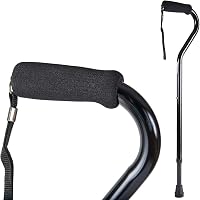
The DMI cane has a soft offset handle and wrist strap. The HurryCane has a three-point contact base and folds for storage.
The REHAND cane folds and has an all-terrain base.
Those features may help narrow your options, but each cane still needs to match your measurement. Compare more options in our best walking cane for seniors guide.
What should you do if the measurement falls outside the cane’s range?
Look for an adjustable cane that includes your measured height, or ask a mobility professional about a suitable alternative. Don’t force a cane to a height its adjustment mechanism does not support.
Check that any cane you are considering can be adjusted in a way that lands close to your wrist measurement. If the increments skip past your measurement, try holding it at the nearest setting and check your elbow and shoulder position before deciding.
Cane designs vary in handle shape, base and adjustment method. Our guide to walking cane cost can help you compare options while keeping fit at the center of the choice.
When should you ask someone to check the fit?
Ask a clinician, physical therapist or mobility equipment professional if you cannot stand safely for the measurement, have a marked difference between sides, or still feel unsteady after adjusting the cane.
A professional can observe how you stand and walk with the cane. Bring the shoes you wear most often, since footwear affects the measurement.
What is the quickest way to choose the right walking cane length?
Choose a cane that adjusts to your wrist-crease measurement in your usual shoes, then confirm that your elbow bends slightly and your shoulder stays relaxed. If you cannot get that fit or feel unsteady, ask a clinician or mobility professional to check it.
Review the best mobility scooter for mall walking if you are also weighing a seated option for longer outings, or read how to choose the right mobility scooter to compare needs and features.
Frequently asked questions
How do you measure for a walking cane?
Stand upright in the shoes you expect to wear, let your arms rest at your sides, and measure from the floor to the crease of your wrist. The handle should reach about that height.
When you hold it, your elbow should bend slightly rather than lock straight.
Should a walking cane reach the wrist or the hip?
Use the wrist crease as a practical starting point: stand tall with relaxed arms and measure from the floor to the crease. Hip height varies with body shape and posture, so it is less useful as a fixed target.
Confirm the fit by checking your elbow bend while holding the cane.
Can a walking cane be too tall?
Yes. A cane that is too tall can make your shoulder lift or your elbow bend too much.
Adjust it so the handle meets your wrist crease while standing naturally, then check that your shoulder stays relaxed and your elbow bends slightly when gripping the handle.
How tall should a quad cane be?
A quad cane should generally reach the wrist crease when you stand upright with your arms at your sides, just like a single-tip cane. Check that its base sits flat on the floor and that your elbow bends slightly when you hold it.
Ask a clinician to confirm fit if you need manual guidance.