7 Best Patient Lift Transfer Chairs (November 2026)
The best patient lift transfer chairs include the Joerns Hoyer Advance Electric Portable Patient Lift for full-body transfers, the Invacare Hydraulic Patient Lift for floor recovery, and the VOCIC Sit to Stand Lift for users who can sit upright.
On this page (7 sections)
- How we compared patient lift transfer chairs
- Patient lift transfer chair comparison
- The best patient lift transfer chairs for home care
- How do you choose between a patient lift and a transfer chair?
- What should you measure before buying a patient lift transfer chair?
- What sling and caregiver checks matter?
- Which patient lift transfer chair should you choose?
The best patient lift transfer chair depends on how much support the person can provide. The Joerns Hoyer Advance is the top pick for full-body transfers, while sit-to-stand aids suit people who can actively help rise and electric transfer chairs support seated moves.
A lift that works between a bed and chair may not fit a toilet, narrow doorway or car opening. Before choosing, match the device to the person's ability, the caregiver's role and the rooms where transfers happen.
For a broader overview of mobility aids for seniors, start with the equipment category and task. If you need a sling-based lift, compare our guide to the best patient lift for home use.
Our picks at a glance
-
1
 Best for full-body transfers
Joerns Hoyer Advance Electric Portable Patient Lift
9.7/10 our score
See it on Amazon -
2

-
3

- 4
 Check it
Graham-Field Lumex LF1600 Stand Assist
Best for supported standing - 5
 Check it
Vive Mobility Sit to Stand Patient Lift
Best for users who can support 60–70% of their weight - 6
 Check it
Mosfer Electric Patient Lift Transfer Chair Lift
Best for assisted car transfers - 7
 Check it
VOCIC AY05 Electric Patient Lift for Home
Best for powered floor-to-bed transfers
How we compared patient lift transfer chairs
We compared the stated transfer uses, support style, capacity, adjustment range and space needs for each option. Our score weighs specs and features against what caregivers need for transfers, including whether the person must actively stand or can remain seated in a sling.
These products serve different needs, so a higher score does not mean a sit-to-stand aid can replace a full-body lift. A person's mobility, care plan and caregiver training should guide the choice.
Patient lift transfer chair comparison
The key differences are the transfer method and how much the person must do. Check these details alongside each model's instructions and fit measurements.
| Product | Best for | Capacity | Weight | Power | Our score |
|---|---|---|---|---|---|
| Joerns Hoyer Advance Electric Portable Patient Lift | full-body transfers | 340 lb | 69.9 lb | Battery powered | 9.7 |
| Invacare Hydraulic Patient Lift | floor recovery | 450 lb | 68 lb | 9.5 | |
| VOCIC Sit to Stand Lift | users who can sit upright | 400 lb | 9.4 | ||
| Graham-Field Lumex LF1600 Stand Assist | supported standing | 400 lb | 61 lb | 9.4 | |
| Vive Mobility Sit to Stand Patient Lift | users who can support 60–70% of their weight | 400 lb | 60 lb | 9.3 | |
| Mosfer Electric Patient Lift Transfer Chair Lift | assisted car transfers | 330 lb | 8.7 | ||
| VOCIC AY05 Electric Patient Lift for Home | powered floor-to-bed transfers | 330 lb | 85 lb | 8.6 |
The best patient lift transfer chairs for home care
The Joerns and Invacare lifts use slings for broader lifting support, while the standing aids require active participation. For the terminology, see patient lift vs Hoyer lift.
The two electric transfer chairs provide seated support with different adjustment and storage features.
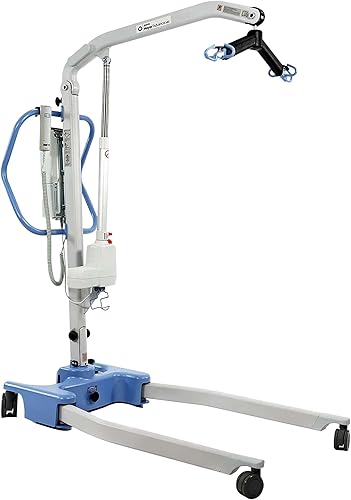
Joerns Hoyer Advance Electric Portable Patient Lift: Best for full-body transfers
- Folds without tools
- Battery powered
- 340 lb capacity
- Transfers from floor, bed, chair, commode, shower seat and lift chair
The foldable electric Hoyer Advance supports transfers from the floor, bed, chair, commode, shower seat and lift chair. It weighs 69.9 lb and is compatible with numerous slings.
Pros
- Folds without tools
- Leg width adjusts with a pedal
- Vehicle transfers may use a different sling
Cons
- Vehicle transfers may require a different sling
- Whether a sling is included is not specified
The Joerns Hoyer Advance is a portable electric lift for several transfer points. It can transfer someone from the floor to a bed, chair, commode, shower seat or lift chair, and from a vehicle with a different sling.
Its 69.9 lb aluminum frame folds without tools for storage or transport. The leg width adjusts with a pedal, which helps the lift fit around a wheelchair or furniture, and the swan-shaped legs are designed to bring the lift closer to the user.
The Hoyer Advance has a 340 lb capacity and runs on batteries. Joerns says it is compatible with numerous slings, and vehicle transfers may require a different sling that is not included.
Choose this when you want a portable lift for multiple rooms. Compare sling styles and confirm that the sling supports the transfer you plan to make.
Invacare Hydraulic Patient Lift: Best for floor recovery
- Hydraulic lift
- 20–64 in lifting range
- 450 lb capacity
- Base adjusts from 22 to 62 in
The Invacare hydraulic lift is designed for floor-to-bed transfers, with a 20–64 in lifting range. Its base closes to 22 in and opens to 62 in.
Pros
- Highest stated capacity here
- Reaches floor level
- Pump handle can be used from either side
Cons
- Manual hydraulic operation
- Open base width needs room
The Invacare hydraulic lift has a stated 20–64 in lift range, which reaches the floor and extends to bed height. Its capacity is 450 lb, the highest among these picks.
The base closes to 22 in for narrower passages and opens to 62 in for transfers around wheelchairs or recliners. Its 68 lb frame is described as lightweight for a manual hydraulic lift, and the rotating pump handle can be used from either side.
This is a sling lift, so check sling fit and transfer technique before use. The wide open base needs enough floor space, and a caregiver must operate the hydraulic pump.
Choose the Invacare for floor-to-bed transfers or when capacity is the deciding factor. Its weight and adjustable base make it worth comparing with the best portable lifts for patients.
VOCIC Sit to Stand Lift: Best for users who can sit upright
- 400 lb capacity
- Padded split-seat cushions and shin pads
- Locking front and rear casters
- Requires the user to sit up and support their upper body
This open-design sit-to-stand aid is for people who can sit up and support their upper body. It has padded split-seat cushions, shin pads and locking front and rear casters.
Pros
- 400 lb capacity
- Low-profile base
- Padded handgrips and supports
Cons
- No safety belt restraint
- Not recommended for completely immobile or paralyzed users
The VOCIC sit-to-stand lift is for a person who can sit up and support their upper body. Its open design does not include or support a safety belt restraint, and it is not recommended for someone who is completely immobile or paralyzed.
Padded split-seat cushions, shin pads and foam-wrapped handgrips provide contact points during an active transfer. The knee pad adjusts to 2 levels, and the low-profile 6 cm base is designed to slide under most furniture.
The frame supports up to 400 lb and has locking rear and front casters. Those features do not change the central fit requirement: the person needs enough control and strength to participate.
Choose this for supported standing transfers only when the person can safely engage. If they cannot remain upright or take weight through their legs, discuss a full-body lift with a trained care professional.
Graham-Field Lumex LF1600 Stand Assist: Best for supported standing
- 400 lb capacity
- Cushioned knee pads
- Padded seat and ergonomic handbars
- Designed for active participation
The Lumex LF1600 supports active sit-to-stand transfers with cushioned knee pads, a padded seat and ergonomic handbars. Its stated user height range is 5 ft 1 in to 6 ft 6 in.
Pros
- 400 lb capacity
- Padded contact points
- Designed to move through most doorways
Cons
- Requires active user participation
- Doorway fit depends on the home's layout
The Lumex LF1600 is a stand-assist option for adults who can take an active role in standing and sitting. It combines a padded seat, cushioned knee pads and ergonomic handbars to support that movement.
Its steel frame supports up to 400 lb and is specified for users from 5 ft 1 in to 6 ft 6 in. At 61 lb, it is a substantial device, so check the route between rooms and the storage space available.
The LF1600 is designed to reduce caregiver strain during transfers, but safe positioning and supervision remain important. Measure the room and confirm the user can participate before choosing a standing aid.
Choose this when a person can rise with support and the padded contact points fit their needs. For someone who cannot stand actively, consider a sling lift instead.
Vive Mobility Sit to Stand Patient Lift: Best for users who can support 60–70% of their weight
- 400 lb capacity
- For users able to support 60–70% of body weight
- 26 in widest base
- Dual-lock brakes
The Vive stand-assist is intended for users who can support 60–70% of their body weight. Its base is 26 in at the widest point, so measure doorways before choosing it.
Pros
- Supports bed, wheelchair, toilet and sofa transfers
- Cushioned handrails and split seat pads
- Dual-lock brakes
Cons
- May not fit narrow doorways
- Requires the ability to support 60–70% of body weight
The Vive stand-assist is designed for people who can support 60–70% of their body weight. It can help with transfers between a bed, wheelchair, toilet or sofa when the user can grip the rails and take part in standing.
Its 26 in widest base may not pass through narrow doorways. Measure the full route, including bathroom and bedroom doors, before choosing it.
Four swivel casters move across multiple flooring surfaces, and the dual-lock brakes lock in place during positioning. The split seat pads, shin rests and foam-covered handrails add padded contact areas.
Choose the Vive if its doorway width fits and the person can support enough of their weight. If either condition is uncertain, get guidance from a clinician or trained caregiver before use.
Mosfer Electric Patient Lift Transfer Chair Lift: Best for assisted car transfers
- Electric height adjustment from 40 to 54 in
- Base adjusts from 23.6 to 38 in
- 330 lb capacity
- Folds for storage and transport
The Mosfer electric transfer chair adjusts in height and base width, and folds for storage or transport. It is intended for assisted transfers and users able to sit upright.
Pros
- Height and base width adjust electrically
- Includes large and small caster sets
- Folds for storage and transport
Cons
- Requires caregiver assistance
- Doorways should be wider than 26 in
The Mosfer is a powered transfer chair for assisted moves between a bed, chair, toilet or car. Its height adjusts from 40 to 54 in, and the base widens from 23.6 to 38 in to fit different transfer positions.
It includes 4 in wheels and a set of smaller 3 in wheels for hard floors or lower-clearance beds and sofas. The chair folds for storage or transport, and its capacity is 330 lb.
Measure carefully: the recommended doorway width is more than 26 in, with more than 5 in of clearance under the bed or sofa. The user must not use it alone, and they need to be able to sit upright.
Choose this for adjustable seated transfers when the room measurements fit. For loading a mobility scooter into a vehicle, see our guide to Best Mobility Scooters with Car Lifts and learn what a scooter lift for cars does.
VOCIC AY05 Electric Patient Lift for Home: Best for powered floor-to-bed transfers
- 330 lb capacity
- 29.5–61 in vertical range
- Foldable frame
- Manual emergency lowering
The electric AY05 includes a mesh sling with head support strips and leg padding. Its manual override crank allows manual lowering if power is lost.
Pros
- Includes a sling
- Base adjusts from 24.4 to 38 in
- Manual emergency lowering
Cons
- 85 lb frame may be cumbersome to move
- Compare the lift range with bed and chair heights
The VOCIC AY05 is a powered sling lift for home transfers from the floor to a bed, wheelchair or recliner. Its vertical range is 29.5–61 in, and the base adjusts from 24.4 to 38 in with a foot pedal.
The foldable carbon steel frame supports up to 330 lb and weighs 85 lb. It includes a breathable mesh sling with head support strips and leg padding, plus a detachable battery handset that VOCIC says charges in 3 hours for up to 40 lifting cycles.
A manual override crank allows the user to be lowered if power is lost. Confirm that the lift's range suits the bed and chair heights in the home, and that there is room to open the base.
Choose this for powered floor-to-bed transfers when the included sling and adjustment range suit the person. Review the patient lift cost guide as you compare the lift, sling and any needed setup.
How do you choose between a patient lift and a transfer chair?
Choose a sling lift when the person needs more support and cannot reliably help stand. Choose a sit-to-stand aid only when they can follow instructions, hold on and take an active part in rising.
A chair-style transfer aid may suit upright seated moves and room-to-room positioning. Check the model's user requirements closely, since some exclude people who cannot sit upright or support their upper body.
What should you measure before buying a patient lift transfer chair?
Measure door widths, the tightest turn, bed and chair heights, and the space around the transfer area. For a chair with a low base, measure the clearance under the bed or sofa as well.
Compare the lift's closed and open base widths with the route and destination. A lift that fits through a doorway may still need more room to turn or position beside a bed.
What sling and caregiver checks matter?
Use a sling that is compatible with the lift and appropriate for the person and transfer. Our guide to patient lift sling types explains the main styles and what to confirm.
Follow the lift and sling instructions, and ask a trained caregiver or clinician to show you the transfer method. A caregiver can also review how to use a gait belt for supported transfers.
Do not rely on capacity alone to decide whether a device is suitable.
Which patient lift transfer chair should you choose?
Choose the Joerns Hoyer Advance for a foldable electric sling lift with several transfer uses, or the Invacare for its 450 lb capacity and floor-level range. Choose a sit-to-stand model only when the person can actively participate, and pick an electric transfer chair when its measurements and upright support fit the home.
For buyers comparing equipment for broader home care, start with the best patient lift for home use and check the sling and room fit before deciding.
Our top 3 picks at a glance
-
1
Best for full-body transfers
Joerns Hoyer Advance Electric Portable Patient Lift
9.7/10 our score
See it on Amazon -
2
-
3
Frequently asked questions
What is the difference between a patient lift and a transfer chair?
A patient lift usually raises a person in a sling, while a transfer chair supports a seated person during movement between surfaces. Sit-to-stand aids require the user to take an active part in rising.
Match the device to the person's ability to sit upright, hold on and bear weight, and ask a care professional for help choosing a suitable transfer method.
Can a patient lift transfer chair move someone from bed to a car?
Some models are designed for car transfers, but fit and sling needs vary. The Joerns Hoyer Advance can transfer from vehicles with a different sling, while the Mosfer chair is designed for car transfers.
Measure the doorway, vehicle opening and transfer space, then confirm the sling or chair setup before use.
Can a sit-to-stand lift be used for someone who cannot stand?
A sit-to-stand lift is meant for someone who can take an active part in standing. The VOCIC open-design aid requires the person to sit up and support their upper body, and the Vive model is intended for users able to support 60–70% of their body weight.
For someone unable to do that, ask a clinician or trained caregiver about a full-body lift and suitable sling.
How do I choose the right patient lift sling?
Choose a sling that fits the lift model, the person's body and the transfer task. A full-body lift and a sit-to-stand aid may use different support styles.
Review our guide to patient lift sling types and confirm compatibility with the manufacturer before transferring someone.
How much room does a patient lift need?
Check the lift's base width, doorway width, turning space and the clearance under the bed or chair. The Invacare base adjusts from 22 to 62 in, while the Vive stand-assist reaches 26 in at its widest point.
Measure the complete route, including tight turns, before choosing a model.