Raised Toilet Seat vs Commode Chair: Which Do You Need? (November 2026)
Choose a raised toilet seat if you mainly need more height on your existing toilet; choose a commode chair if you need a separate bedside toilet or a frame over the toilet. The right raised toilet seat vs commode choice depends on where you use it and how much support you need.
On this page (7 sections)
- Raised toilet seat vs commode: what is the difference?
- Which option fits your main need?
- How much support and transfer access do you need?
- What should you measure before choosing?
- Can a commode chair replace a raised toilet seat?
- Which products match each setup?
- How do you decide between a raised toilet seat and commode chair?
Choose a raised toilet seat if you mainly need more height on your existing toilet; choose a commode chair if you need a separate bedside toilet or a frame over the toilet. The decision depends on where you will use it, whether you need hand support and how the frame fits your space.
A seat riser adds height to a toilet. It does not add a new toilet location, and it does not usually provide a bucket for bedside use.
A commode chair is a freestanding frame that can have a removable bucket. Some models can also sit over a toilet, which gives them more than one possible use.
Start with the place where the device will be used most often. If that place is the bathroom toilet, a riser may be enough because extra height can make sitting and standing easier.
If that place is beside a bed, a riser alone will not help. A commode with a bucket can be placed close to the person who needs it at night.
Hand support is the next detail to consider. Some people mainly need height, while others also want handles or arms to hold.
The HealthSmart riser is a simple height option for a round toilet. It adds 5 inches and needs no assembly, which suits a straightforward setup.
The Vive riser adds 3.5 inches under an elongated toilet seat. It also includes removable padded handles for people who want support at the toilet.
The DMI commode has drop arms for side access. That design may suit someone who transfers from a wheelchair or another seat beside the commode.
The HOMLAND commode offers bedside, over-toilet and safety frame options. That flexibility may suit a household that wants one frame for more than one setup.
We compared 2 risers and 2 commode chairs on function, fit and daily use rather than brand alone. For wider bathroom safety for seniors, consider the route to the toilet, floor space and support you can reach from a seated position.
Weight capacity also matters, so check the limit for the exact model you are considering. Space matters too, as a commode frame needs clear floor room while a riser needs a close match with toilet shape and size.
Night use and care deserve separate thought. A person who manages during the day may still need a bedside option after dark, and a bucket must be emptied and cleaned.
The sections ahead look at measuring, support and replacement use. They also explain which product fits each setup, so you can compare with your own room and routine in mind.

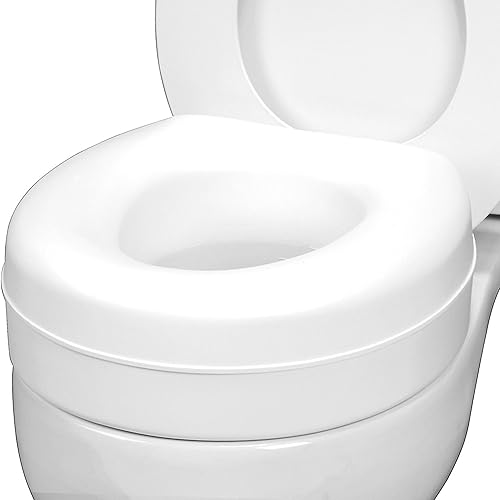 Best for simple height increase
HealthSmart 5" Padded Raised Toilet Seat Riser
Raised toilet seat vs commode: what is the difference?
A raised toilet seat changes the height of your existing toilet; a commode chair adds a separate seat and frame. The right choice starts with whether you need a change to the toilet or another place to sit.
A riser sits on or attaches to the toilet, depending on its design. For example, the HealthSmart riser adds 5 inches on top of a round toilet bowl, while the Vive model adds 3.5 inches under an elongated toilet seat and includes removable handles.
A commode chair can be placed beside a bed with a bucket or used over a toilet if its design allows it. The DMI and HOMLAND models both have adjustable legs and a bucket, and HOMLAND describes its frame for bedside, over-toilet and safety-frame use.
Is a raised toilet seat a commode?
No, a standalone riser is not a commode chair. It raises the toilet you already use and does not provide a separate bedside toilet or bucket.
Some commode chairs can also act as a raised seat or safety frame. That makes them more flexible, but they take floor space and may need setup before use.
Which option fits your main need?
Pick the device based on the task you want to make easier: sitting on your current toilet, using the toilet from bed or getting support at the toilet. A product's label alone won't tell you whether its shape and setup suit your room.
Choose a riser when you can reach the bathroom and mainly want the toilet seat higher. Choose a commode when a bedside location, a frame over the toilet or a bucket is useful.
When does a raised toilet seat make more sense?
A riser is a direct option if the bathroom toilet is already in the right place and you don't need a bucket. The HealthSmart model rests on a round bowl and adds 5 inches, with no assembly required.
If you want handles at the toilet, the Vive riser attaches under an elongated seat and includes removable padded handles. Measure the toilet before choosing, since those two models fit different toilet shapes.
Compare the likely fit with our guide to raised toilet seat sizes. If you are also checking your budget, see raised toilet seat cost.
When does a commode chair make more sense?
A commode chair can help when walking to the bathroom is difficult or you need a bedside toilet. Its bucket can be removed for emptying, and the frame can be positioned near the bed if there is enough clear floor space.
A commode may also fit over a toilet, depending on the model and bathroom. Check frame dimensions and height adjustments against the toilet and nearby fixtures before choosing this setup.
How much support and transfer access do you need?
A riser with handles or a commode with arms can give you something to hold while sitting or standing, but the support layout differs. Match it to the transfer direction and the movement you can manage safely.
The Vive riser's handles are padded and removable. The DMI commode has drop arms that lower with a release button, allowing side access for transfers.
A fixed arm can get in the way when you need to move sideways from a wheelchair or another seat. Drop arms may clear that path, but only if the frame can be positioned securely and the user can reach the release safely.
The HOMLAND commode has armrests and is height adjustable. Its dual-crossbar frame is designed to support up to 350 lb, while the DMI model has a 500 lb capacity; choose only after checking the user's needs and the exact device limits.
What should you measure before choosing?
Measure the toilet, the available floor area and the route into the bathroom before buying. A riser needs to match the toilet shape, while a commode needs room for its frame and for a safe approach.
Toilet shape is a key fit detail for a seat riser. The HealthSmart model is for round toilets, and the Vive riser is made for elongated toilets and fits under the existing seat.
A round toilet and an elongated toilet do not accept the same riser in the same way. Checking the shape first can prevent a poor fit that makes the seat feel unstable.
Measure the toilet bowl from front to back and side to side. Note whether the existing seat is round or elongated before you compare models.
Also check the current seat height in the bathroom. Added height should make sitting and standing easier, not force an awkward posture.
For a commode, compare the frame width and height range with the toilet and nearby walls, cabinets and grab bars. The frame must clear the toilet if it will sit over it.
Leave enough room for the user and a caregiver, if one assists with transfers. A caregiver needs space to stand safely without pushing against walls or furniture.
Clear the route into the bathroom as well. A narrow doorway, a rug edge or stored items can make a frame harder to position each time.
Check the floor surface where the commode will stand. The feet should sit evenly on a firm surface and the frame should not rock.
For bedside use, measure the clear floor beside the bed. There should be room for the frame, the user and any helper who may be present at night.
Measure the space for bucket removal too. The bucket needs to lift out and move toward a bathroom without tight turns or low obstacles.
Check height adjustments against the user and the toilet. Adjustable legs should let the seat sit at a comfortable level without forcing the user to stretch or slouch.
Look at nearby fixtures before choosing an over-toilet setup. A cabinet door, a grab bar or a wall can block the frame or limit arm movement.
Handles and drop arms also need clear space. A support feature cannot help if it is pressed against a wall or blocked by furniture.
Test the approach from the side when side transfers are planned. The user should be able to reach the seat without twisting across an arm or frame leg.
Check the floor around the toilet for the riser as well. Feet should be placed safely, and the added height should not make the user reach too far for support.
Look at lighting along the route, especially for night use. A clear and well lit path can matter as much as the device itself.
Keep the measurements with the product details when you compare options. Exact numbers make it easier to see whether a frame will fit both the toilet and the room.
Also check the weight limit and the stated dimensions for each model. A frame that fits the space may still be wrong if its capacity does not match the user.
Do not use a setup that rocks or shifts. If a riser does not sit firmly or a frame feels unsteady, stop and recheck the fit before use.
Can a commode chair replace a raised toilet seat?
Sometimes, if the commode is designed to fit over your toilet and the fit is secure. A bedside commode with a bucket is a separate use, even if its frame can also go over the toilet.
A commode chair does not become a raised toilet seat in every setup. The intended use matters, and the frame must be set up as the manufacturer directs.
The HOMLAND model is described for bedside use, as a raised toilet seat or as a safety frame. That range of uses gives it more flexibility than a seat-only riser.
The DMI has adjustable legs and is described for bedside and over-toilet use. Its legs adjust from 20 to 24 inches, which can help it fit over many standard toilets.
Fitting over a toilet is not the same as fitting well. The frame should sit securely, the seat height should feel comfortable and the user should be able to approach it safely.
A bucket is not needed when a commode frame is used over a toilet. Removing the bucket for that setup can keep the space clearer and simplify care.
A bedside setup is different because the bucket becomes part of daily use. It must be emptied, cleaned and returned to place with care.
The DMI bucket lifts out for emptying and can be rinsed with mild soap and water. That routine suits bedside use, where the bucket is the toilet itself.
The HOMLAND bucket holds 7.5 quarts and has a lid and handle. Its removable design is meant to make emptying and cleaning easier in a bedside setup.
A dedicated riser may be simpler when you only need extra height at one toilet. It can sit on or attach to the toilet without a full freestanding frame.
Simplicity matters for daily care. A riser has no bucket to empty, while a commode used beside a bed needs a regular cleaning routine.
A commode frame also takes floor space. That space may be welcome beside a bed, but it can feel crowded in a small bathroom.
Follow the manufacturer's setup instructions for either device. The instructions explain how to position the frame, adjust the legs and secure the parts for that use.
Do not assume that a frame fitting one toilet will fit another. Toilet shape, bowl size and nearby fixtures can change the result from one bathroom to the next.
Check the height range before you plan an over-toilet setup. The seat should be high enough to use comfortably without making the frame feel tip prone.
Also check whether arms or handles will block the approach. A drop arm may help with side access, while a fixed arm may limit movement in a tight space.
Our guide explains how to install a raised toilet seat. Read it before you attach a riser under a seat or place a frame over a bowl.
If installation or positioning is difficult, ask a qualified caregiver or health professional for help. A second pair of hands can make setup safer and help you test the approach.
Consider the daily routine, not only the first setup. The best option should remain easy to use, clean and check over time.
A commode can replace a riser function in some homes, but it should not be assumed to do so in every bathroom. Fit, space and support decide the answer.
Which products match each setup?
Choose by function first: the DMI for side access, HealthSmart for a 5-inch lift on a round toilet, Vive for an elongated toilet with handles, or HOMLAND for three setup options. Compare the fit and capacity with your needs before selecting.
The DMI commode has drop arms for side access, an adjustable 20 to 24 inch height and a removable bucket for bedside or over-toilet use.
The HealthSmart riser adds 5 inches on a round toilet and needs no assembly. It suits a simple height increase where the toilet is already in the right place.
The Vive riser adds 3.5 inches under an elongated toilet seat and has removable padded handles. It suits a toilet that will stay in place and a user who wants hand support.
The HOMLAND frame can serve as a bedside commode, raised toilet seat or safety frame, with an adjustable height and removable bucket. It suits a household that wants one frame for more than one setup.
Check toilet shape before you compare these options. A riser for a round toilet will not match an elongated toilet in the same way.
Check weight capacity as well. The DMI supports up to 500 lb, while the HOMLAND supports up to 350 lb and the two risers each support up to 300 lb.
Our score weighs specs, features and buyer feedback against what you're shopping for.
How do you decide between a raised toilet seat and commode chair?
Choose a raised toilet seat for extra height at the toilet you already use; choose a commode chair for bedside use, a frame over the toilet or more transfer options. Confirm toilet shape, floor space, support needs and weight capacity before deciding.
If the bathroom toilet is easy to reach and only the seat height is a concern, start with a riser that fits the bowl. Height alone may be the main problem to solve.
Measure the toilet shape first. The HealthSmart riser fits a round toilet, while the Vive riser fits an elongated toilet and attaches under the existing seat.
Think about handles next. Removable padded handles on the Vive model may help a user who wants support while sitting and standing at the toilet.
If you need another toilet location or a frame that can adapt to different setups, compare commode chairs and measure the space where you plan to use one. Bedside use changes the choice in a major way.
A commode with a bucket can sit beside a bed at night. That setup can reduce a long walk to the bathroom when getting up is difficult.
A commode frame can also fit over a toilet when the model allows it. The DMI and HOMLAND frames both offer adjustable height for that kind of setup.
Side access may be the reason to choose the DMI. Its drop arms lower with a release button, which can clear a path for a sideways transfer.
The HOMLAND frame may suit a home that wants more setup choices. It can be used beside the bed, over a toilet or as a safety frame, depending on the intended use.
Check the weight limit for the exact device you choose. The DMI frame supports up to 500 lb, the HOMLAND supports up to 350 lb and the risers support up to 300 lb.
Also check the care routine. A bucket must be emptied and cleaned, while a riser needs regular checking to confirm that it still sits firmly on the toilet.
Measure the room before you buy any freestanding frame. Clear floor space, a safe approach and room for a caregiver all affect daily use.
Follow the setup instructions for the device you select. A secure fit matters more than having more features in a product list.
In short, match the device to the place and task. A riser suits added height at one toilet, while a commode suits bedside use, an over-toilet frame or wider transfer options.
Frequently asked questions
Is a raised toilet seat a commode?
No. A raised toilet seat adds height to the toilet you already have, while a commode chair is a separate frame that can hold a bucket and may also fit over a toilet.
Some commode chairs can serve as a raised seat or safety frame, so check the intended setup.
Should I choose a raised toilet seat or commode after surgery?
Choose based on the setup and support you need, and follow your care team's advice. A riser adds height to the toilet; some models include handles.
A commode can sit beside the bed or over a toilet, and drop arms may help with side transfers.
Can a commode chair fit over a regular toilet?
Some commode chairs are designed for use over a toilet, but fit depends on the frame and toilet dimensions. Check the chair's height and width, leg adjustment range and the toilet's shape before choosing; confirm that the frame sits securely without rocking.
How do I choose the right raised toilet seat height?
Start by considering how easily you can sit down and stand up, then check the added height against the toilet and your body position. Seat risers can add different amounts of height, and toilet shape matters too.
See our guide to raised toilet seat sizes before choosing.
How do you clean a bedside commode bucket?
Follow the commode's care instructions and use a method that suits the bucket material. Removable buckets make emptying easier; the DMI bucket can be rinsed with mild soap and water.
Wash your hands after handling waste and keep the bathroom or bedside area clean.


