Types of Rollator Walkers: Which One Fits You?
The main types of rollator walkers are 3-wheel, 4-wheel, upright and terrain-focused models. Choose based on your routes, need for a seat, fit, brake control and storage space.
On this page (10 sections)
- What are the main types of rollator walkers?
- Is a 3-wheel or 4-wheel rollator a better fit?
- Which rollator type works for indoor and outdoor routes?
- Do you need a rollator with a seat?
- What is an upright rollator?
- How should you fit and set up a rollator?
- What features should you compare before choosing?
- How do you care for and use a rollator?
- What common rollator mistakes should you avoid?
- Which type of rollator walker should you choose?
The main types of rollator walkers are 3-wheel, 4-wheel, upright and terrain-focused designs. Choose among them by where you walk, whether you need a seat, how well you can use the brakes and where you'll store the frame.
A compact 3-wheel style may suit tight indoor turns. A 4-wheel model often adds a seat and backrest, while larger wheels may suit routes with bumps or uneven sections.
These categories overlap, so check the features and fit of the model you are considering.
If you are comparing rollators with other walking aids, start with the complete walkers and rollators buying guide. Then use the sections below to narrow your choice.
What are the main types of rollator walkers?
The main types of rollator walkers are 3-wheel, 4-wheel, upright and terrain-focused models. Folding frames are also common, and some designs combine features from more than one group.
| Type | Common features | Consider it when |
|---|---|---|
| 3-wheel | Three wheels and a compact frame, often without a seat | You need to turn in tighter indoor spaces |
| 4-wheel | Four wheels, often with a seat and backrest | You want a place to pause during a walk |
| Upright | Handles or supports designed for a more upright grip | The specific handle position suits your posture |
| Outdoor or all-terrain | Features such as larger wheels or tires for varied surfaces | Your route includes more than smooth indoor floors |
| Folding | A frame that folds for storage or transport | You need to put it away between uses |
The category name is only a starting point. Check the model’s dimensions, brake controls, seat details and instructions to see whether it fits your home and routines.
A rollator is a wheeled walking aid. It can help you move without lifting a standard walker at every step, but it also rolls forward, so controlling the brakes matters.
How do rollator walker types differ by wheels?
Wheel setup affects how a rollator steers and which routes may suit it. Compare the actual wheel size and tire design instead of assuming every model in a category handles the same way.
A 3-wheel rollator has one front wheel and two rear wheels. Its compact shape may help you steer around furniture or through narrow hallways, but many such models do not offer the seat and backrest found on some 4-wheel designs.
A 4-wheel rollator has a wheel at each corner. Many include a seat and backrest, though the wider frame may need more turning space.
Consider whether you can keep it close and steer it through your usual doorways.
Some outdoor-focused models have larger wheels or tires meant for varied ground. Those features can help a model pass over bumps, but they do not guarantee that a steep, loose or slippery path is safe.
Is a 3-wheel or 4-wheel rollator a better fit?
A 3-wheel rollator may fit tight indoor routes, while a 4-wheel model may be a better match if you want a seat for planned rest breaks. Consider your turning space and brake control along with the features you want.
A 3-wheel design can suit someone who walks mainly indoors and needs to steer around furniture. Check the frame width, turning space and storage arrangement; a compact shape does not help if you cannot grip the handles or use the brakes comfortably.
A 4-wheel model can suit someone who wants a seat and backrest along with walking support. It may be a poor fit if you have little room to turn, cannot set the brakes reliably or cannot safely sit down and stand up from its seat.
Before choosing either type, practice squeezing and locking the brakes while standing still. If a brake lever is difficult to reach or operate, ask a qualified professional about other walking aids or a better-fitting model.
If you're weighing wheels against a frame you lift with each step, see rollator vs standard walker. The types of walkers for seniors guide covers other options too.
Which rollator type works for indoor and outdoor routes?
Choose a rollator by the surfaces and spaces on your regular routes, then check its wheels and dimensions. Smooth indoor floors, paved paths and rougher ground pose different steering and control demands.
For indoor use, check the frame width against doorways, hallway turns and storage spots. A narrow design can still be difficult to manage if it is too tall, the handles don't fit or the brakes are hard to use.
For outdoor routes, look at wheel size, tire type and the maker's guidance. Larger wheels may help with small bumps.
They do not make a rollator suitable for every uneven surface, slope or weather condition.
The VOCIC Z21 has 8 in wheels, puncture-proof tires and 3 brake modes: free, deceleration and stop. Its front wheels and storage bags have reflective strips, and its frame folds for storage.
This type may suit someone who regularly uses both indoor spaces and paths with bumps. Skip it if its frame dimensions, seat or handle adjustments don't fit you, or if you need a design specifically recommended for a route the maker does not cover.
Before taking any rollator outside, try its steering and brakes on a familiar, level surface. Add more challenging routes only when you can control the frame.
Do you need a rollator with a seat?
A seat is useful when you want a place to stop during a walk, provided you can park the rollator and sit down safely. Check seat height and back support before choosing a seated model.
A seat adds steps to using the rollator. You need to stop on level ground, set the brakes as directed, turn carefully and sit without pulling the frame toward you.
The seat must also be a comfortable height for standing up again.
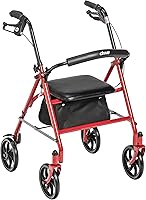
The Drive Medical Rollator Walker with Seat has a padded seat, fold-down backrest, hand brakes and an under-seat pouch. Its handles adjust, and the frame folds for storage.
This model may fit someone who wants a place to sit and storage close at hand. Skip a seated rollator if you cannot operate its brakes before sitting or need help getting up that the frame cannot provide.
Ask a qualified health professional to help you choose if those movements are difficult.
For more model options, see best rollator walkers for seniors.
What is an upright rollator?
An upright rollator has a handle setup intended to support a more upright grip position. Judge the fit of the specific handles and supports, since the label alone does not show whether you'll walk comfortably.
Some models place the hands higher or include forearm supports. A standard rollator usually has lower handles that you grip with your hands.
Either design needs to let you steer and operate the brakes without leaning or reaching awkwardly.
Check the handle adjustment range, frame width and the space needed to turn. If you cannot use the controls in a comfortable position, that model is a poor fit, even if you like its frame style.
An upright design may suit someone whose posture or grip makes a standard handle position uncomfortable. It may not suit you if its supports restrict your arm movement or make the brakes hard to reach.
Compare the U-Step walker vs rollator if you are considering a specialized walking frame.
How should you fit and set up a rollator?
Fit the handles so you can stand upright and reach the brakes without straining. Follow the model's instructions for unfolding, locking and adjusting the frame before walking.
Start with the rollator on a level surface. Unfold it fully, check that the frame locks open and tighten any adjustment knobs or fasteners as directed.
Make sure the wheels turn smoothly and the seat, backrest and storage parts are attached correctly.
Set the handle height according to the maker's instructions. With your hands on the grips, your shoulders should stay relaxed and you should not need to hunch or reach far forward.
If the adjustment range cannot give you a comfortable position, choose a different size or design.
Practice moving, turning, stopping and locking the brakes in a clear space. If the frame pulls away from you, feels hard to steer or the brakes don't hold as expected, stop and check the setup before relying on it.
The VOCIC Z21 has 5 handle height positions and a seat that adjusts across 3 levels. It is designed for users from 4 ft 11 in to 6 ft 3 in, but the actual fit still depends on your posture and reach.
What features should you compare before choosing?
Compare fit, brakes, wheels, storage and folded dimensions before you decide. Those details determine whether the rollator works in your home and on your regular routes.
- Handle height: Make sure the grips let you walk without hunching or reaching.
- Brake controls: Check that you can squeeze and lock them as directed.
- Wheel setup: Match the wheel size and tire design to the surfaces you use.
- Seat: If included, check height and back support, and consider whether you can get up safely.
- Folded size: Measure the closet, car space or storage area where it will go.
- Frame width: Check doorways and tight turns at home.
- Storage: A pouch or basket can keep small items nearby, but it must not block your hands or controls.
- Open-frame lock: Confirm the frame is fully open and locked before each use.
A basket can keep personal items within reach, but first check that it fits your frame and does not get in the way. The HealthSmart basket has adjustable hook-and-loop straps, a removable tray, a built-in cup holder and a 10 lb capacity.
This accessory may suit someone who wants to carry small items without holding them. Skip it if it blocks your brake controls, makes steering awkward or does not attach securely to your frame.
For a flat surface to carry items, compare walker trays for seniors.
How do you care for and use a rollator?
Use a rollator only when its frame is locked open and its brakes work properly. Check it before each use and follow the model's instructions for cleaning and maintenance.
Before walking, confirm the frame is fully unfolded, fasteners are secure and wheels turn smoothly. Check that the brakes engage and that the seat, backrest and any storage parts are attached correctly.
Do not use a rollator that has a loose part or a brake problem.
Wipe dirt from the frame and wheels with a suitable cloth, and dry the surfaces before storage. Keep the rollator in a dry place and check the maker's care instructions before applying cleaners or lubricants.
Pay attention to changes in steering, rolling or braking. A wheel that catches or a brake that no longer holds can affect control.
Stop using the rollator until the issue is corrected.
Keep loads modest and balanced so a bag or basket doesn't pull the frame to one side. Do not hang heavy items from one handle unless the maker says the rollator can carry them there.
What common rollator mistakes should you avoid?
The most common mistakes are choosing by category name alone, skipping the fit check and sitting before setting the brakes. A short setup routine helps you catch problems before they affect a walk.
- Assuming all 4-wheel models suit outdoors: Check wheel and tire details, plus the maker's route guidance.
- Buying for wheel size alone: A larger wheel does not fix poor handle fit or difficult brake controls.
- Ignoring storage measurements: Measure the folded frame and the space it needs to pass through.
- Using a seat without parking: Stop on level ground and set the brakes as directed before sitting.
- Overloading a basket or pouch: Keep items within its stated capacity and avoid blocking the controls.
- Walking with the frame partly folded: Confirm it is fully open and locked before each use.
- Continuing after a fault: Stop if a wheel catches, a fastener loosens or the brakes don't work as expected.
If you feel unsteady with a rollator or have fallen, ask a qualified health professional to assess which walking aid fits your balance and strength. A rollator is not a substitute for advice about your specific mobility needs.
Which type of rollator walker should you choose?
Pick a 3-wheel rollator for tight indoor turns, a seated 4-wheel model for planned rest breaks, or a terrain-focused design when its wheels and maker guidance fit your usual routes. Then confirm that the handles, brakes and frame dimensions work for you.
Choose the Drive Medical model if you want a padded seat, backrest and under-seat pouch. Consider the VOCIC Z21 if you need larger wheels and puncture-proof tires for varied ground, and its size and adjustments suit you.
Add the HealthSmart basket only if you want its tray and cup holder and it attaches without interfering with the controls. If no rollator lets you steer, brake and sit safely, ask a qualified professional about another walking aid.
For more choices, compare the best rollator walkers for seniors using your routes, fit and storage needs.
Which rollator walker types should you compare first?
Compare rollator walker types that match your main route and need for breaks. Start with a compact 3-wheel design for tight turns, a seated 4-wheel model for planned rests, or an outdoor-focused model for varied surfaces.
Before you decide, check the handle fit, brake controls, folded dimensions and any accessory attachment. Choose the rollator you can control safely in the places you walk.
Frequently asked questions
What are the main types of rollator walkers?
The main types are 3-wheel, 4-wheel, upright and terrain-focused rollators. They may also fold for storage or transport.
Start with the shape and features that suit your routes, then check handle fit, brakes, seat height if included, folded size and the maker's use instructions.
Is a 3-wheel or 4-wheel rollator easier to turn?
A 3-wheel rollator may be easier to steer through tight indoor spaces because its frame is often compact. A 4-wheel model may include a seat and backrest, but needs room to turn.
Compare the model's width and turning space with your hallways and doorways.
Do all rollators have seats?
No. Many 4-wheel rollators include seats, while some 3-wheel models focus on a compact frame and storage.
Check the specific model.
If you choose a seat, make sure you can set the brakes before sitting and stand up safely when you're ready to move.
Can you use a rollator walker outdoors?
Some rollators are designed for varied surfaces, with features such as larger wheels or puncture-proof tires. Those features don't make every path suitable.
Check the maker's guidance, then practice steering and braking on a familiar, level surface before trying a new route.
What should I check before choosing a rollator?
Check handle height, brake operation, frame width, wheel type and folded size. If there's a seat, confirm its height and support, and practice setting the brakes before sitting.
Make sure you can unfold and lock the frame, and ask a qualified health professional for help if you're unsure which walking aid fits your needs.