9 Best Rollator Walkers for Parkinson's Patients (November 2026)
The best rollator walkers for people with Parkinson's include the Helavo Upright Walker with Seat for upright forearm support, the VOCIC Z21 Rollator Walker for Seniors for varied brake control, and the Vive Mobility Upright Walker with Seat for adjustable arm placement.
On this page (7 sections)
- Which rollator walkers suit different needs with Parkinson's?
- How do you choose a rollator for Parkinson's symptoms?
- Is an upright walker or standard rollator better for Parkinson's?
- How should you set up and check a Parkinson's rollator?
- What common rollator mistakes should you avoid?
- Which rollator walker should you choose for Parkinson's?
- Frequently asked questions
The best rollator walker for Parkinson's patients depends on the user's gait, grip and need for rest breaks. The Helavo is our first choice for someone who prefers padded forearm support; the VOCIC Z21 is a standard rollator with 8 in wheels and three brake modes.
Parkinson's can affect walking, turning, balance and hand control differently from person to person. Ask a physical therapist or clinician to help assess fit and use, especially if the user freezes, has trouble turning or cannot reliably operate brakes.
For an overview of walker styles, see our walkers and rollators buying guide. If safety is the main concern, read what makes a walker safer for seniors.
Our picks at a glance
-
1

-
2
 Best for varied brake control
VOCIC Z21 Rollator Walker for Seniors
9.6/10 our score
See it on Amazon -
3
 Best for adjustable arm placement
Vive Mobility Upright Walker with Seat
9.5/10 our score
See it on Amazon
- 4
 Check it
Drive Medical Rollator Walker with Seat
Best for a fold-down backrest - 5
 Check it
Medline Steel Rollator Walker with Seat
Best for lighter steel construction - 6
 Check it
VOCIC Z11 Standard Rollator Walker for Seniors
Best for broad handle adjustment - 7
 Check it
HOMLAND Foldable Rollator Walker for Seniors
Best for a wider resting seat - 8
 Check it
Pelegon Rollator Walker with Seat for Seniors
Best for narrow storage spaces - 9
 Check it
byACRE Carbon Ultralight Rollator Walker
Best for frequent lifting
Which rollator walkers suit different needs with Parkinson's?
The best rollator walker for Parkinson's patients is one the user can steer, stop and turn reliably. These 9 options include upright walkers with forearm supports and standard rollators with hand grips, brakes and seats.
The score reflects how well each model's features match common buying needs, such as support style, brake access, fit, transport and resting. A high score does not replace an individual mobility assessment or a fit check with the intended user.
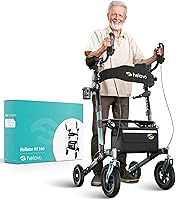
Helavo Upright Walker with Seat: Best for upright forearm support
- Soft padded armrests
- 10 in puncture-proof rubber front wheels
- Height-adjustable handles
- Parking brake
Soft padded armrests and height-adjustable handles support an upright position. The 10 in rubber front wheels and parking brake suit buyers who want an upright walker with a seat.
Pros
- Padded armrests
- 10 in puncture-proof rubber front wheels
- Cane holder and cup holder
Cons
- Maximum user capacity is 300 lb
- Upright forearm support may not suit every user's walking pattern
The Helavo is the clearest choice for someone who wants padded forearm support while walking. Its height-adjustable handles support an upright position, and the 10 in puncture-proof rubber front wheels may suit routes that include outdoor surfaces.
A parking brake is useful only if the user can engage it reliably. Check the handle height and arm position while the person stands naturally, and make sure they can reach and operate the brakes without leaning or losing balance.
The frame weighs 22.7 lb and supports users up to 300 lb. A cup holder and cane holder are included, but those extras should come after a good fit and confident brake use.
Choose it if forearm support and larger front wheels are priorities. Skip it if the user is more comfortable holding standard grips or cannot manage the upright arm position.
For another upright style, see our guide to the best upright walkers for Parkinson's.
VOCIC Z21 Rollator Walker for Seniors: Best for varied brake control
- 8 in puncture-proof wheels
- Free, deceleration and stop brake modes
- Handle height adjusts from 31.5 to 36.6 in
- User capacity up to 350 lb
The Z21 pairs 8 in wheels with three brake modes, including deceleration. Its adjustable handles and seat offer several fit options for buyers who prefer a standard rollator.
Pros
- Three brake modes
- 8 in puncture-proof wheels
- Folds for car-trunk storage
Cons
- About 22 lb to lift or carry
- Check that the frame is fully unfolded and locked before use
The VOCIC Z21 is the strongest standard rollator option here for buyers who want three brake modes: free, deceleration and stop. Its 8 in puncture-proof wheels and 20–22 in adjustable seat height also suit users who want a larger-wheel model with room to tune the fit.
Test each brake mode in a clear indoor area before taking the walker outside. The user should be able to understand the settings and operate them consistently; more modes are only useful when they feel familiar.
The Z21 weighs about 22 lb and supports up to 350 lb. Its folding size is designed for car-trunk storage, but consider who will lift it and whether that person can manage the weight.
Choose it if a standard handle-and-brake rollator feels natural and the user can manage its modes. Skip it if extra brake choices cause confusion or if its weight is difficult to load.
Before each use, confirm the frame is unfolded and locked.
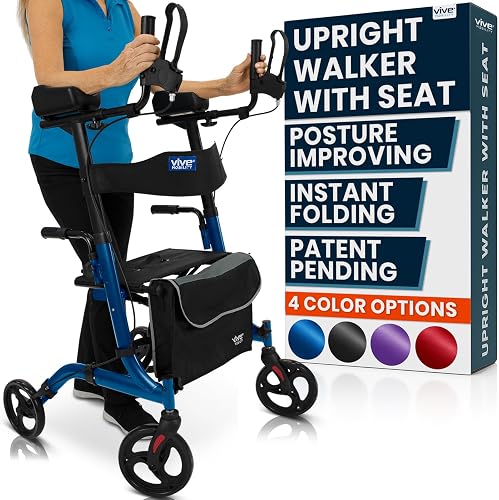
Vive Mobility Upright Walker with Seat: Best for adjustable arm placement
- 8 in flat-free wheels
- Forearm pads adjust forward and backward
- Loop brakes
- Folds for transport
The Vive upright walker has forearm pads that adjust forward and backward. Its loop brakes and 8 in flat-free wheels suit buyers seeking an upright rollator.
Pros
- Adjustable forearm-pad position
- Folds for storage or transport
- Detachable shoulder bag
Cons
- Intended for heights 5 ft 2 in to 6 ft 4 in
- Maximum user capacity is 300 lb
The Vive upright walker fits someone who wants forearm pads that move forward and backward to better match arm length. Its stated ideal height range is 5 ft 2 in to 6 ft 4 in, so check the user's height and arm position before choosing it.
The loop brakes and 8 in flat-free wheels are straightforward features to compare, while the 17.5 in seat offers a resting place. The frame weighs 20 lb and supports up to 300 lb.
An upright walker changes how a person holds and steers a mobility aid. Skip this style if the user cannot comfortably rest their forearms on the pads or struggles to use the loop brakes.
Have a clinician or caregiver help with the first practice session.
Choose it if adjustable forearm-pad position and the height range fit the user. For longer outings where walking distance is the bigger issue, compare a mobility scooter for people with Parkinson's disease.
Drive Medical Rollator Walker with Seat: Best for a fold-down backrest
- 7.5 in wheels
- Steel frame
- Height-adjustable handles
- Locking hand brake
This standard rollator combines a padded seat with a fold-down backrest and locking hand brake. Its 7.5 in wheels and under-seat pouch suit everyday use and errands.
Pros
- Fold-down backrest
- Under-seat storage pouch
- Steel frame
Cons
- Steel frame weighs 20 lb
- Wheel size is smaller than the 8 in options here
The Drive Medical rollator suits buyers who want a padded seat with a fold-down backrest and a standard hand-brake layout. Its 7.5 in wheels, height-adjustable handles and under-seat pouch cover useful needs for everyday errands and rest breaks.
The locking hand brake should feel easy for the user to squeeze and secure before sitting. Practice stopping, locking, and then standing up again in a clear space before relying on the seat during an outing.
The steel frame weighs 20 lb, and the user capacity is not stated here. Confirm capacity and handle fit before buying, and account for the frame weight if someone else will lift it into a vehicle.
Choose it if a backrest and storage pouch matter more than larger wheels. Skip it if the user cannot reliably operate the hand brake or if you need a confirmed capacity before purchase.
For post-surgery mobility needs, see our walker guide for knee replacement.
Medline Steel Rollator Walker with Seat: Best for lighter steel construction
- 16.5 lb steel frame
- 6 in wheels
- Adjustable handles from 31 to 35 in
- Push-down wheel lock
At 16.5 lb, the Medline steel rollator is lighter than several other standard models here. It has a padded seat, backrest, storage and handles that adjust from 31 to 35 in.
Pros
- 16.5 lb frame
- 350 lb user capacity
- Adjustable handle height
Cons
- 6 in wheels are smaller than several picks here
- Seat is 12 x 12 in
The Medline is a relatively light standard rollator with a 16.5 lb steel frame. Its handles adjust from 31 to 35 in, and the push-down wheel lock helps keep the walker still when the user is standing or sitting.
Its 6 in wheels are smaller than several other picks, so consider the thresholds, flooring and outdoor paths on the user's regular route. Smaller wheels may be less suitable if that route includes rough or uneven surfaces.
The rollator supports up to 350 lb and folds for storage or transport. The padded seat, backrest and under-seat storage cover basic rest and carry needs without adding a more complex upright support style.
Choose it if lower frame weight matters and the user's routes are mostly smooth. Skip it if larger wheels are important for the surfaces they use.
Our guide to walkers for seniors on carpet covers another common home-fit question.
VOCIC Z11 Standard Rollator Walker for Seniors: Best for broad handle adjustment
- Handle height adjusts from 30.7 to 38.2 in
- Dual-brake system with parking
- 11 lb storage bag
- User capacity up to 380 lb
The Z11 offers five handle-height settings and a dual-brake system with parking. Its 380 lb capacity and included storage bag may suit buyers who need those features in a standard rollator.
Pros
- 380 lb user capacity
- Five handle-height settings
- Large storage bag
Cons
- Standard rollator handle design may not suit buyers seeking forearm support
- Check fit and brake use before choosing
The VOCIC Z11 stands out for its broad handle-height range, from 30.7 to 38.2 in across five settings. This can help when other standard rollators do not adjust to the user's natural arm position.
The Z11 has a dual-brake system with parking and an 11 lb storage bag. It supports up to 380 lb and weighs 19.4 lb, but it uses standard hand grips rather than forearm supports.
Choose it only if the user can steer through the grips and operate the brakes consistently. Its higher capacity does not make it the right fit by itself; check the handle height, turning control and brake use with the intended user.
Choose it if the user needs a wide handle-height range or a higher stated capacity. Skip it if forearm support is preferred or standard brakes are difficult to use.
HOMLAND Foldable Rollator Walker for Seniors: Best for a wider resting seat
- 16 x 12 in seat
- 8 in puncture-proof wheels
- Three brake modes
- Handle height adjusts from 33 to 40 in
The HOMLAND has a 16 x 12 in seat and 8 in puncture-proof wheels. Its three brake modes and adjustable seat and handle heights give buyers several fit details to check.
Pros
- 16 x 12 in seat
- Three brake modes
- 8 in puncture-proof wheels
Cons
- 20.4 lb frame
- User capacity is not stated
The HOMLAND is a good fit for someone who wants a wider padded seat and adjustable seating height. Its 16 x 12 in seat adjusts from 20 to 23 in, while the handles adjust from 33 to 40 in.
It also has 8 in puncture-proof wheels and three brake modes. Practice the free, deceleration and stop modes so the user knows what each does before walking in a busy place.
The frame weighs 20.4 lb, and the user capacity is not stated here. Confirm that capacity and make sure the user can fold and unfold the frame without pinching fingers or losing balance.
Choose it if seat width and seat-height adjustment are priorities. Skip it if you need a confirmed user capacity or the user finds multiple brake modes hard to manage.
Pelegon Rollator Walker with Seat for Seniors: Best for narrow storage spaces
- Folds to 7.5 in wide
- 7.5 in wheels
- Built-in step assist
- Handle height adjusts from 32 to 35 in
The Pelegon folds to 7.5 in wide for storage and transport. It has a built-in step assist and a reflective handle, with a 300 lb user capacity.
Pros
- Folds to 7.5 in wide
- Built-in step assist
- Removable carry bag
Cons
- 7.5 in wheels are smaller than the 8 in options
- Handle range is 32–35 in
The Pelegon is useful when narrow storage space matters: it folds to 7.5 in wide. It has a 16 x 10 in padded seat, a removable carry bag, a built-in step assist and handles that adjust from 32 to 35 in.
Its 7.5 in wheels and reflective handle are relevant to daily use, but check how the walker handles the user's regular route. The step assist is not a substitute for supervised practice on curbs or uneven ground.
The Pelegon supports up to 300 lb. Its package weight is 15.6 lb, so confirm the assembled walker is manageable for the person who will lift it.
Choose it if storage width is a deciding factor and the handle range fits. Skip it if the user's height falls outside that range or if you need wheels larger than 7.5 in.
byACRE Carbon Ultralight Rollator Walker: Best for frequent lifting
- 10.6 lb carbon frame
- Puncture-proof wheels
- Foldable seat
- Arrives assembled
The 10.6 lb byACRE rollator is the lightest option in this group. Its low weight may matter when lifting is part of the routine, but check capacity and fit before choosing.
Pros
- 10.6 lb weight
- Puncture-proof wheels
- Arrives assembled
Cons
- User capacity is not stated
- Check seat and handle fit for your needs
The byACRE Carbon Ultralight is the pick for frequent lifting because it weighs 10.6 lb and arrives assembled. Its puncture-proof wheels and foldable seat keep the design focused on travel and everyday trips.
The available product information does not state a user capacity, seat dimensions or handle range. Confirm those details before buying, especially if the user's fit or support needs are specific.
A light frame is useful when a caregiver often lifts the walker into a car, but it does not automatically make the walker easier to steer. The user still needs a stable grip and comfortable fit.
Choose it if low lifting weight is the leading need and fit checks out. Skip it if you need a published capacity or seat and handle measurements before deciding.
For longer distances, compare mobility scooters for Parkinson's disease.
How do you choose a rollator for Parkinson's symptoms?
Start with the user's control of the walker, then compare comfort and convenience. A rollator should match how the person walks, turns, stops and uses their hands on an ordinary day.
First, decide whether upright forearm support or standard hand grips feel more natural. The Helavo and Vive use forearm pads; the other picks use standard rollator grips.
This choice affects posture and steering, so a clinician can help the user compare them safely.
Next, check the brakes in person. The user should be able to reach the controls, understand how they work, squeeze or press them, and lock the walker before sitting.
If a control is confusing or hard to operate, another model may be a better fit.
Then check how the walker fits the person's body and environment. Confirm handle height, arm position, turning space, doorway clearance and seat height.
If the user walks outside, account for the surfaces and thresholds on their usual route.
Finally, think about transport and capacity. Compare frame weight and folded size if someone will load the walker into a car, and verify the capacity when it is not stated.
Don't choose a model based only on a feature or capacity number.
Is an upright walker or standard rollator better for Parkinson's?
An upright walker may suit someone who prefers forearm support, while a standard rollator may suit someone who comfortably uses hand grips and brakes. The person's ability to steer, stop and turn should decide between them.
The Helavo and Vive are upright options, with differences in wheel size, arm-pad adjustment and fit ranges. The VOCIC Z21, Drive Medical and other standard rollators use hand grips and offer different brake, seat and storage features.
Neither style is automatically safer for every user. If freezing, balance changes, reduced grip or difficulty turning affect walking, ask a physical therapist to assess whether a rollator is appropriate and which style is manageable.
How should you set up and check a Parkinson's rollator?
Set the rollator to the user's height and posture before the first walk. Use the model's instructions for assembly, adjustment and folding, and ask a clinician or caregiver to help if the user has trouble standing safely.
Place the handles or forearm pads so the user can hold them without reaching up, leaning forward or shrugging. Confirm the user's feet have room to move and that they can steer the frame through a gentle turn.
Before each walk, check that the frame is fully open and locked, and that the wheels turn freely. Confirm that the brake levers work.
Confirm that seat, backrest, bag and brake cables are secure where those parts are included. Do not use the walker if a fastener is loose or a brake is not working.
Practice starting, stopping, turning, locking the brakes and sitting in a clear area. Use the seat only after the walker is stopped and the parking brakes are engaged.
What common rollator mistakes should you avoid?
The most common mistake is choosing by extras before confirming control and fit. A seat, large wheels or multiple brake modes cannot compensate for a walker the user cannot steer or stop reliably.
- Buying without checking height: Poor handle or armrest fit can make steering awkward. Adjust the walker and confirm a relaxed standing position.
- Assuming more brake modes are easier: A user may find a simple brake layout easier to remember. Practice every mode before relying on it.
- Sitting before locking the brakes: Stop first, engage the parking lock, and check that the frame stays still before transferring to the seat.
- Ignoring route surfaces: A model that works on smooth indoor floors may not feel suitable on uneven paths or thresholds. Consider the actual route.
- Overlooking who will lift it: A rollator can feel manageable to push but difficult for a caregiver to load into a car. Compare the frame weight and folded size.
- Skipping routine checks: Loose fasteners, a frame that is not locked open or brakes that do not engage can make use unsafe. Check the walker before each trip.
If movement or balance changes, review the fit and suitability with a clinician instead of simply changing how the user walks with the device.
Which rollator walker should you choose for Parkinson's?
Choose the Helavo if the user prefers padded forearm support, or the VOCIC Z21 if standard hand grips feel comfortable and three brake modes are useful. Choose the Vive for adjustable forearm-pad position, the Medline for a lighter steel frame, or the byACRE when low lifting weight is the main need.
For a wider resting seat, consider the HOMLAND; for a fold-down backrest and pouch, consider the Drive Medical. Choose the Pelegon when narrow folded storage matters, and the VOCIC Z11 when its broad handle adjustment or higher stated capacity fits the user's needs.
Before buying, have the user try the walker with a clinician or caregiver. The best rollator walker for Parkinson's patients is the one that fits the person's body, route and ability to steer and brake every time.
Frequently asked questions
What type of walker is best for someone with Parkinson's?
The best walker depends on how the person walks, turns, stops and uses their hands. An upright walker offers forearm support, while a standard rollator has hand grips and brakes.
Ask a physical therapist or clinician to assess fit and use, especially if freezing, balance changes or brake operation are concerns.
Is an upright walker better for Parkinson's?
An upright walker may suit someone who prefers forearm support and a more upright position. The Helavo and Vive have adjustable arm supports, but their height and brake setup still need to fit the user.
A physical therapist can help compare walker styles with the person's gait and daily needs.
Are rollator brakes safe for people with Parkinson's?
Rollator brakes can be useful when the user can reach, squeeze and reliably operate them. Some models have a deceleration mode, but extra settings don't guarantee that the controls will be easy to use.
Practice with a clinician or caregiver in a clear space, and check the parking brakes before sitting.
Should someone with Parkinson's use a walker with a seat?
A seat can provide a place to rest during an outing, but the user needs to stop, lock the brakes and sit safely. Check that the seat height and brake controls are manageable.
A clinician can help decide whether a rollator seat fits the person's balance and ability to transfer.
What should I check before buying a rollator for Parkinson's?
Check handle height, grip comfort, brake operation, turning space, seat height and the user's ability to control the walker. Compare folded size and weight if someone will load it into a car.
Try the chosen style with a physical therapist when possible, and follow the setup and safety instructions.
Our top 3 picks at a glance
-
1
-
2
Best for varied brake control
VOCIC Z21 Rollator Walker for Seniors
9.6/10 our score
See it on Amazon -
3
Best for adjustable arm placement
Vive Mobility Upright Walker with Seat
9.5/10 our score
See it on Amazon
Frequently asked questions
What type of walker is best for someone with Parkinson's?
The best walker depends on how the person walks, turns, stops and uses their hands. An upright walker offers forearm support, while a standard rollator has hand grips and brakes.
Ask a physical therapist or clinician to assess fit and use, especially if freezing, balance changes or brake operation are concerns.
Is an upright walker better for Parkinson's?
An upright walker may suit someone who prefers forearm support and a more upright position. The Helavo and Vive have adjustable arm supports, but their height and brake setup still need to fit the user.
A physical therapist can help compare walker styles with the person's gait and daily needs.
Are rollator brakes safe for people with Parkinson's?
Rollator brakes can be useful when the user can reach, squeeze and reliably operate them. Some models have a deceleration mode, but extra settings don't guarantee that the controls will be easy to use.
Practice with a clinician or caregiver in a clear space, and check the parking brakes before sitting.
Should someone with Parkinson's use a walker with a seat?
A seat can provide a place to rest during an outing, but the user needs to stop, lock the brakes and sit safely. Check that the seat height and brake controls are manageable.
A clinician can help decide whether a rollator seat fits the person's balance and ability to transfer.
What should I check before buying a rollator for Parkinson's?
Check handle height, grip comfort, brake operation, turning space, seat height and the user's ability to control the walker. Compare folded size and weight if someone will load it into a car.
Try the chosen style with a physical therapist when possible, and follow the setup and safety instructions.